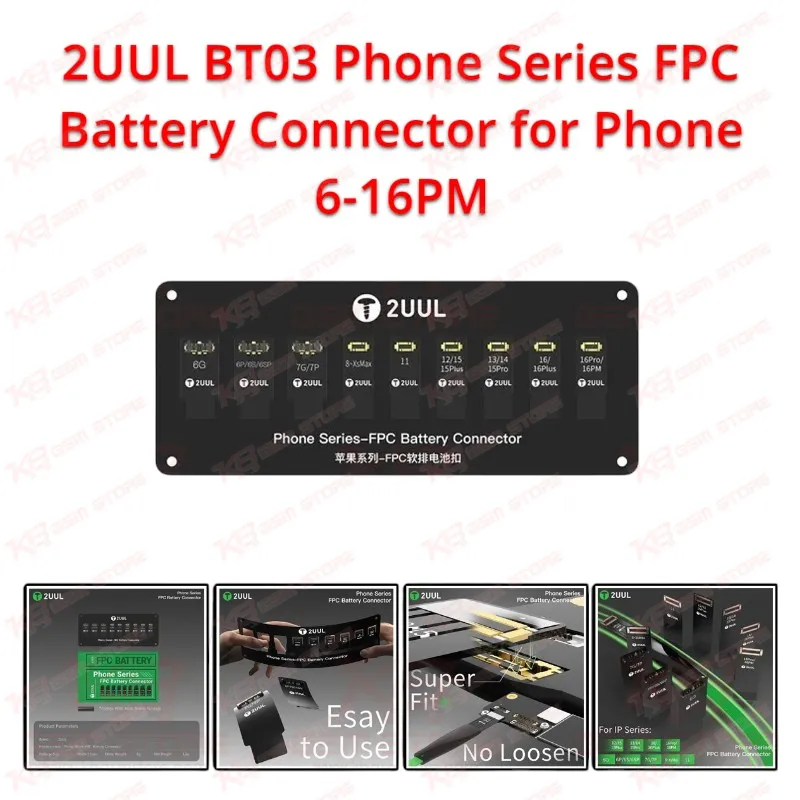
Battery-related faults are one of the most common reasons a phone lands on your bench, and the 2UUL BT03 gives you a direct, solder-free way to work through them. This double-sided battery FPC connector plugs straight into the battery buckle connector on the board, letting you establish a clean electrical path to the battery FPC without lifting the original connector or risking pad damage on a delicate iPhone board. Covering models from iPhone 6 all the way to iPhone 16 Pro Max, the BT03 saves you from stocking a separate connector for every generation of board layout you come across in a Pakistani repair market where phones from six-plus-year-old iPhone 6 units to the newest 16 Pro Max still show up side by side on the same day. You reach for this tool whenever a phone comes in dead, when the battery reads a charging issue on the meter, or when you need a stable connection point to run activation or diagnostic checks without guessing whether a loose or half-broken connector is the real hardware fault. The double-sided design means you are not locked into one orientation — flip it and you still get a firm, repeatable contact, which matters when you are running the same test multiple times to confirm a fix before closing up the phone. For technicians who already run battery activation boards, PD charging boards, or bench power supplies, the BT03 slots into that same workflow as the physical link between the battery flex and your test setup, so you are not forced to solder a bridge wire onto pads that are already fragile from repeated rework. This is especially useful on boards where the native battery FPC connector pins have been damaged from previous repair attempts, cracked housings, or corrosion — instead of replacing the entire connector with a reflow job, you use the BT03 to restore a working contact point and get the battery circuit live again. In a workshop environment, that translates directly into fewer board-level repairs escalated to full connector replacement, which keeps your turnaround time down and your customer's bill lower. The build is designed for the kind of daily handling a repair bench sees — plugged in, tested, unplugged, moved to the next unit — without the pins losing their grip or the housing cracking after a few weeks of use. Because it does not require any soldering, iron, or flux, junior technicians can use it safely for routine battery diagnostics while senior technicians focus on board-level faults that actually need micro-soldering skills. It also fits naturally into a diagnostic sequence: isolate whether a dead phone is a battery fault, a charging IC fault, or a board-level short before you commit to a more invasive repair. For shops running high volumes of battery replacements and battery health checks, having a dedicated FPC bridge tool like the BT03 on hand cuts the guesswork out of intermittent charging problems, especially on older iPhone 6 and 7 series boards where the original battery connectors have already been through several battery swaps. The wide compatibility range across ten-plus iPhone generations also means this single tool earns its place on the bench instead of sitting unused between specific repair jobs, making it a practical, repeatable addition to any GSM repair toolkit focused on battery diagnostics and connector-level fixes.