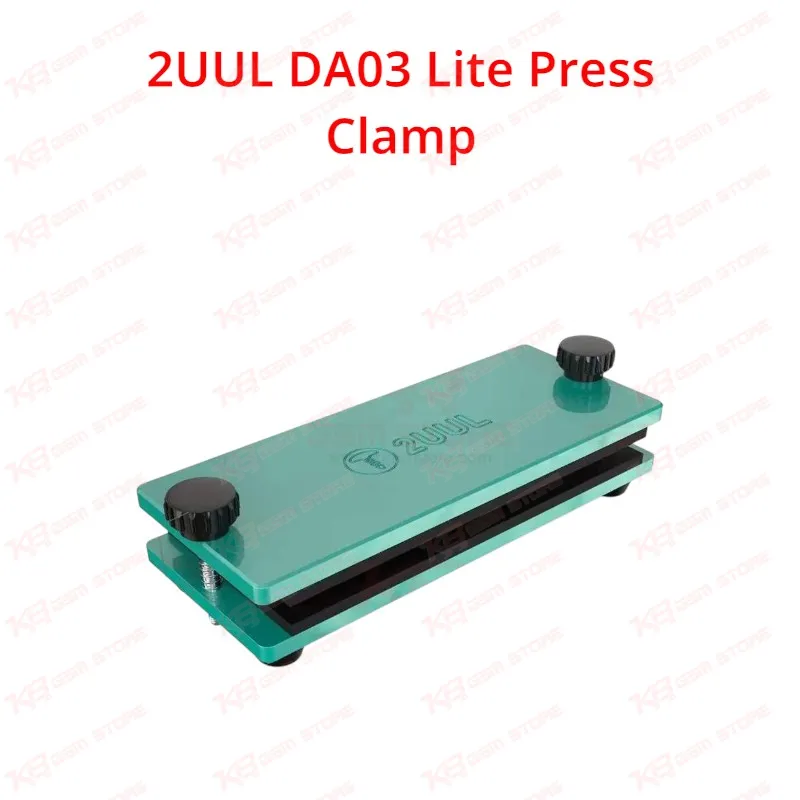
When you finish a glass or screen replacement job, the last thing you want is a display that sits proud at one edge or sinks in at the corner, and that's exactly the problem the 2UUL DA03 Lite Press Clamp solves. You place the phone or tablet between the padded jaws, tighten the clamp, and let the tempered steel spring apply steady, even pressure across the whole screen surface while the adhesive or OCA bonds the glass to the frame. Unlike pressing a screen down by hand or weighing it with random objects, this clamp keeps constant pressure on the panel for as long as the bonding needs, so you get a flat, gap-free fit without babysitting the job. The jaw pivots to match the shape of the device you're working on, which matters because phones and tablets rarely have perfectly flat backs, and an uneven grip is how technicians end up with a screen that looks fine off the clamp but lifts at one corner two days later. The body is built from extra-strong nylon and fiberglass rather than plain plastic, so it holds its shape under repeated clamping pressure instead of flexing or cracking after a few weeks of daily use. The tempered steel spring is the part doing the real work here, and it's what gives the clamp consistent holding force from the first squeeze to the last, rather than the pressure fading the way cheaper spring-clip fixtures tend to after heavy rotation. Handle grips are soft and textured rather than bare plastic, so your hand doesn't slip while you're tightening down on a slick glass panel, and that matters when you're doing back-to-back jobs and your hands are already covered in flux or isopropyl. The clamp is also anti-static, which is a small detail but a real one when you're setting a freshly repaired board and display down next to it on the same bench. At 199.0 x 80.5 x 52.0mm, the DA03 Lite is the compact option in the 2UUL press clamp lineup, sized for phone and smaller tablet screens rather than full-size iPads, where the larger 2UUL DA02 oversize clamp is the better fit. That size makes it easy to keep within reach on a crowded bench instead of taking up the space a full-size clamp needs. In terms of where it fits into your actual workflow, this isn't a diagnostic tool or a flashing box, it's the fixture you reach for right after the glass goes down and before you hand the device back to the customer, sitting between screen separation and final reassembly. Technicians doing OCA lamination, frame rebonding, or straight glass replacement on cracked-screen jobs use it the same way: clamp, wait for the adhesive to cure, release, and check the seam. For a repair shop taking in several screen jobs a day, that consistency is what keeps callbacks down, because a screen that's properly seated the first time doesn't come back with a lifting edge or a dust gap a week later. It's not built for CPU or IC-level board work, and it won't help with a boot loop or a software issue, but for the mechanical side of screen replacement, it does one job and does it properly. Lightweight enough to hold in one hand while you check alignment with the other, and durable enough to survive being picked up dozens of times a shift, it's the kind of tool that earns its place on the bench simply by getting used every day rather than sitting in a drawer.