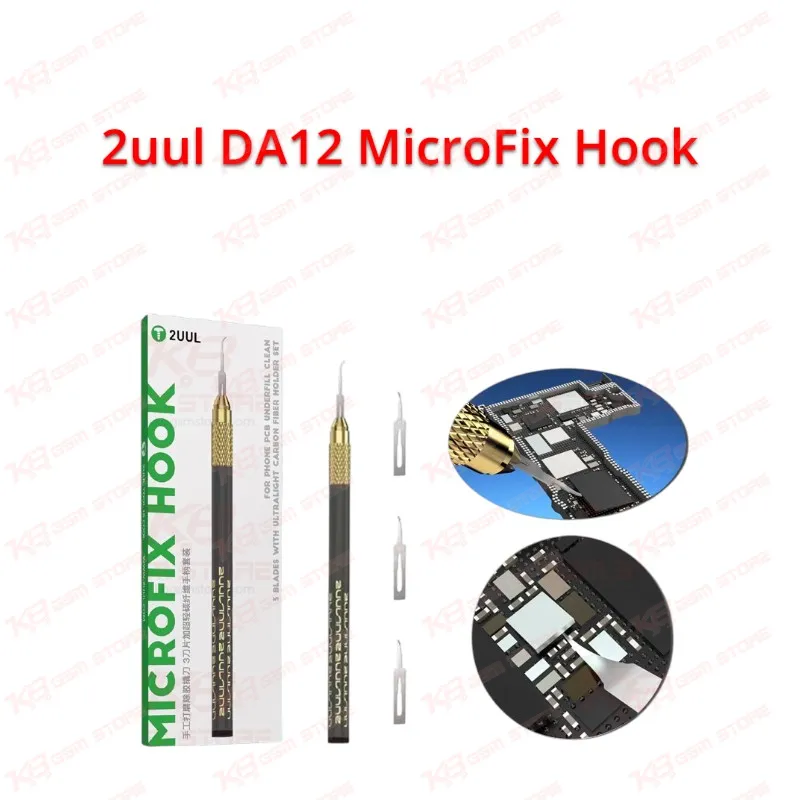
The 2UUL DA12 MicroFix Hook solves a problem every board-level technician runs into eventually: how do you scrape hardened underfill glue off a CPU chip or PMIC without chipping a pad, lifting a trace, or damaging the component you're trying to save. Standard tweezers and generic blades either flex too much to cut through cured epoxy or stay too rigid to follow the contour of a chip edge, and that mismatch is exactly where boards get scratched during glue removal on a dead phone or a board with a stubborn charging issue. The DA12 set answers this with three hand-forged blades attached to an ultralight carbon fiber handle, giving you enough stiffness to break through underfill while keeping the flex needed to trace around CPU chips, diodes, and other small components without gouging the substrate underneath. Hand forging gives the blade edges high ductility, so they hold a working edge through repeated scraping sessions instead of dulling or chipping the way stamped blades often do after a few boards. That matters on a busy repair bench where the same tool goes from cleaning glue off a network issue board in the morning to prepping a chip for reballing in the afternoon. The carbon fiber handle keeps the overall tool light in the hand, which reduces fatigue during long sessions of fine motor work under a microscope, and the balance point sits close enough to the blade that you get real tactile feedback as the edge engages the glue layer. This is a hand tool, not an electrically powered device, so there's no learning curve around settings or calibration; the skill lives entirely in blade angle, pressure control, and reading how the glue responds as you work. Where the DA12 earns its place in a technician's kit is in the small-gap work: boards with tightly packed ICs, shielded areas, or components sitting close enough together that a wider blade simply can't get in without touching a neighboring part. The three-blade set gives you angle options for different approach directions, so you're not forced to use the same edge for a flat scrape and a corner lift. In the broader repair workflow, this tool sits at the diagnostic-to-disassembly stage: once a technician has isolated a hardware fault to a specific IC, whether that's a boot loop tied to a PMIC, a charging issue traced to a charging IC, or a display problem linked to a display driver chip, the DA12 is what gets used to clean the underfill and free the chip before reflow, reballing, or replacement. It's equally relevant during board cleaning after a liquid damage job, where corroded underfill needs to come off cleanly before continuity testing can even begin. Because the blades are a separate wear item from the handle, the set is also a practical long-term investment; when an edge eventually dulls past a comfortable working point, the handle stays in service and only the blade needs replacing, using 2UUL's own BL01 MicroFix Hook blade refills sized for the same handle. For a Pakistani repair shop running multiple boards a day across CPU repair, PMIC-level work, and general PCB repair, having a dedicated glue-removal tool instead of repurposing tweezers or a screwdriver tip cuts down on accidental pad damage and shortens the time between diagnosis and a clean chip removal.