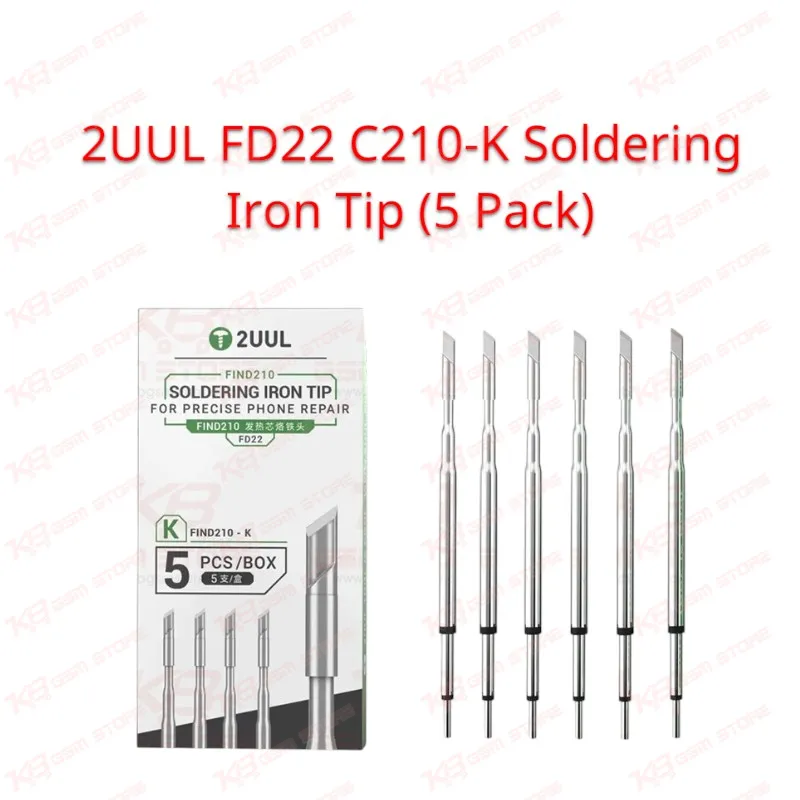
Every soldering bench runs on tip life, and the 2UUL FD22 C210-K Soldering Iron Tip (5 Pack) solves that problem the way a working technician actually wants it solved: five ready-to-swap tips instead of one. This is an integrated tip design, meaning the heating core sits inside the tip body itself rather than as a separate part you thread onto a heater, so heat moves from the core to the working edge with less loss and less lag. On a C210-style handle, that translates into faster warm-up after a tip change and a more consistent temperature while you work through connector reflow, small IC legs, or general board-level soldering. The K shape is a general-purpose profile technicians reach for most often on a repair bench, wide enough to hold solder for drag soldering and desoldering work, yet controlled enough for close work around densely packed components on a motherboard. You get a tip that suits everyday soldering tasks rather than one narrow use case, which is why it becomes the tip most repair shops keep several of on hand at once. The C210 handle format is shared across a number of popular rework stations built around JBC-style handles, including Sugon and Aifen units, so this tip pack fits directly into workflows already built around those stations without needing an adapter or a different handle. In a typical repair shop in Lahore, Karachi, or Islamabad, that means a technician working on a dead phone after a failed flash, a board showing a charging issue, or a device with a hardware fault from liquid damage can move straight into rework without hunting for a compatible tip first. Tip wear is constant in this line of work: oxidation, repeated contact with flux and solder, and daily heat cycling all shorten a tip's usable life, and running low mid-repair forces a technician to either push a worn tip past its useful point or stop the job entirely. Five tips per pack removes that pressure, letting a workshop rotate tips through cleaning, tinning, and storage without treating a single tip as irreplaceable. Within the wider PCB repair process, a tip like this sits at the point where diagnostics end and physical rework begins: after a technician has confirmed a board fault through testing, this tip is what actually reflows a joint, reseats a connector, or reworks a section of the board by hand. Because the tip and core are integrated, cleaning and maintenance stay simple too, since there is no separate core to unscrew or reseat between tip swaps, and a technician can tin and wipe the tip between joints the same way they would on any C210-compatible tip. For a shop running multiple benches or training junior technicians, having a full pack on hand also standardizes the soldering experience across stations, since every tip performs the same way instead of technicians working with tips at different stages of wear. This is a consumable built for volume repair work rather than occasional use, and it earns its place in a technician's toolkit through consistency: predictable heat transfer, a shape suited to the soldering and desoldering work that comes up daily, and enough spares in one pack to keep a bench running through a full week of board-level repairs without a supply gap.