


Brand:
2UUL
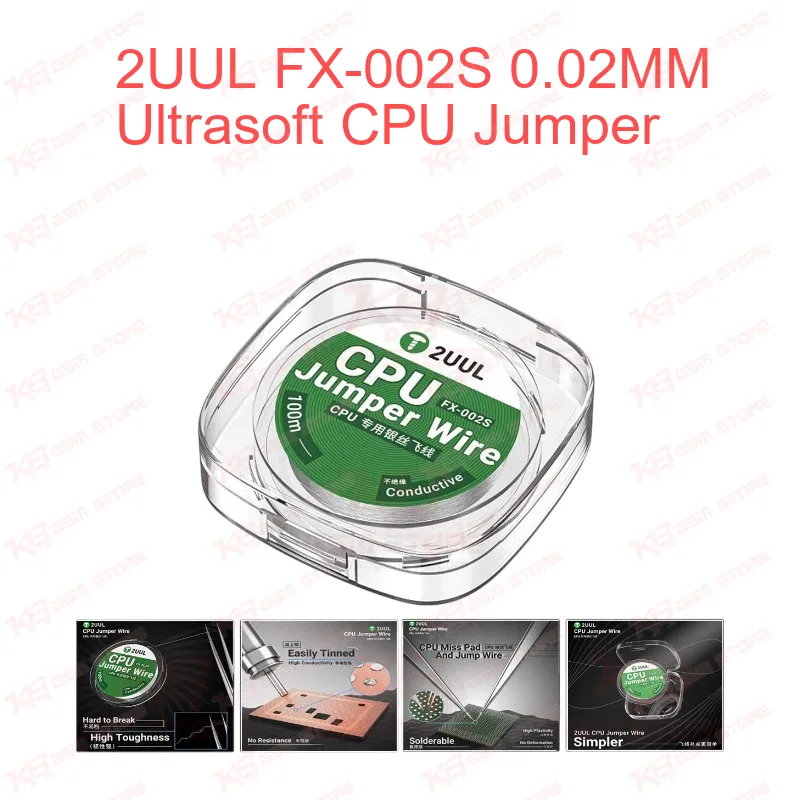
2UUL FX-002S 0.02MM Ultrasoft CPU Jumper
2UUL FX-002S 0.02MM Ultrasoft CPU Jumper
Regular price
Rs.800.00 PKR
Regular price
Sale price
Rs.800.00 PKR
Shipping calculated at checkout.
Quantity
Couldn't load pickup availability
The 2UUL FX-002S is a 0.02mm ultrasoft jumper wire built for CPU, BGA and fingerprint IC repair work on mobile phone and tablet motherboards. Supplied on a 100m spool, this flying line offers low solder resistance so it tins fast without paint scraping, and it welds directly onto damaged pads without leaving a breakpoint. The wire stays non-magnetic and holds good toughness while remaining flexible enough for tight bends around micro components. Pakistani technicians use it daily for jumper repair, dead-after-flash board fixes, and reballing work where a standard flying line is too thick to sit cleanly on a CPU pad.
SKU:MST-SOLDERING-ACCESSORIES-586
⚖️ Weight: 0.01 kg
- Safe & Secure Payment
- Fast Delivery
- WhatsApp Support


Description
FAQ
What is the product name?
The product name is 2UUL FX-002S 0.02mm Ultrasoft CPU Jumper Wire.
What is the brand of this product?
The brand of this product is 2UUL.
What is the model of this product?
The model is FX-002S.
What is this product used for?
This wire is used for CPU and BGA reballing, PCB trace repair, fingerprint IC jumper work, and general motherboard flying-line rework.
Which devices are compatible with this product?
This wire works at the motherboard level across mobile phones and tablets — it is not tied to a specific brand or chipset.
Who should use this product?
This product is suitable for mobile repair technicians, repair shops, service centers, and professional micro-soldering users.
Does this jumper wire need the coating scraped off before soldering?
No, the FX-002S is designed for direct welding, so it tins and bonds without scraping the coating first.
Is 0.02mm jumper wire fine enough for BGA pad-level repairs?
Yes, 0.02mm is thin enough to bridge individual BGA and CPU pads without shorting neighboring points, which is why technicians use it for reballing and fine jumper work.