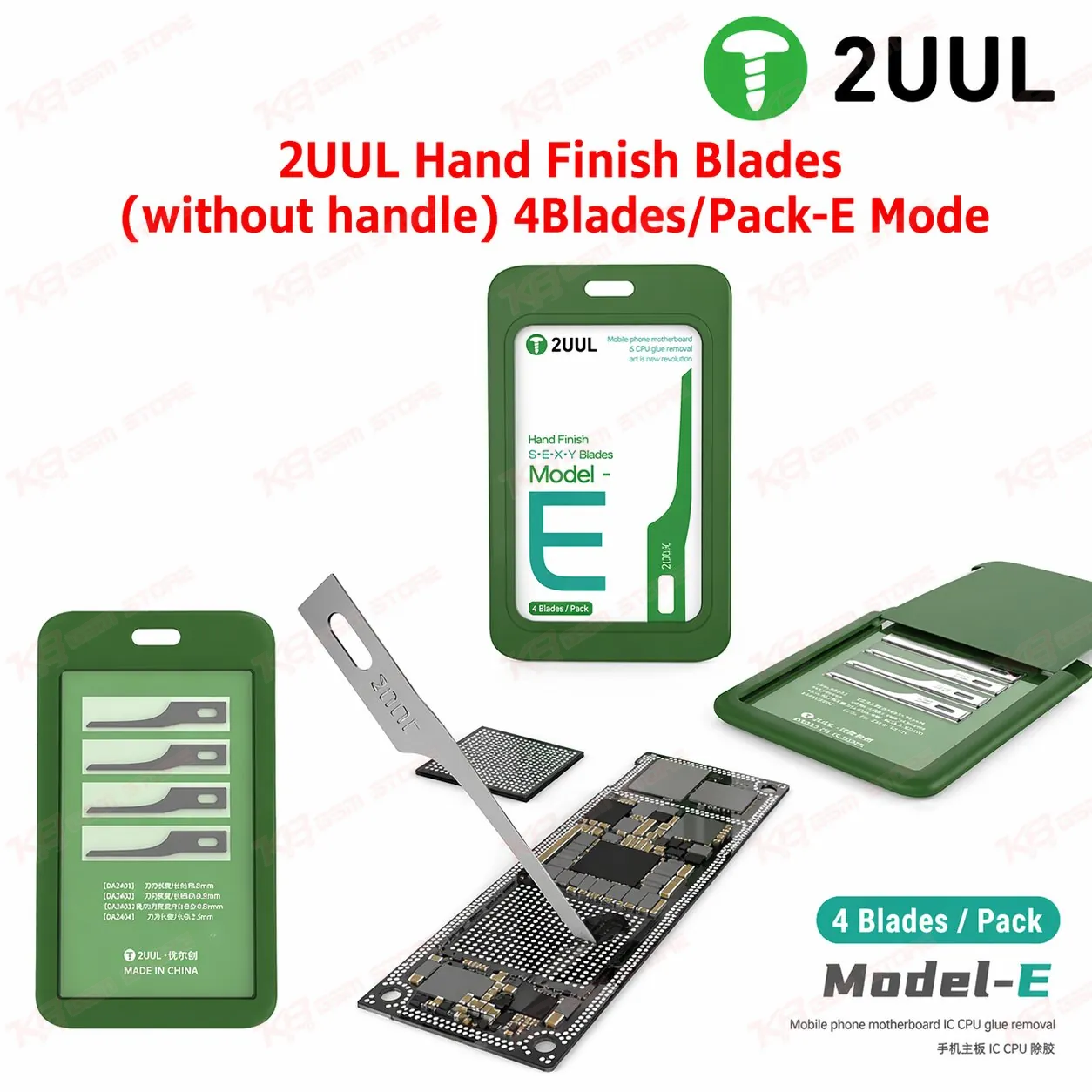
Removing hardened glue from a motherboard without lifting a pad or cracking an IC package is one of the more delicate parts of mobile repair, and the blade doing that job matters as much as the hand holding it. The 2UUL DA15 Hand Finish Blade Model E is built specifically for this kind of precision cutting, offering a 4-blade pack designed to handle CPU removal, screen IC separation, and general glue cleanup without the guesswork that comes from using a generic utility blade. Every blade in this pack carries a thin-to-thick taper along its cutting edge, which means the force a technician applies stays uniform as the blade moves through the glue line instead of spiking unpredictably at one point and risking a slip. That taper is what separates a purpose-built repair blade from an ordinary hobby blade, and it becomes obvious the first time you work through a stubborn glue seam under an IC and feel the resistance stay level rather than jump. Double-sided uniform trimming is another practical detail built into the Model E design. Since both edges of the blade are usable, a technician can rotate the blade mid-session once one edge starts to dull slightly from repeated glue contact, extending the working life of each blade before it needs replacing. On a busy repair bench where dead phone boards, CPU reballing jobs, and screen IC swaps line up back to back, that rotation saves time that would otherwise go toward digging out a fresh blade. The bent-blade geometry used in the Model E is a deliberate upgrade over flat blade designs. By angling the blade slightly, the point of contact with the board shifts away from direct pressure against the chip or motherboard surface, which lowers the chance of scratching a trace, cracking a BGA ball, or nicking a nearby component while working glue free from underneath a CPU or screen IC. This matters most during rework on tightly packed boards, where a millimeter of misplaced pressure can turn a five-minute glue removal task into a full board repair. Technicians handling boot loop issue diagnostics, dead-after-flash boards, or hardware fault troubleshooting often need to lift shielded components or separate glued screen assemblies before they can even begin real diagnostic work, and a blade that manages pressure predictably reduces the risk of creating new damage while investigating an existing fault. The blade tip on the Model E measures approximately 0.06mm, thin enough to slide beneath fine-pitch components and separator lines without forcing a gap, while the blade tail tapers to roughly 0.3mm for structural rigidity during firmer prying moments. This dual-thickness build lets one blade handle both the delicate entry cut and the more assertive lifting motion that follows, rather than requiring a technician to switch between multiple blade types mid-repair. A nano-coating finish protects the blade surface against rust, which is a real concern on a bench where flux residue, cleaning alcohol, and humidity are constant companions. Over months of daily use, uncoated blades tend to develop surface corrosion that dulls the edge and leaves marks on sensitive board surfaces; the coating on the Model E is intended to keep the blade performing consistently through repeated glue-removal cycles. This particular listing covers the blade set without a handle, making it a practical restock option for technicians who already own a compatible 2UUL handle body and simply need replacement blades for their glue-removal and CPU-opening workflow. Each pack contains four Model E blades, giving enough supply to get through several boards' worth of IC removal, screen separation, and motherboard cleaning before a technician needs to reorder. In a Pakistani repair workshop handling everything from charging issue boards to network issue troubleshooting, having a dependable glue-cutting blade on hand directly affects how cleanly a board comes apart and how quickly a repair moves from diagnosis to component-level work. The Model E fits naturally into workflows built around 2UUL's hand-finish blade handle system, alongside related tools like ISP pinout fixtures, board holders, and reballing stencils that make up a complete rework station setup.