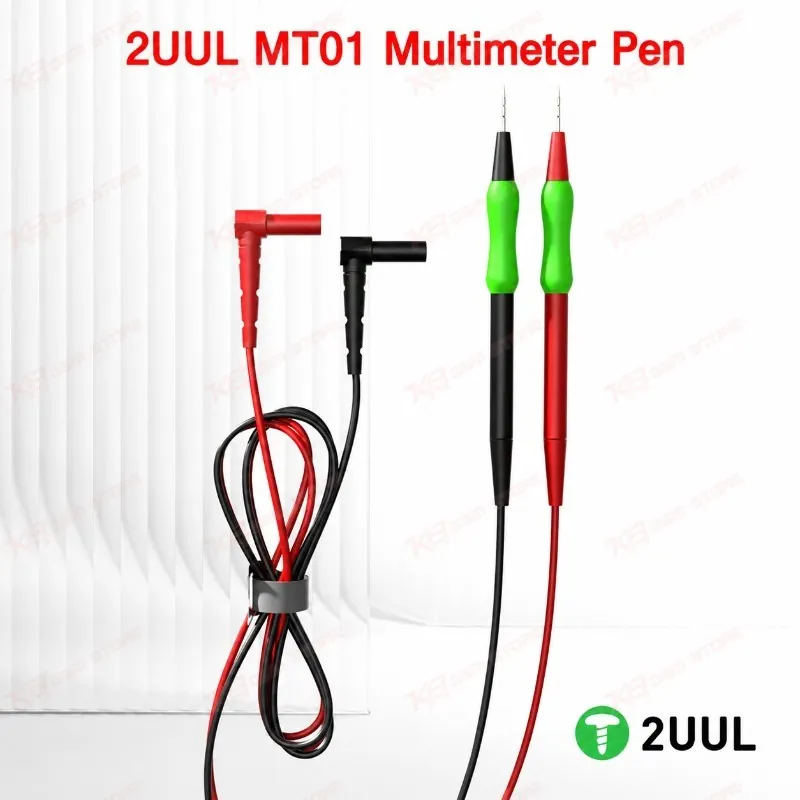
When you're chasing a dead phone or a hang-on-logo fault down to a single failed component, your multimeter is only as good as the probe touching the board, and this is exactly where the 2UUL MT01 Multimeter Pen earns its place on your bench. Standard multimeter probes ship with thick, blunt tips that work fine on wires and large connectors but become a liability the moment you need to test a PMIC leg, a charging IC pin, or a tightly packed BGA pad — you either bridge two points by accident or you can't get contact at all. The MT01 solves that with a needle-sharp, gold-plated stainless steel tip measuring just 0.2mm in diameter, small enough to land precisely on a single pad or component leg while your multimeter reads voltage, resistance, or continuity with real accuracy. Gold plating on the tip resists oxidation over repeated use, so the probe keeps delivering consistent readings instead of degrading after a few weeks of daily workshop use, and the underlying stainless steel construction gives it the stiffness you need to press into a pad without the tip bending or flexing away. Rated for up to 1000V, the MT01 handles everything from low-voltage board-level diagnostics to higher-voltage checks, which means you're not swapping probes between different testing tasks during a single repair job. The wire connecting the tip to your meter uses a silicone jacket rather than standard PVC insulation, and that choice matters more than it sounds — silicone stays soft and pliable in cold weather instead of stiffening and cracking, it resists heat from nearby soldering work, and it won't harden or crack after months of coiling and uncoiling on your bench. You get a wire that survives real workshop conditions instead of one that needs replacing every few months. The handle itself uses a non-slip silicone grip, which sounds like a small detail until you're three hours into board diagnostics and your hand starts to fatigue from gripping a hard plastic pen — the softer, textured surface reduces slippage and keeps your probing hand steady, which directly affects whether you get a clean reading or a false one from probe movement. In practice, this pen becomes most useful during exactly the situations that frustrate technicians the most: chasing a short on a dead-after-flash board, checking continuity across a jumper wire you've just soldered in, verifying voltage at a PMIC output before you commit to an IC change, or confirming a charging IC pin is actually receiving power when a phone shows a charging issue. Because the tip is this precise, you can probe individual pads on modern high-density boards — the kind found in current Qualcomm, MediaTek, and Apple-platform devices — without accidentally touching an adjacent pad and getting a misleading reading, which matters a lot when you're trying to isolate a hardware fault before opening up your hot air station or soldering iron. The package includes the test pen itself along with a crowbar tool and four spare needle tips, so when the tip eventually wears down from daily use, you swap it out instead of buying a whole new probe. For a technician running a busy repair shop or service center where board-level diagnostics happen daily, a probe this precise pays for itself the first time it saves you from a wrong IC replacement guess.