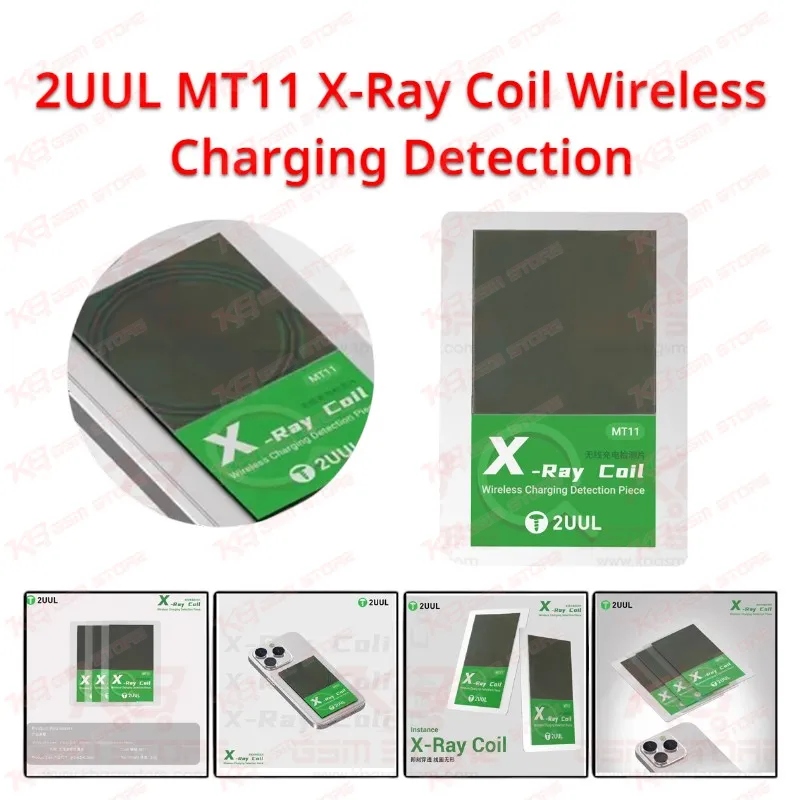
Wireless charging complaints are common on your repair bench, and diagnosing them without visual proof wastes time on remove-and-check guesswork. The 2UUL MT11 X-Ray Coil Wireless Charging Detection card closes that gap by giving you a direct look at the coil's magnetic field before you touch a single screw. You place this green-labeled detection piece over the back panel where the wireless charging coil sits, and the transparent window reacts to the magnetic field generated underneath, letting you confirm whether the coil is functioning, weak, or dead. This visual feedback comes from a magnetic sensing layer built into the card, so you read the coil status the way you would read an X-ray, without cutting the back glass or lifting the battery. When a customer reports a phone that stopped charging wirelessly, you often can't tell if the fault sits in the coil, the charging IC, or the power management chip until you open the device. This card removes that first guess by isolating the coil itself, so you narrow the fault path before committing to a teardown. You get faster turnaround on wireless charging complaints because you stop opening phones that don't actually need coil replacement, and you stop replacing coils on phones where the real fault sits elsewhere on the board. The card works on a simple placement principle: hold it flat against the coil area, activate wireless charging on the device, and read the response on the transparent window. Because the design is auto-restoring, the card resets after each test and stays ready for the next unit on your bench, so you reuse it across dozens of repairs instead of treating it as a single-use consumable. This reusability matters on a busy repair counter where wireless charging complaints show up daily across different brands, since you don't want a diagnostic tool that wears out after a handful of tests. The compact card format stores flat in your tool drawer next to your other testing accessories, and you can carry it between service centers without extra packaging. For PCB-level troubleshooting, this card fits into your wider wireless charging diagnostic workflow: you use it before continuity checks on the coil traces, before inspecting the charging IC under your microscope, and before deciding whether the fault calls for a coil swap or a board-level repair. Technicians handling iPhone and Android wireless charging complaints both rely on this kind of coil-specific check, since Qi-based wireless charging modules share the same basic coil-and-magnet interaction regardless of brand. You avoid unnecessary disassembly on devices where the coil tests fine, which protects the back glass adhesive and connectors from repeated opening. On devices where the coil shows no magnetic response, you get confirmation to proceed straight to coil replacement instead of chasing software or charging IC causes first. This detection card also lets you show the customer a visible test result instead of a verbal diagnosis, which builds trust when you quote a coil replacement job. Keep it in your standard testing kit alongside your multimeter and test box, since a full wireless charging diagnostic routine works best when you combine coil-level magnetic detection with electrical testing on the charging circuit. For a repair shop handling volume, this tool pays for itself the first time it saves you from opening a phone that turns out to have a fine coil, and it keeps paying off every time it confirms a genuine coil failure before you order the replacement part.