


Brand:
2UUL
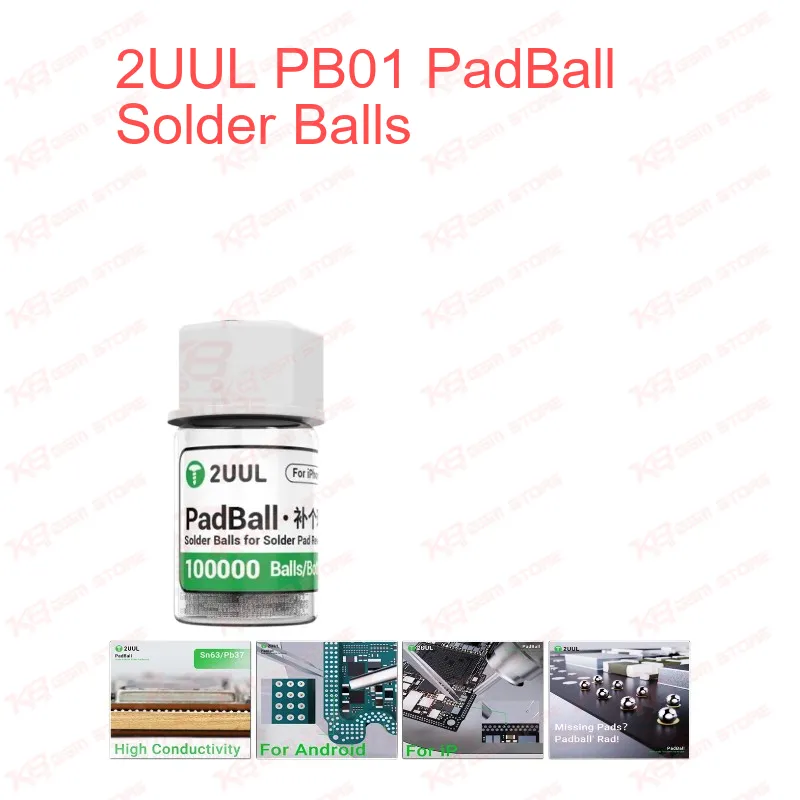
2UUL PB01 PadBall Solder Balls
2UUL PB01 PadBall Solder Balls
Regular price
Rs.1,900.00 PKR
Regular price
Sale price
Rs.1,900.00 PKR
Shipping calculated at checkout.
Quantity
Couldn't load pickup availability
Missing or damaged solder pads after a bad reflow, a botched IC change, or a rushed board clean are one of the most common reasons an iPhone stays dead after flash. The 2UUL PB01 PadBall Solder Balls give you a ready supply of Sn63/Pb37 eutectic balls in five precise sizes, so you can rebuild a lifted pad instead of writing off the board. One bottle holds 100,000 balls, which means you won't run short mid-job on a busy repair bench. Every technician doing board-level iPhone repair, IC reballing, or pad restoration under a microscope needs this in the toolbox.
SKU:MST-SOLDERING-ACCESSORIES-619
⚖️ Weight: 0.1 kg
- Safe & Secure Payment
- Fast Delivery
- WhatsApp Support


Description
FAQ
What is the product name?
The product name is 2UUL PB01 PadBall Solder Balls for iPhone Solder Pad Rework.
What is the brand of this product?
The brand of this product is 2UUL.
What is the model of this product?
The model of this product is PB01.
What is this product used for?
This product is used for rebuilding damaged or missing solder pads on iPhone logic boards before reballing or component reattachment.
Which devices are compatible with this product?
This product is compatible with iPhone logic boards, sized for Apple-standard IC and CPU pad pitches.
Who should use this product?
This product is suitable for mobile repair technicians, IC reballing specialists, repair shops, service centers, and professional micro-soldering workshops.
Which solder ball sizes are included in the PB01 set?
The set includes five sizes: 0.2mm, 0.3mm, 0.45mm, 0.6mm, and 0.76mm.
Is the PB01 solder alloy lead-free or leaded?
PB01 uses a leaded Sn63/Pb37 eutectic alloy with a 183°C melting point, not a lead-free blend.