


Brand:
2UUL
2UUL PB02 PadBall Solder Balls
2UUL PB02 PadBall Solder Balls
Regular price
Rs.1,900.00 PKR
Regular price
Sale price
Rs.1,900.00 PKR
Shipping calculated at checkout.
Quantity
Couldn't load pickup availability
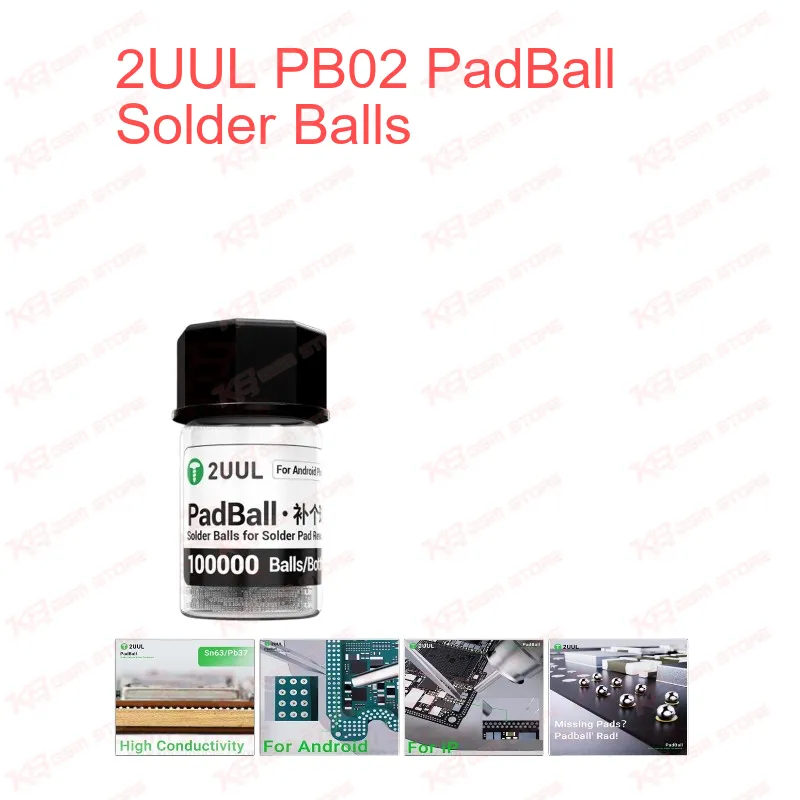
2UUL PB02 PadBall Solder Balls give you a reliable Sn63/Pb37 reballing consumable built for Android motherboard repair. Each bottle packs 100,000 precision balls in five diameters — 0.2mm to 0.76mm — so you cover everything from small CSP pads to larger chipset footprints on one bench. The 183°C eutectic alloy reflows smoothly and leaves minimal residue, which keeps bridging risk low when you rebuild missing pads. Technicians use PB02 for GPU, CPU, and PMIC reballing, plus general pad restoration after IC removal. RoHS and REACH compliant, it fits straight into your daily Android repair workflow.
SKU:MST-SOLDERING-ACCESSORIES-620
⚖️ Weight: 0.1 kg
- Safe & Secure Payment
- Fast Delivery
- WhatsApp Support


Description
FAQ
What is the product name?
The product name is 2UUL PB02 PadBall Solder Balls.
What is the brand of this product?
The brand of this product is 2UUL.
What is the model of this product?
The model of this product is PB02.
What is this product used for?
This product is used for rebuilding missing or damaged BGA/CSP solder pads on Android motherboards before IC reballing and reattachment.
Which devices are compatible with this product?
This product is compatible with Android smartphone and tablet motherboards using standard BGA/CSP chip packages, including GPU, CPU, and PMIC footprints.
Who should use this product?
This product is suitable for mobile repair technicians, repair shops, service centers, and professional users.
What ball sizes are included in one bottle of PB02?
One bottle includes five diameters — 0.2mm, 0.3mm, 0.45mm, 0.6mm, and 0.76mm — covering small CSP pads through larger chipset footprints.
Does PB02 work for iPhone boards or only Android?
PB02 is sized specifically for Android chipset pad geometry; for iPhone boards, use the 2UUL PB01 variant instead.