


Brand:
2UUL
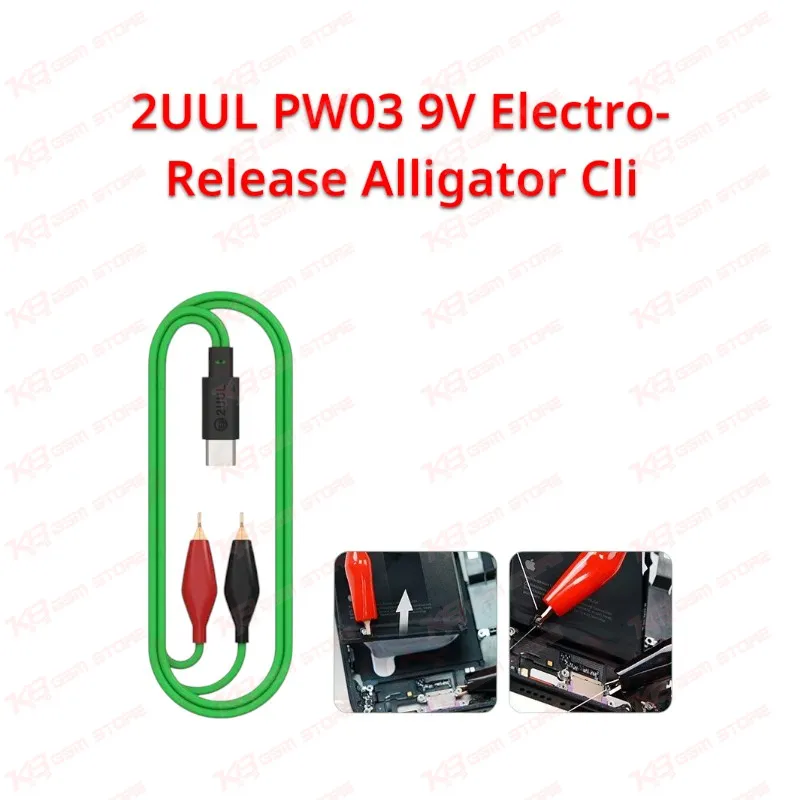
2UUL PW03 9V Electro-Release Alligator Cli
2UUL PW03 9V Electro-Release Alligator Cli
Regular price
Rs.900.00 PKR
Regular price
Sale price
Rs.900.00 PKR
Shipping calculated at checkout.
Quantity
Couldn't load pickup availability
The 2UUL PW03 is a 9V electro-release alligator clip built for debonding electrically-activated battery adhesive on iPhone 16, 16 Plus, 17, Air, 17 Pro, and 17 Pro Max models. A flat-jaw clip design speeds up the discharge process, loosening the battery adhesive in around 90 seconds without heat, prying tools, or pull tabs. The clip runs on a Type-C power input, so you connect it to any 5–20V power supply already on your bench. Compact and lightweight, it fits easily into a technician's toolbox and supports faster, safer battery replacement work in busy repair shops.
SKU:MST-SOLDERING-ACCESSORIES-464
⚖️ Weight: 0.15 kg
- Safe & Secure Payment
- Fast Delivery
- WhatsApp Support


Description
FAQ
What is the product name?
The product name is the 2UUL PW03 9V Electro-Release Alligator Clip.
What is the brand of this product?
The brand of this product is 2UUL.
What is the model of this product?
The model of this product is PW03.
What is this product used for?
This product is used for electrically debonding battery adhesive so the battery can be removed safely during replacement.
Which devices are compatible with this product?
This product is compatible with iPhone 16, iPhone 16 Plus, iPhone 17, iPhone Air, iPhone 17 Pro, and iPhone 17 Pro Max.
Who should use this product?
This product is suitable for mobile repair technicians, repair shops, service centers, and professional users.
Does the PW03 need its own battery to work?
No, the PW03 has no internal battery — it draws power through its Type-C port from an external supply rated between 5V and 20V.
Why does the battery adhesive not fully release when I use this clip?
Incomplete release usually happens when the positive electrode does not land directly on the battery's adhesive pull tab; correct clip placement on that tab is required for a clean 90-second release.