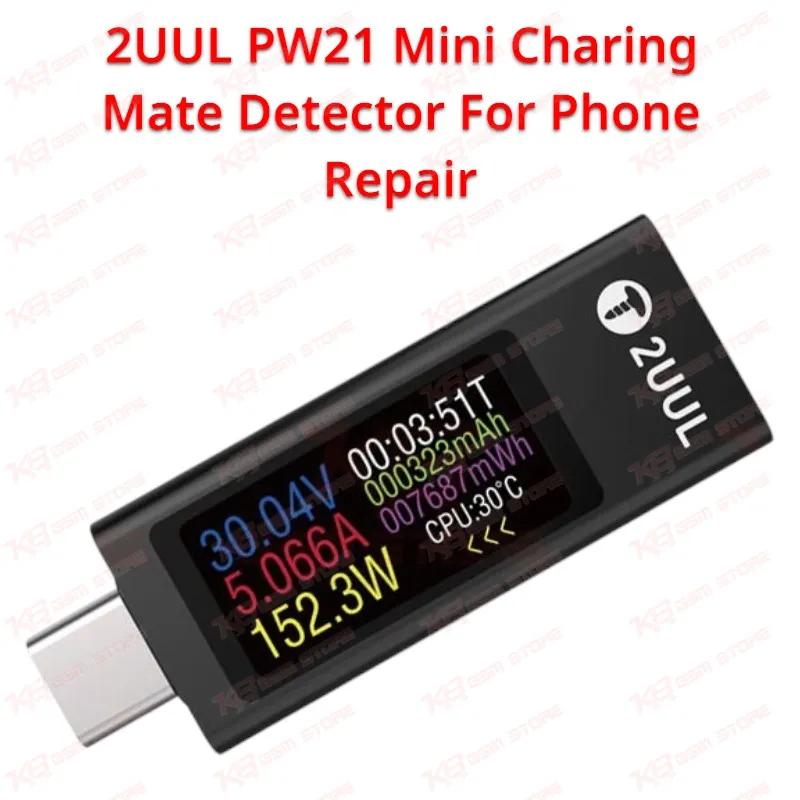
When a customer brings in a phone with a charging issue, the first question every technician asks is whether the fault sits in the cable, the adapter, the charging port, or the power management IC on the board, and the 2UUL PW21 answers that question in seconds instead of guesswork. This mini charging mate detector connects inline between the power source and the device under test, then displays live voltage, current, and wattage readings so you can see exactly what is being delivered and what the device is actually pulling. Because it supports bidirectional current testing, you can measure both charging and discharging behavior, which is especially useful when checking whether a power bank is delivering its rated capacity or when a device suddenly drops load mid-charge, a classic symptom of a failing charging IC or a damaged Type-C connector. The PW21 automatically identifies fast-charging protocols including PD2.0/3.0, PPS, QC2.0/3.0, FCP, SCP, AFC, PE, DASH, VOOC, and Super VOOC, so instead of manually cross-checking which protocol a device negotiates, the detector shows it on screen the moment the connection is made. This protocol recognition matters on the Pakistani repair market where technicians handle a wide mix of Android brands each running different fast-charging standards, and misreading the protocol often leads to wasted time chasing a hardware fault that is actually a charging negotiation issue. Rated up to 30V and 12A, the PW21 handles everything from standard 5V phone charging up to higher-wattage fast-charge and laptop-class loads, giving you one tool that covers most bench charging diagnostics rather than switching between multiple testers. The multi-group data recording function stores readings from several test sessions directly on the device, and because the data persists even after the phone's power is disconnected, you can pull a device off the bench, move to the next job, and come back later to review exactly what current and voltage it drew during the test. This is particularly useful for intermittent charging issue complaints, where the fault does not show up on every plug-in and a single snapshot reading would miss it. On the workshop floor, the PW21 earns its place in the charging issue and dead phone diagnostic workflow: plug it inline before opening the phone, and you immediately know whether to look at the battery, the charging IC, the Type-C port, or the customer's own cable and adapter, saving disassembly time on units that turn out to have nothing wrong with the board. It also fits naturally into the power bank testing workflow, where confirming actual output against advertised capacity separates a genuine hardware fault from a customer expectation mismatch. For shops that also handle laptop and tablet charging complaints, the same detector covers USB-C PD testing on those devices without needing a separate laptop-specific tester. Because the unit is compact and USB-C based, it slots into daily use without adding bulk to a technician's tool tray, and its plug-and-play operation means no calibration or software setup before a diagnostic session. For a repair shop running a busy dead phone and charging issue queue, having a dedicated protocol-aware detector like the PW21 cuts down the guesswork that normally comes from testing charging faults with a basic multimeter, which cannot identify fast-charge protocols or log session data the way this tool does.