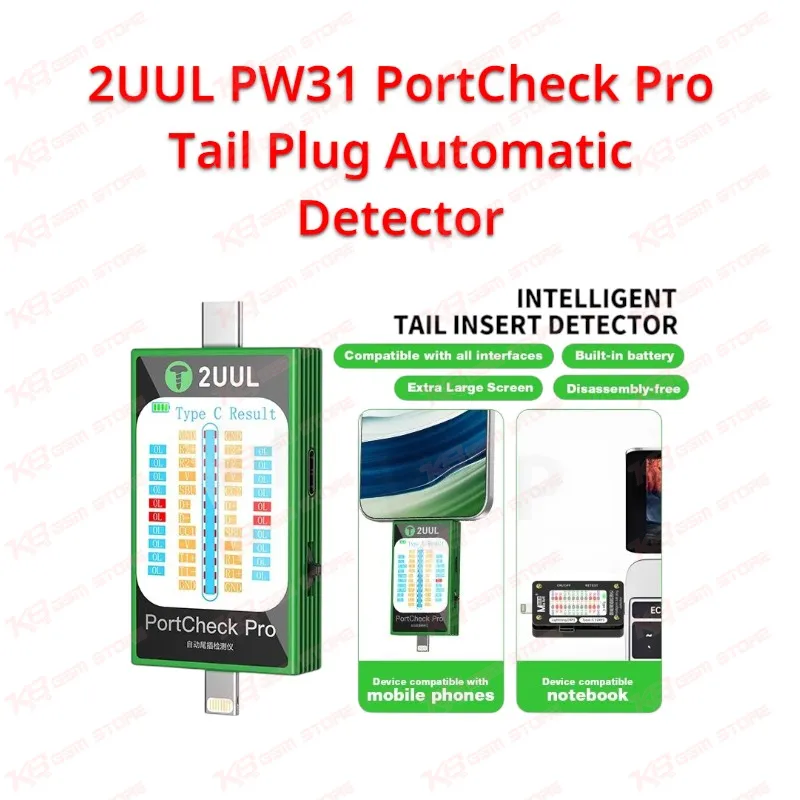
When a customer walks in complaining that their phone "won't charge" or charges intermittently, the real question every technician has to answer first is whether the fault sits in the port itself, the cable, or somewhere deeper on the board, and the 2UUL PW31 PortCheck Pro exists to answer exactly that question without you touching a screwdriver. You insert the tail plug into the Type-C or Lightning port you're testing, and the detector reads the connection instantly, showing a blue indicator when the circuit is normal and switching to red the moment it detects an open circuit or connection fault. That single color change tells you in seconds whether you're dealing with a genuinely damaged port or a software-side charging issue, which means you stop wasting time stripping down a phone that never needed disassembly in the first place. The large display screen puts the measurement data directly in front of you, so instead of relying on a customer's vague description of "sometimes it charges, sometimes it doesn't," you get a concrete reading you can trust and explain. Because the PW31 supports both Type-C and Lightning interfaces, it covers the two connector families that dominate current phones, tablets, and laptops on your repair bench, which means one tool handles port diagnostics across most of the devices coming through your shop rather than forcing you to keep separate testers for each connector type. The built-in 300 mAh battery is a practical detail that matters more than it sounds on paper, because it means the detector doesn't depend on a separate power bank or a wall adapter every time you need to run a quick check between jobs, giving you long standby time and letting you pick it up and test a port the moment a device lands on your desk. Beyond the basic pass or fail read, the PW31 checks pin connection integrity inside the port, which catches the kind of partial pin damage that causes intermittent charging rather than complete failure, a fault pattern that's notoriously hard to pin down with a multimeter alone. It also helps you identify short circuit conditions before they escalate into board-level damage, and it gives you a way to verify whether power is actually reaching the motherboard, which separates a charging IC problem from a physical port problem before you commit to a repair quote. For technicians running a busy service center, this kind of fast triage step directly affects turnaround time: a port that tests bad on the PW31 tells you immediately that the fix is a port replacement, while a port that tests clean redirects your diagnosis toward the charging IC, battery, or software side of the device, saving you from unnecessary disassembly and reassembly cycles. The detector also gives you a reliable way to check whether a cable or connector supports proper power delivery, which is useful when customers bring in their own cables and insist the phone itself is faulty when the cable is actually the culprit. Because the readout is color-coded and immediate, it's also a strong tool for training junior technicians, since they don't need years of experience reading multimeter values to understand a clear blue-versus-red result. In a Pakistani repair market where charging port complaints make up a large share of daily walk-in jobs, having a dedicated, disassembly-free detector like the PW31 on your bench means faster diagnosis, fewer misdiagnosed repairs, and a cleaner workflow between port-level and board-level troubleshooting, all from a compact device you can keep charged and ready between customers.