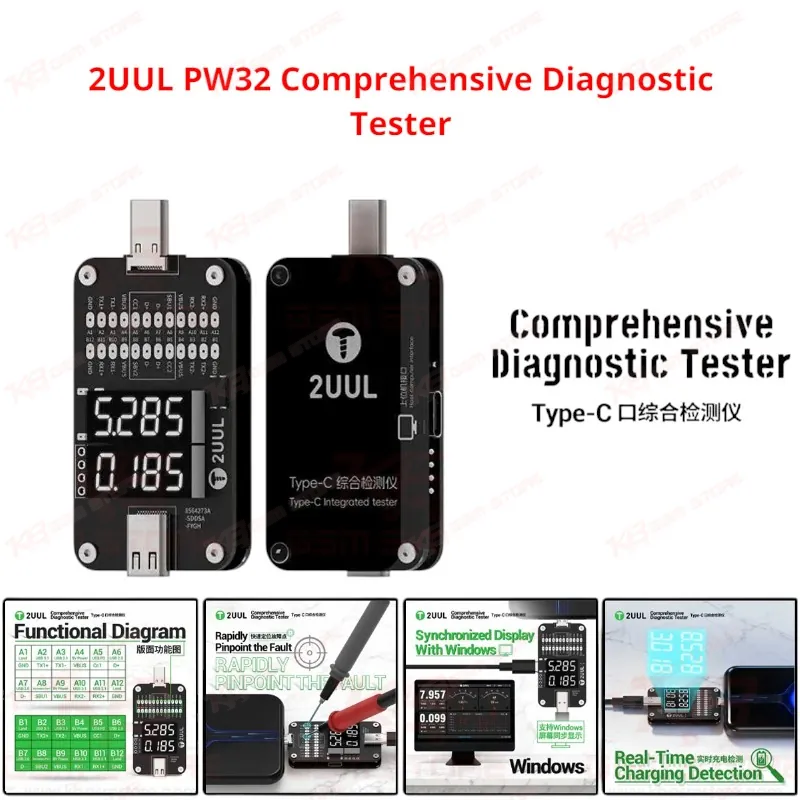
Every technician in Pakistan knows the customer line — "charging nahi ho raha" — and every technician also knows that complaint hides at least six different faults behind it, so the 2UUL PW32 Comprehensive Diagnostic Tester earns its place on the bench by answering the first and most expensive question before you touch a screwdriver: does the Type-C port itself behave correctly under real charging conditions? You connect the tester to the USB-C port of a mobile phone, tablet or iPad, supply power through the included cable, and the tool immediately reports how that port responds while current flows, which means you stop diagnosing by feel and start diagnosing by measurement. Real-time charging detection sits at the heart of this workflow: instead of plugging a charger, watching a battery icon and guessing, you watch voltage, current and charging status change live, and that live picture separates a genuinely dead connector from a weak cable, a damaged charging IC, a faulty tail board, or a battery that simply refuses to accept charge. That distinction matters commercially, not just technically, because a shop that confirms the fault in ninety seconds quotes accurately, orders the right part once, and avoids the classic loss where you replace a charging port only to discover the real damage sat deeper on the board. The tester also supports quick fault-point localisation, so when a board arrives after water damage or a rough tail-change attempt, you narrow the suspect area early and take a targeted route rather than heating and lifting components blindly. Windows screen synchronisation widens the tool further for shops doing volume work — mirror the diagnostic data onto a laptop or PC display and the whole team reads the same values while a board sits under the microscope, which helps enormously during training, during customer explanation at the counter, and during any repair where you need both hands free on the hot air station. Trainers at technical institutes get real value here too, since students watch measured behaviour on a large screen instead of crowding around a tiny module. Practically, the PW32 slots into the diagnostic stage of a standard board-level workflow: intake and complaint verification first, then Type-C port testing with this tester, then multimeter continuity and short checks, then microscope inspection of the connector pins and surrounding filters, and only after that do you commit to reballing, tail replacement, or charging IC removal with your hot air station and PCB holder. Because the tool works without disassembly at the first stage, you keep low-value jobs profitable — a customer whose problem turns out to be a bad cable walks away happy in two minutes, and you never absorbed the labour cost of opening a device for nothing. For workshops handling Samsung, Oppo, Vivo, Infinix, Tecno, Xiaomi, Realme and Android tablets alongside iPad units carrying USB-C connectors, that universal Type-C scope covers the bulk of daily charging intake in Pakistan, where USB-C now dominates every price segment from entry-level to flagship. Technicians running refurbishment lines find another angle: before you grade a used handset or push a batch through resale, you verify charging behaviour on each unit quickly and catch the weak ones early instead of hearing about them after sale. The build stays compact and bench-friendly, so it sits beside your soldering station without claiming space you need for a microscope arm or reballing kit, and it travels easily if you run service calls or work across more than one counter. Pair it with your existing diagnostic set and the coverage becomes genuinely broad — the PW32 handles port and charging behaviour, your multimeter chases shorts and continuity, your test box or DC power supply watches boot current on dead phones, and your ISP and eMMC tools take over when the fault turns out to be software rather than hardware. That layered approach is exactly how experienced GSM technicians avoid the two most common traps in charging repair: replacing hardware for a software-side fault, or flashing a board that never had a software problem in the first place. Buying decisions in Pakistan usually come down to whether a tool pays for itself, and for a charging-focused shop the arithmetic is simple, since charging complaints arrive daily and each correct first-attempt diagnosis protects both your parts inventory and your reputation with walk-in customers. The 2UUL PW32 Comprehensive Diagnostic Tester answers that need directly — a focused, measurement-driven Type-C diagnostic tool from 2UUL, built for repair technicians who want facts on screen before they reach for the hot air gun. KB GSM Store stocks it alongside the rest of the charging-repair ecosystem your bench depends on, so you can build a complete diagnostic corner in one order.