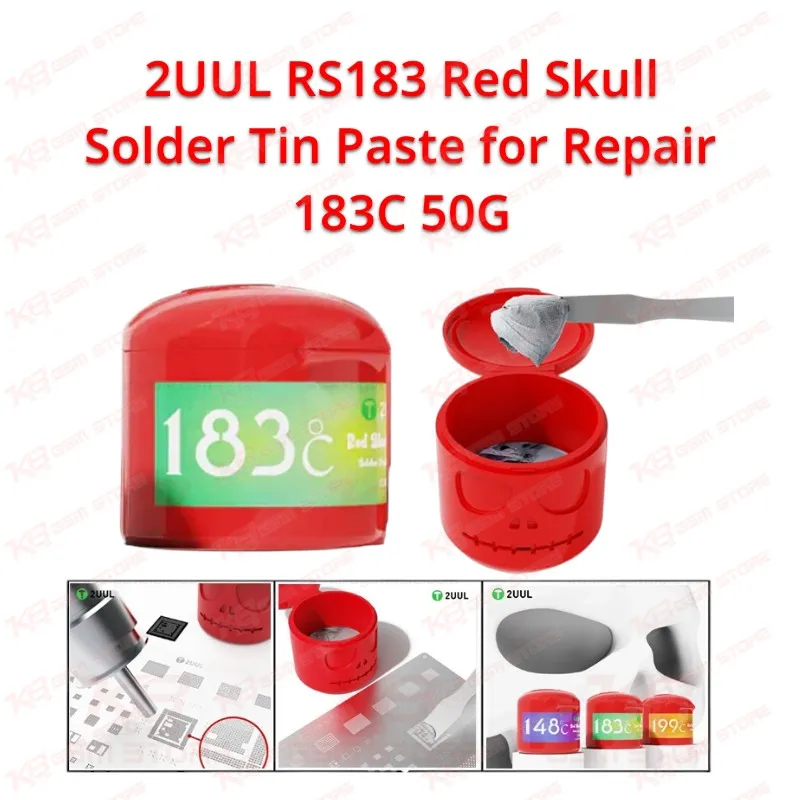
Working on motherboards all day means you already know that solder quality decides whether a chip joint holds or fails a week later. The 2UUL RS183 Red Skull Solder Tin Paste is formulated at a 183°C melting point, giving you a middle-ground reflow temperature that works comfortably across most small and medium IC repair jobs without pushing your board through unnecessary thermal stress. This paste sits inside the wider 2UUL Red Skull lineup, which also includes 138°C, 148°C, and 199°C variants, so you can match paste temperature to the specific chip or workflow you are handling instead of using one paste for everything. When you are dealing with a dead phone that needs IC change karna on the power management chip, or you are prepping pads before jumper lagana on a charging line, having a paste that flows evenly at a predictable temperature saves you rework time and reduces the chance of a false weld. The 50g syringe-style container is sized for regular shop use, so you are not constantly reordering small tubes, and dispensing stays controlled instead of messy. Consistency matters most when you are tinning fine-pitch pads under a microscope, and this paste is built to spread evenly across small IC footprints without leaving dry spots or excess residue that would otherwise need extra cleaning before reflow. Red Skull paste is positioned in the market as a general-purpose SMT and BGA soldering material, meaning it works across a wide range of PCB repair scenarios rather than being locked to one chip family. That flexibility is useful on a busy bench where you might tin a CPU pad one hour and rework a small audio IC the next, both using the same paste at 183°C. Because the paste already carries flux mixed with fine solder particles, you skip the step of applying flux and solder wire separately for small joints, which speeds up chip-level work when you are handling several boards in a day. For hardware fault diagnosis where a board shows dead after flash symptoms or a hang on logo issue traced back to a cold solder joint, reflowing the affected IC pad with a fresh, even layer of paste is often the fix that gets the board booting again. The paste also plays a role in reballing prep, since a clean, even tin layer on the board pads before placing a new BGA ball array directly affects how well the reball takes and how reliable the joint is afterward. Technicians handling iPhone and Android motherboards both rely on general-purpose paste like this because chip-level repair on either platform comes down to the same fundamentals: clean pads, controlled heat, and a paste that reflows predictably. Whether you are working on a display problem traced to a driver IC, a network issue linked to an RF chip, or a charging issue on the PMIC, the soldering step is common ground, and having a trustworthy 183°C paste on your bench covers a large share of that daily workload. Storage and handling matter too — solder paste performs best when kept at a stable temperature and used within its practical shelf window, so treating it the same way you would any flux-based consumable keeps results consistent over time. For a repair shop juggling multiple boards, a full BGA rework station schedule, and walk-in customers waiting on quick turnarounds, a mid-temperature paste like the 2UUL RS183 gives you a reliable default for general IC soldering without forcing you to switch tools for every job. Pair it with your existing hot air station, soldering iron, and PCB fixture setup, and it fits directly into your existing workflow without requiring new equipment or process changes.