


2UUL SC11 EcoFlux Solder Flux for PCB Repair 10cc
2UUL SC11 EcoFlux Solder Flux for PCB Repair 10cc
Regular price
Rs.999.00 PKR
Regular price
Sale price
Rs.999.00 PKR
Shipping calculated at checkout.
Quantity
Couldn't load pickup availability
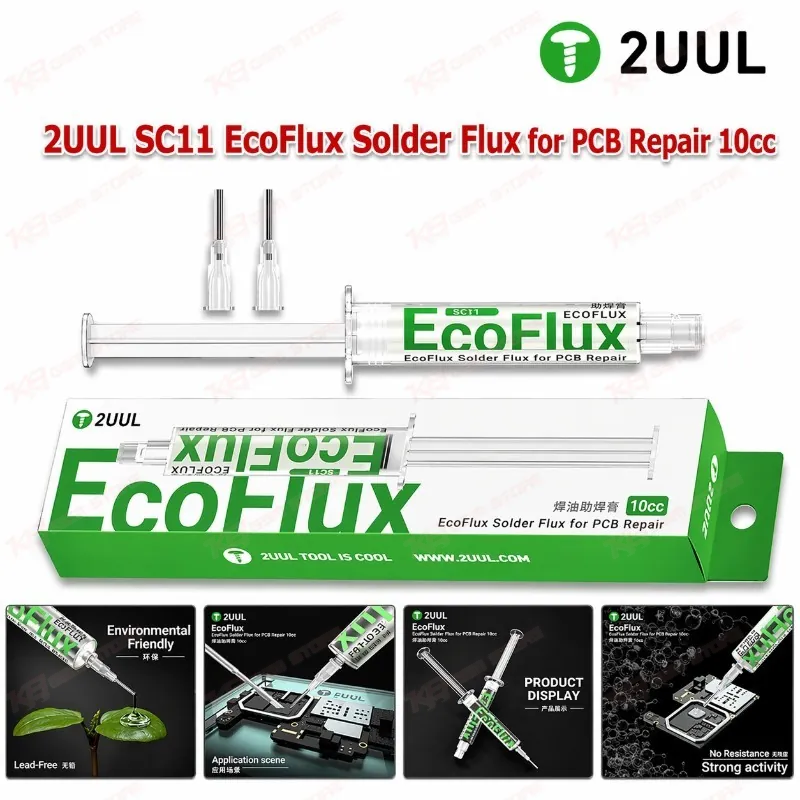
The 2UUL SC11 EcoFlux is a lead-free, RoHS-compliant solder flux built for chip-level mobile repair work. Packed in a precision 10cc syringe with a 1.6mm needle, it gives you controlled, drip-free application on tight BGA pads and small board traces. The formula activates fast, flows evenly under a hot air station, and leaves minimal smoke on your repair bench. Technicians use it for IC reflow, reballing, dead phone recovery, and general PCB soldering where clean, oxidation-free joints matter. It supports mobile phone, tablet, and computer board repair work equally well.
SKU:MST-SOLDERING-ACCESSORIES-494
⚖️ Weight: 0.05 kg
- Safe & Secure Payment
- Fast Delivery
- WhatsApp Support


Description
FAQ
What is the product name?
The product name is 2UUL SC11 EcoFlux Solder Flux for PCB Repair 10cc.
What is the brand of this product?
The brand of this product is 2UUL.
What is the model of this product?
The model is SC11 EcoFlux.
What is this product used for?
It is used for chip-level soldering, BGA reballing, IC reflow, and general PCB repair work.
Which devices are compatible with this product?
It is compatible across mobile phones, tablets, and computer boards on a universal, non-device-specific basis.
Who should use this product?
This product is suitable for mobile repair technicians, repair shops, service centers, and professional repair businesses.
Is this flux safe to use on lead-free solder joints?
Yes, the SC11 EcoFlux is a lead-free formulation designed to work with lead-free solder for RoHS-compliant repair work.
Does this flux produce heavy smoke during hot air rework?
No, it is formulated for smokeless welding, producing minimal fume during hot air and iron soldering compared to standard fluxes.