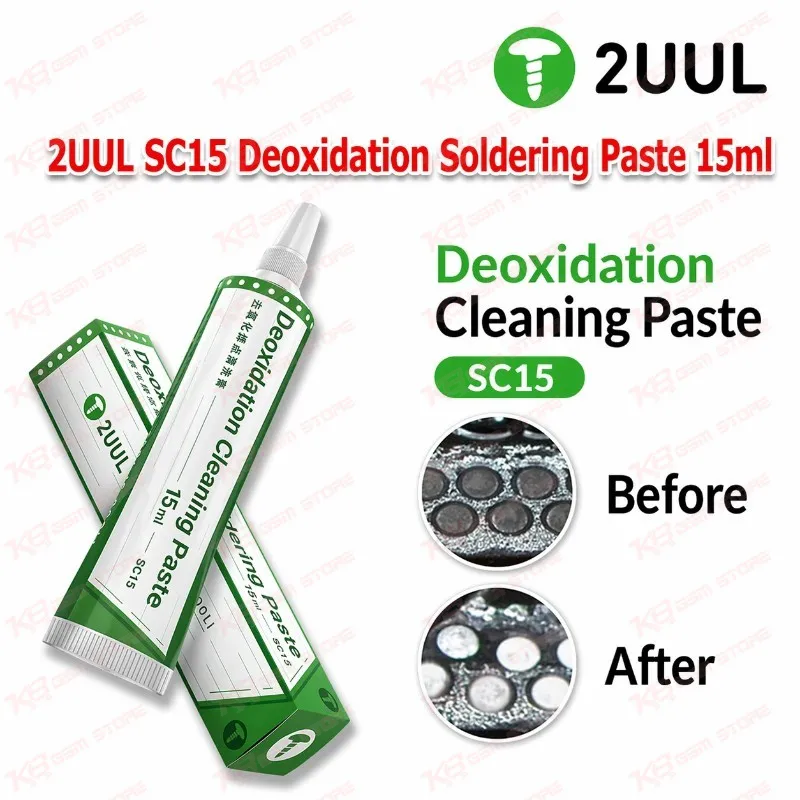
2UUL SC15 solves a problem every board-level technician runs into sooner or later: black, corroded solder pads that refuse to take fresh solder no matter how much flux gets applied on top. This deoxidation paste is a thick flux-gel, not a thin liquid, which is why the tube ships with a plain tip instead of a needle applicator. You apply a small amount directly onto the oxidized point with a brush or cotton swab, spread it evenly, then heat the area with a soldering iron or hot air station to activate the cleaning action. The oxidation breaks down as the paste heats up, the dark residue lifts off the pad, and a clean cloth wipe finishes the job, leaving the copper or solder ball bright and ready to accept fresh tin. On lightly oxidized pads the results come through cleanly on the first pass; heavily corroded ground pads, especially on boards that took liquid damage, may still need a bit of mechanical scraping alongside the paste to fully clear the corrosion. What separates SC15 from generic soldering pastes is behavior under heat: it releases very little smoke and almost no odor while working, which matters on a busy bench where several technicians are soldering side by side. Electrically, the unreacted paste tests out around 5 to 10 megaohms of insulation resistance, and after heat exposure near 240°C followed by cooling, resistance climbs to roughly 100 megaohms and keeps rising, numbers that hold up well for board work. That said, the paste is chemically active, so residue should never be left on a board after the repair; a proper flux remover or isopropyl alcohol wash followed by compressed air drying is the standard way to clear it before reassembly. In day-to-day repair work, SC15 earns its place in chip reballing and micro-soldering, where clean, oxidation-free pads directly affect ball adhesion and joint reliability. It also fits naturally into general board cleaning ahead of IC change or jumper work, where a technician needs the pad free of dark oxidation before tinning it or dropping a jumper wire. For a dead-after-liquid-damage board with visibly blackened test points, running SC15 over the affected pads before diagnosis often restores enough conductivity to get accurate multimeter readings, which speeds up fault-finding on a hardware fault case. The 15ml tube size keeps the paste practical for a single workstation rather than a production line, and because the tube is compact, it travels easily between a repair counter and a home service call. Technicians who currently rely on mechanical cleaning alone, like meleman sponges or fiberglass brushes, will find SC15 cuts down the time spent on that step, since the chemical action does a good share of the work before any scraping starts. As with any oxidation-removal flux, results depend on how far the corrosion has progressed. Fresh oxidation clears easily, while long-standing corrosion on boards that sat wet for weeks will still need combined mechanical and chemical cleaning. Used correctly and washed off properly afterward, SC15 is a straightforward addition to a PCB repair workflow: apply, heat, wipe, wash, then solder.