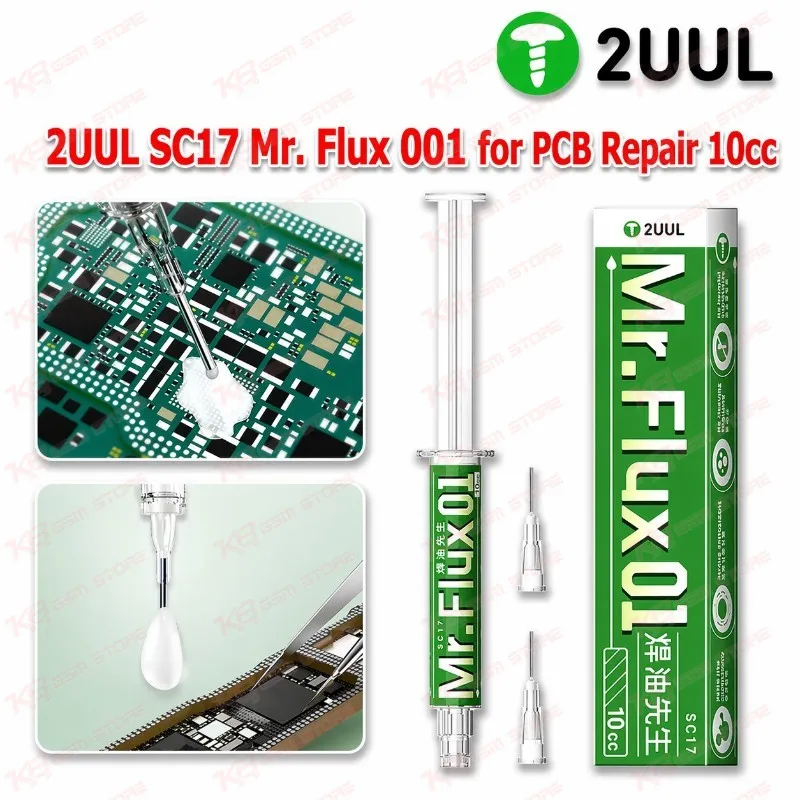
Every GSM technician knows a repair job lives or dies on flux quality, and the 2UUL SC17 Mr. Flux 001 solves the problem that cheap, no-name flux creates on a busy repair bench: cold joints, board discoloration, and IC pads that lift the moment you apply heat. This 10cc syringe carries a no-acid, no-halogen formulation, which means you skip the corrosive residue that eats into copper traces over months of daily use, a real concern when you're handling dozens of boards a week and don't have time to scrub every trace afterward. You dip your soldering iron tip or your hot air nozzle straight into the flux before touching a BGA chip, a CPU, or a fine-pitch IC, and the flux breaks surface tension on the solder balls so they flow evenly instead of clumping into cold joints. That single step saves you from re-touching a chip three or four times, which matters when you're diagnosing a dead after flash board or chasing a hang on logo fault where the motherboard has already been reflowed once by someone else. During IC reballing, you apply this flux before placing new solder balls onto the BGA pad, and it holds the balls in position through the reflow cycle so you don't end up with shifted balls or bridging under the microscope. For CPU reballing specifically, where pad spacing is tighter and the margin for error is smaller, a flux that doesn't dry out mid-process gives you a longer working window to align the stencil and reflow cleanly. Board cleaning is another place this flux earns its spot on your bench: when you're removing an old charging IC or a power IC that's causing a charging issue, brushing a small amount of flux around the pads before desoldering softens the old solder and lifts the component without tearing the pad off the board, a common cause of a fully dead board after a rushed IC change. You'll also use it for jumper lagana work, where a clean solder joint on a hair-thin jumper wire depends entirely on flux that activates fast and doesn't leave a sticky film that interferes with continuity testing afterward. Because the formulation skips halogen-based activators, you reduce the chance of long-term corrosion around sensitive components like the PMIC or RF shield, areas where residue-related failures tend to show up months after the original repair and get blamed on a "hardware fault" nobody can trace back to the flux used. The 10cc syringe format gives you controlled dispensing, so you're not wasting flux or oversaturating a board the way you would with an open jar, and one syringe covers a meaningful volume of daily repair work before you need a refill. This flux sits naturally in your ISP, eMMC, and UFS repair workflow too, since board-level rework on these tools almost always involves reflowing or reballing a chip at some point, and having a dependable flux on hand keeps that step from becoming the weak link in an otherwise solid repair. Whether you're running a solo repair counter or managing a service center with multiple technicians on the bench, the 2UUL SC17 Mr. Flux 001 gives you consistent, repeatable results on the soldering and reballing work that makes up a large share of motherboard-level repair.