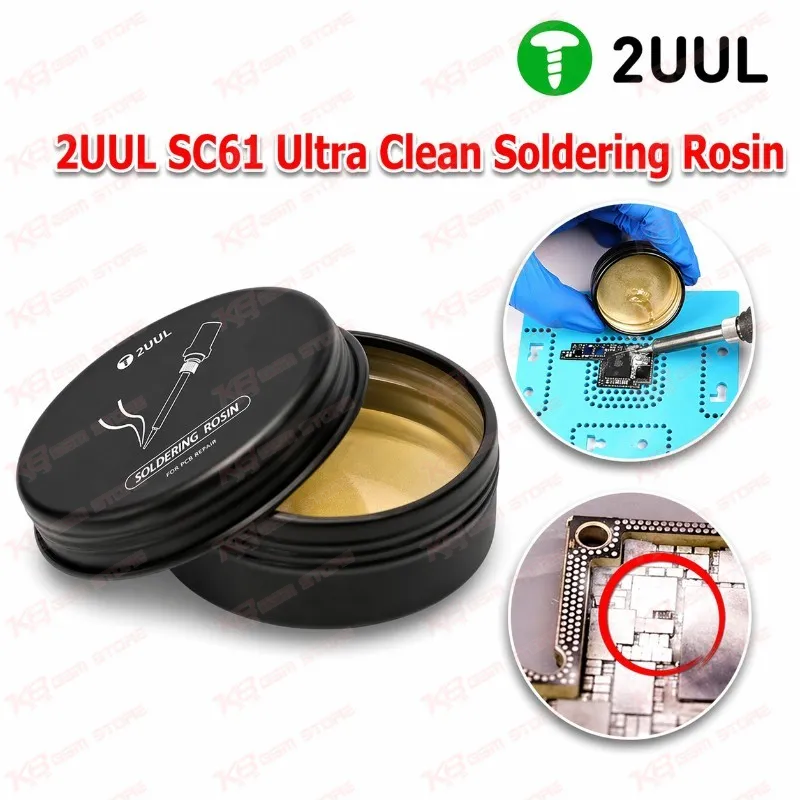
Every mobile repair workshop deals with dirty, oxidized, or hard-to-wet solder joints, and the 2UUL SC61 Ultra Clean Soldering Rosin solves this problem at the source. Made from natural red pine rosin harvested in Northeast Heilongjiang, this flux carries a mild pH that protects ICs, connectors, and PCB copper traces from corrosion during and after soldering. You apply it directly to the joint before touching your iron or hot air nozzle, and it immediately breaks down surface oxidation so solder spreads evenly instead of balling up or skipping pads. This matters most when you work on tight BGA pads or fine-pitch IC legs, where a bad wetting angle turns into a bridged joint or a dead after flash situation you did not cause but now have to fix. Because the rosin leaves a transparent residue, you do not need to stop and clean the board with isopropyl alcohol before moving to the next step, which keeps your workflow moving during busy repair days. Many Pakistani technicians still reach for older opaque fluxes that leave a sticky brown film across the board, forcing extra cleaning cycles that slow down diagnosis and testing. The SC61 avoids that entirely, so your board stays visually clear for continuity checks and further probing with a multimeter. Its melting point sits slightly higher than standard soldering tin, which gives you a short extra window of control during reflow — the rosin stays active a moment longer than the solder itself, letting you reposition components or touch up a joint before everything sets. This is especially useful during CPU reballing, EMMC/UFS chip removal, and charging IC replacement, where timing between heat application and solder flow makes the difference between a clean job and a lifted pad. You get consistent results whether you are working with a hot air station on BGA packages or a fine-tip soldering iron on small SMD parts like charging ICs, PMICs, or backlight resistors. Repair shops handling charging issue complaints, display problem boards, network issue repairs, and hang on logo cases all pass through some stage of board-level soldering, and having a reliable rosin on the bench reduces rework caused by weak or cold joints. Because 2UUL formulates this rosin specifically for smartphone and PCB repair rather than general electrical work, it behaves predictably across the chipset families and board types common in a Pakistani repair shop — Qualcomm, MediaTek, and Samsung Exynos boards alike. You do not need to guess dosage or worry about excess residue attracting dust into your workspace over time, since the thin transparent layer stays put without becoming tacky. For technicians training junior staff, this rosin also simplifies teaching proper soldering technique, since students can see the joint clearly through the residue and self-correct their iron angle or dwell time. Stock this alongside your hot air station, PCB holder, and microscope setup so your soldering station is ready for IC change work, jumper wire installation, and board-level diagnostics without interruption. The compact jar format keeps it easy to store on a crowded repair bench and dip into repeatedly across a full day of jobs, from simple charging port repairs to complex motherboard-level rework.