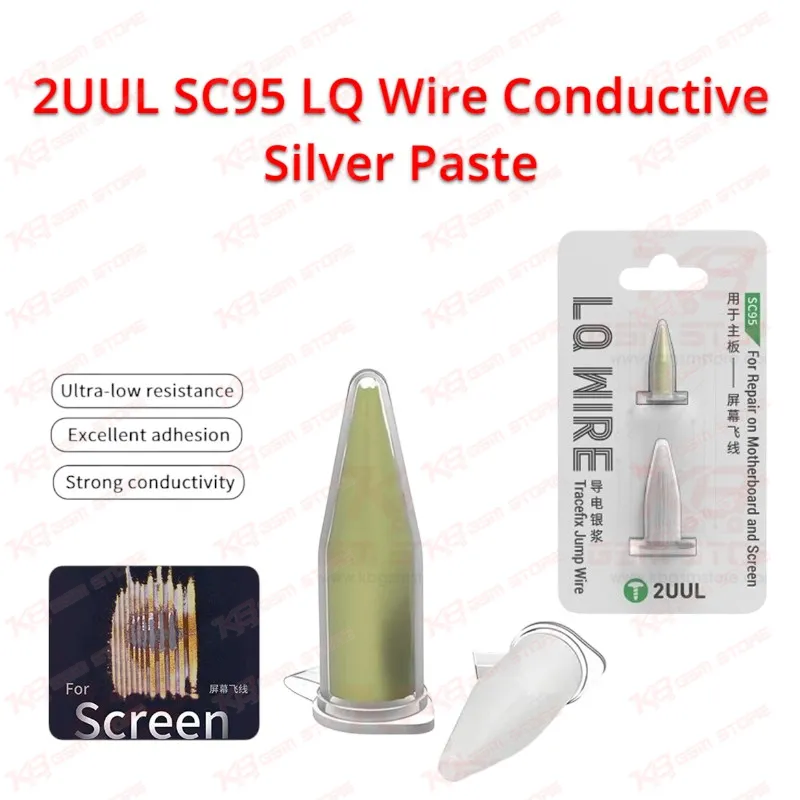
When a motherboard trace lifts off during rework or a screen flex cable tears near the connector, running a soldered flying wire is not always practical, especially on tight, multi-layer boards where the surrounding pads are already fragile from repeated reflow. The 2UUL SC95 LQ Wire Conductive Silver Paste gives you a different route: you apply a fine line of conductive paste directly over the broken trace or between two points that need an electrical bridge, and it hardens into a stable conductive path without touching a soldering iron. This matters on boards where heat has already damaged nearby components, since adding more thermal stress with a soldering tip can turn a small fault into a bigger one. You get a cold-application repair method that keeps the rest of the board cool while still closing the circuit. Pakistani repair shops handle a steady mix of charging issue boards, dead phone motherboards, and hang on logo units where the root cause traces back to a hairline crack in copper traces under the solder mask. In these cases, cutting open the mask and scraping the trace clean, then drawing a line of SC95 paste across the break, restores continuity faster than routing a wire and tacking both ends down. The same logic applies to screen repairs. Flex cables for displays and touch panels often tear right at the connector fold, and a jumper lagana approach with actual wire is fiddly at that scale. A dot of conductive silver paste bridges the torn pad to a working point on the flex without adding bulk that would stop the connector from seating properly. Connector repair on charging ports and board-to-board connectors benefits the same way, since a lifted or broken pad can be rebuilt with a controlled line of paste rather than replacing the whole connector when that is not available in stock. Because the paste is silver-based, it carries current reliably across the short jump lengths typical of phone and tablet PCB work, and it adheres to common board surfaces, solder mask, and flex material well enough to survive normal handling during reassembly and testing. It resists the heat generated during a hot air reflow pass nearby, so a paste jumper does not lift or degrade if you need to rework a chip close to the repaired trace afterward. For a workshop juggling IC change karna jobs, software marna sessions, and hardware fault diagnosis on the same bench, having a no-solder trace fix option speeds up the parts of a repair that used to eat the most time under the microscope. It also keeps your tool list simpler, since one small pack of paste covers jump wire work that would otherwise need fine gauge wire, extra flux, and a steady soldering hand at very small pad sizes. The compact 0.03 kg pack fits into any repair kit or drawer without taking up bench space, and a small amount goes a long way across multiple boards. Whether you are pulling a board out of an FRP lock unit for a full check, chasing a network issue back to a cracked antenna trace, or rebuilding a torn flex on a pattern unlock job, this paste gives you a quick, repeatable way to close the gap and move the board on to testing.