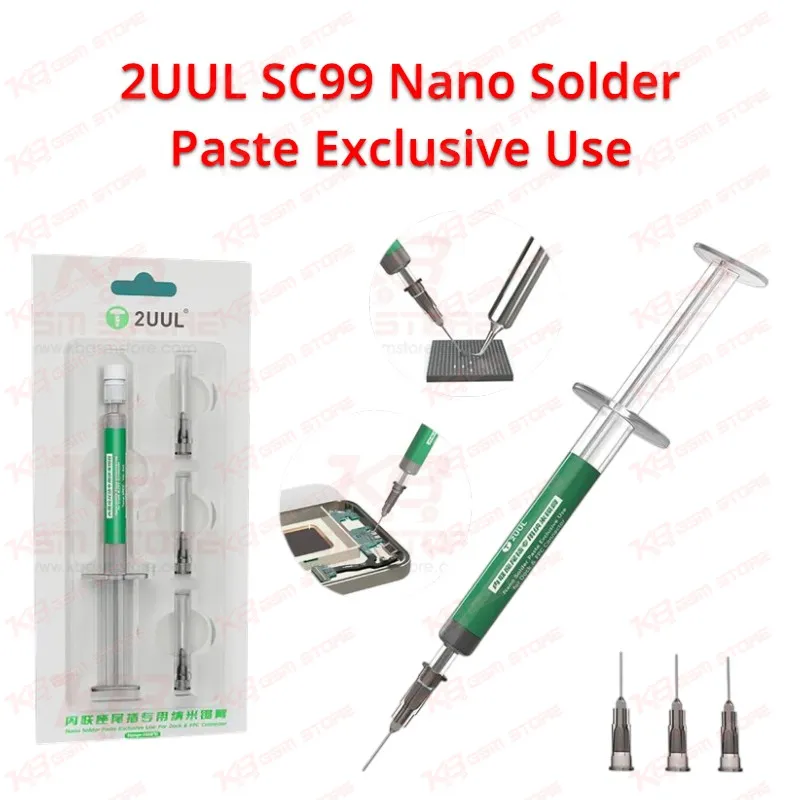
When you're working on a dock connector or FPC ribbon repair, standard solder paste often lets you down — it spreads too much, bridges neighboring pads, or forces you to run higher iron temperatures that put nearby ICs and flex traces at risk. The 2UUL SC99 Nano Solder Paste solves exactly this problem. Built with nano-grade solder particles, it gives you a paste fine enough to sit precisely on tiny dock connector pins and FPC pads without spilling onto adjacent contacts, which matters most when you're reworking a charging port on a board that's already tight on space. You get a pre-mixed flux formulation baked directly into the paste, so you skip the extra step of applying flux separately before you solder — it cuts your prep time on the bench and keeps your workflow consistent across repeat charging port jobs. The flux content also handles oxide removal on the pads automatically, which means you get cleaner wetting and stronger joints even on connectors that have already seen wear from repeated cable insertions. What really sets the SC99 apart on your repair bench is its 183°C melting point. That's noticeably lower than many general-purpose solder pastes, and it matters because dock connectors sit close to charging ICs, PMIC circuits, and thin FPC traces that don't tolerate excessive heat well. Reflowing at a lower temperature means you reduce the risk of lifting pads, damaging nearby components, or warping the flex ribbon itself — all common causes of a phone coming back dead after flash or developing a fresh charging issue right after a repair. In the mobile repair workflow, the SC99 fits naturally into board-level and FPC-level soldering stages: after you've diagnosed a charging port fault, disconnected the damaged connector, and cleaned the pads, this paste becomes your bonding agent for reattaching the new dock connector or reinforcing a lifted trace. Its bright, full solder flow reduces the chance of cold joints, false soldering, or dry joints — issues that typically show up later as an intermittent charging issue or a phone that charges only at certain cable angles. For technicians who handle sim tray connectors, mic and audio jack flex repairs, or fine-pitch SMD rework alongside dock connector jobs, the same nano-paste formula applies cleanly across these small-footprint components, giving you one consistent tool instead of switching between multiple paste types. The paste dispenses through a needle-tip applicator, letting you place small, controlled amounts exactly where you need them rather than relying on a soldering iron tip to carry solder from a spool, which is especially useful when you're working under a microscope on tail insert connectors or fine-pitch FPC pads. Because the particles are nano-sized, you also avoid the common problem of solder balls scattering across the board during reflow — a frequent cause of short circuits after connector-level repair work. If your repair shop regularly handles charging port replacements, board-level connector soldering, or FPC reinforcement work, keeping the SC99 stocked on your bench reduces rework call-backs tied to bridging, cold joints, or heat-damaged components. It pairs naturally with a hot air station or soldering iron set to a controlled low-temperature profile, and it works well alongside flux cleaner and PCB cleaning brushes as part of a complete connector repair sequence. For a repair business trying to standardize quality across technicians, a dedicated low-temperature nano paste like this also reduces the variability that comes from technicians using general-purpose paste at inconsistent temperatures.