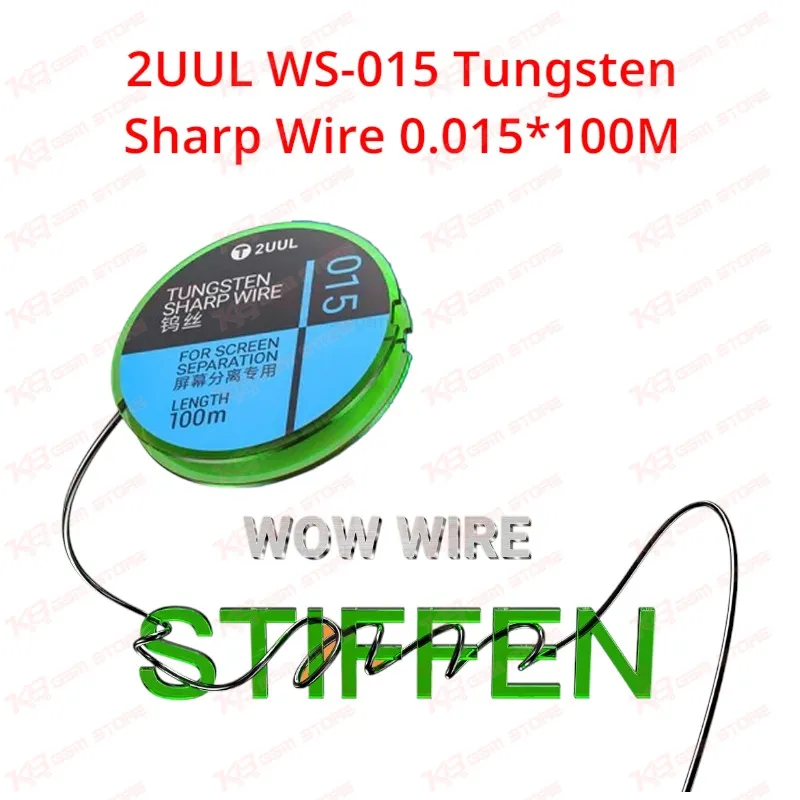
When you're separating a cracked polarizer film or lifting glass off an LCD or OLED panel, the thickness of your cutting wire decides whether the job goes clean or ends with a scrapped screen. The 2UUL WS-015 tungsten wire measures just 0.015mm in diameter, the thinnest option in the WS series, and that fine gauge lets you slide the wire under the polarizer layer or through the OCA bond line without dragging on the display beneath it. You feed the wire between the glass and the panel, apply light heat if the adhesive needs softening, and saw the wire back and forth in short, controlled strokes to shear through the bond without transferring pressure into the LCD or OLED cells. This makes the WS-015 the tool you reach for on polarizer replacement jobs specifically, while the thicker WS-028 handles full screen separation and the WS-035 covers tablet-sized panels where you need more rigidity. Every roll runs 100 meters, and the pack gives you 5 rolls, so you're not stopping mid-shift to cut a new length or worrying about running short during a batch of refurbishment jobs. The tungsten alloy holds its sharpness across repeated passes instead of dulling or fraying like standard steel wire, and the metal resists corrosion from the isopropyl alcohol and cleaning agents you're already using around the workbench. Wind resistance and flex matter here too — this wire stays taut under tension instead of kinking, so you keep consistent cutting pressure across the full width of a screen without the wire snapping partway through a pass. That consistency is what separates a clean polarizer removal from one that leaves adhesive residue or micro-scratches on the display glass, both of which turn a simple film swap into a warranty headache. For technicians running a refurbishment line, this wire fits directly into your existing workflow: heat the panel on your preheat station or hot plate to loosen the OCA bond, work the WS-015 wire under the polarizer edge, saw through the adhesive layer, then move to your scraper or spudger for any remaining residue before applying the replacement film. The 0.015mm gauge also works well on glass-only replacement jobs where the original LCD or OLED stays intact and only the outer glass needs separating, since the thin profile reduces the risk of the wire catching on the frame bezel or adhesive foam around the screen edge. Because the wire isn't tied to any specific chipset or board, it fits into almost any mobile repair bench regardless of whether you're running Samsung, Apple, Oppo, Vivo, Xiaomi, or local-market device brands through your shop that week. Store the spool away from moisture and handle the wire with care during unspooling, since the fine gauge that makes it effective for separation work also makes it easy to kink if pulled roughly. For a shop processing multiple screen jobs per day, keeping this wire stocked cuts down on the delays and damaged panels that come from stretching a dulled or improvised cutting wire past its useful life.