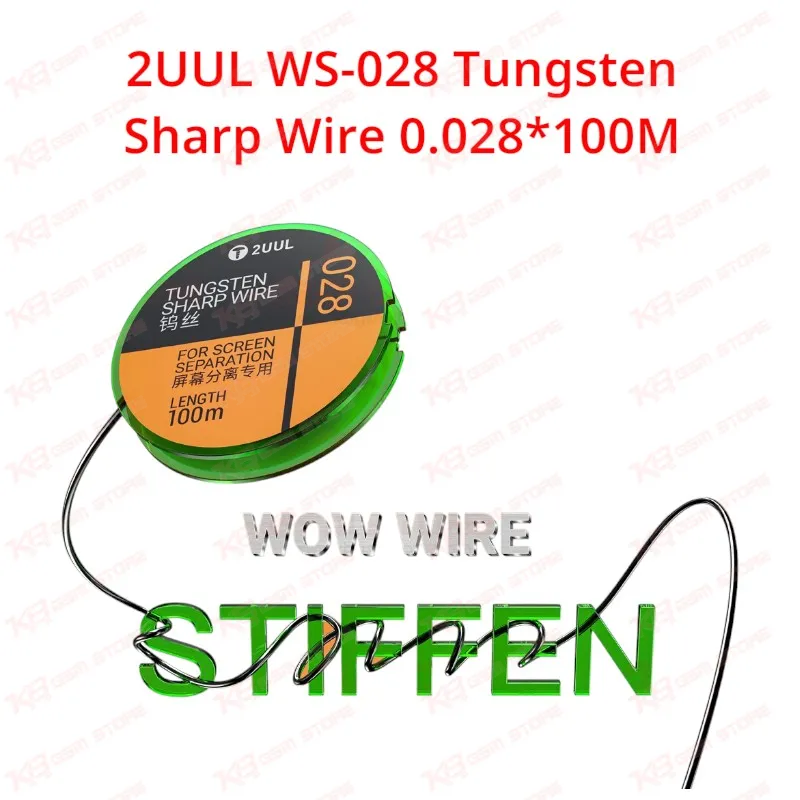
When you're pulling a cracked or delaminated screen off a phone or tablet, the tool doing the actual separating matters more than most technicians give it credit for, and the 2UUL WS-028 earns its place on the bench because it's built specifically for that one job. This is a 0.028mm tungsten wire, coated with diamond particles, supplied in a set of five 100-meter rolls, which means you're not measuring out short lengths for every repair — you cut what you need and move on. Tungsten gives the wire the hardness and tensile strength to survive being pulled through hardened OCA adhesive and factory glue without stretching or snapping halfway through a cut, and the diamond coating is what actually does the cutting, shearing through the bonding layer instead of tearing at it. That distinction shows up in the result: a clean separation line instead of a jagged one, which keeps your risk of cracking the glass or damaging the LCD or OLED panel underneath much lower than working with a blade or a standard steel wire. The 0.028mm diameter puts this wire in the middle of 2UUL's range — thinner than the WS-035, which is sized more for tablet screens and heavier adhesive layers, and thicker than the WS-015, which is meant for polarizer film separation rather than full screen removal. That middle diameter is what makes the WS-028 the practical choice for everyday mobile phone screen separation, where you want enough wire strength to push through the glue line but still need the thinness to stay clear of the digitizer and backlight layers. On the bench, the process is simple: anchor one end, feed the wire under the screen edge after a light heat or ultrasonic pre-treatment to soften the adhesive, and draw it steadily across the width of the display. Because the wire resists stretching, you keep consistent tension through the whole pass instead of the wire ballooning and digging into the frame, which is where accidental scratches usually come from. Rust resistance also matters here — a wire that's been sitting in a drawer for weeks in a humid workshop shouldn't corrode and lose its cutting edge before you've used through even one roll, and the tungsten construction holds up under that kind of storage. For a shop doing regular display problem repairs — cracked glass, dead pixels needing a panel swap, or touch digitizer replacements — this wire becomes a routine consumable rather than a specialty tool, which is exactly why it ships in a five-roll set instead of a single spool. It also fits into refurbishment workflows where the screen itself needs to come off intact for reuse or resale, since a clean OCA cut preserves the panel instead of cracking it during removal. Pair it with a heating pad or hot air setup to soften the adhesive first, and a set of screen opening pliers or suction cups to control the lift while you feed the wire through, and you've got a complete screen separation station. The WS-028 doesn't do anything flashy — it's a length of coated wire — but the material quality and precise diameter are what separate a smooth teardown from a cracked screen and a wasted panel, and that's the entire value proposition for a technician running screen repairs day after day.