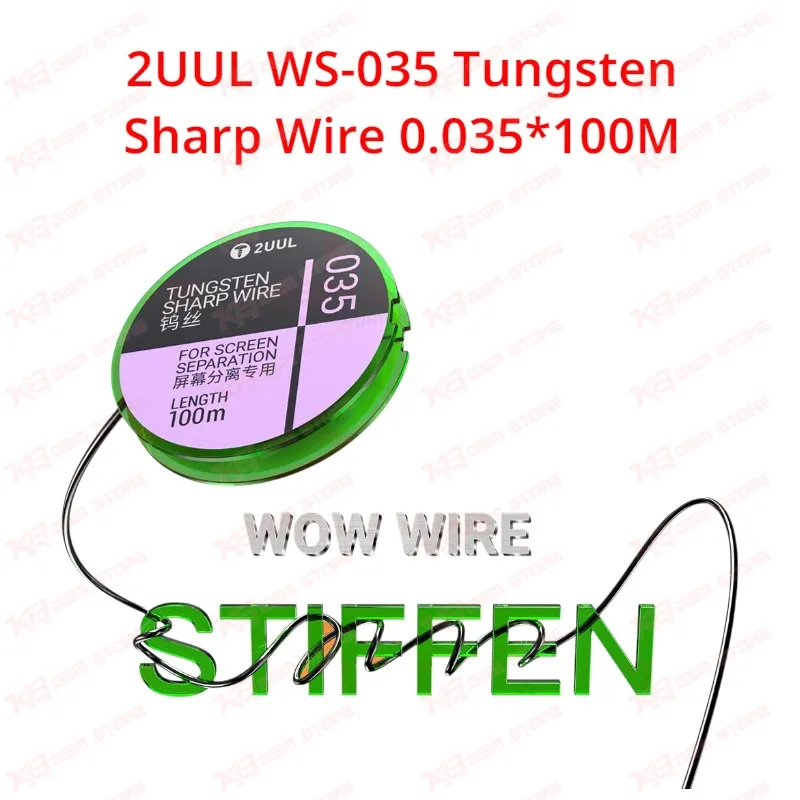
When you're separating a cracked digitizer from a good LCD or pulling OCA off a panel you're about to refurbish, the wire you use decides whether the job goes clean or you end up with a scratched frame and a technician cursing under their breath. The 2UUL WS-035 solves that with a 0.035mm tungsten alloy core wrapped in a diamond coating, giving you a wire thin enough to slide under adhesive layers but strong enough not to snap halfway through a cut. You get 100M of wire split across 5 pieces per pack, so a single pack covers a serious stretch of daily screen separation work before you need to restock. Tungsten as a base material is naturally hard and wear-resistant, and 2UUL pairs that with a diamond coating that keeps the cutting edge sharp long after cheaper wires have gone dull and started dragging instead of slicing. That matters on your repair bench because a dull wire doesn't just slow you down, it increases the chance of heat buildup and pressure marks on the glass you're trying to save. The corrosion-resistant finish on this wire also means it holds up in a busy workshop environment where humidity and constant handling wear down lesser tools fast. Diameter selection is where technicians usually get this wrong, and 2UUL addresses it by offering the WS-035 alongside the WS-028 and WS-015 variants, each suited to a different separation task. The WS-035's 0.035mm thickness puts it in the range built for tablet screen separation and heavier-duty cutting jobs where you need a wire that can handle thicker adhesive layers and larger panel sizes without bending out of shape mid-cut. If you're mainly doing thin polarizer separation on phones, you'd reach for the WS-015 instead, and for standard phone screen separation the WS-028 is the closer match, but for tablets and larger-format glass work the WS-035 gives you the strength and control you need. In actual use, you thread the wire under the edge of the panel, keep tension steady, and work it across the adhesive line in smooth passes rather than sawing motions, which is where the diamond coating earns its keep by cutting the OCA cleanly instead of tearing it and leaving residue behind. This makes cleanup faster afterward, since you're not stuck scraping stubborn adhesive fragments off the frame before you can proceed to reassembly. For shops handling OLED and AMOLED regeneration work, wire quality directly affects your success rate, because these panels are more sensitive to pressure damage than standard LCDs, and a wire that snags or requires excess force increases your scrap rate on expensive screens. The WS-035 gives you a more forgiving margin here since the sharpness reduces the pressure needed to get through the adhesive layer. This wire fits naturally into a screen refurbishment workflow that also includes a heating platform or hot plate to soften the OCA before separation, followed by a UV or OCA laminator for reassembly, so if you're building out a full refurbishment station, the WS-035 slots in as your separation-stage tool. Whether you're running a solo repair counter or managing a full-scale refurbishment operation, having a reliable diamond wire on hand cuts down on damaged panels and repeat jobs, which translates directly into fewer losses and faster turnaround per unit.