


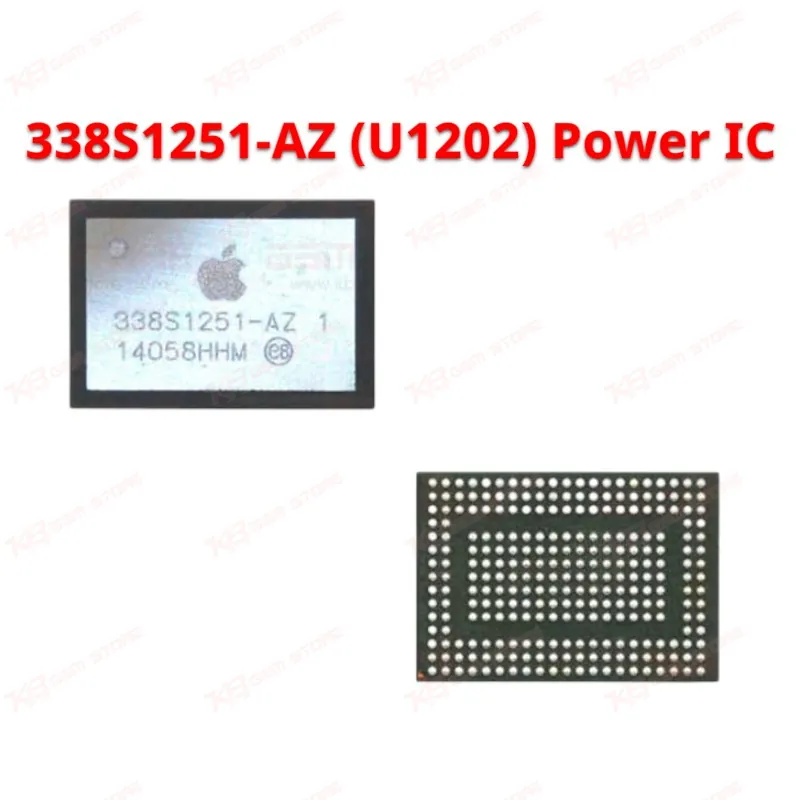
338S1251-AZ (U1202) Power IC
338S1251-AZ (U1202) Power IC
Regular price
Rs.450.00 PKR
Regular price
Sale price
Rs.450.00 PKR
Shipping calculated at checkout.
Quantity
Couldn't load pickup availability
The 338S1251-AZ (U1202) is the main power management IC used in iPhone 6 and iPhone 6 Plus logic boards. Known among Pakistani technicians as the "big power IC," this 267-pin BGA chip controls power distribution to the CPU, baseband, and other critical sections of the board. It is commonly reballed or replaced when a device shows dead phone symptoms, no power, boot loop, or abnormal current draw on the power supply. Sourced for professional GSM repair workshops, this IC suits technicians handling iPhone 6 series board-level repair, motherboard troubleshooting, and PMIC replacement work across Lahore, Karachi, and Islamabad service centers.
⚖️ Weight: 0.01 kg
SKU:MST-IC-166
- Safe & Secure Payment
- Fast Delivery
- WhatsApp Support


Description
FAQ
What is the product name?
The product name is the 338S1251-AZ U1202 Power Management IC.
What is the brand of this product?
The brand of this product is Apple.
What is the model of this product?
The model of this product is U1202, marked 338S1251-AZ.
What is this product used for?
This product regulates power distribution to the CPU and baseband sections of the iPhone 6 and iPhone 6 Plus logic board.
Which devices are compatible with this product?
This product is compatible with iPhone 6 (A1549, A1586, A1589) and iPhone 6 Plus (A1522, A1524, A1593).
Who should use this product?
This product is suitable for mobile repair technicians, repair shops, service centers, and professional board-level repair specialists.
Does this IC fix a completely dead iPhone 6 that shows no power at all?
Dead phone and no-power symptoms on iPhone 6 boards often trace back to this power IC, but confirming the fault with a DC power supply current test before replacement is recommended.
What pin count and package type does this IC use for reballing?
This IC uses a 267-pin BGA package, so a stencil matched to that specific footprint is required for accurate reballing.