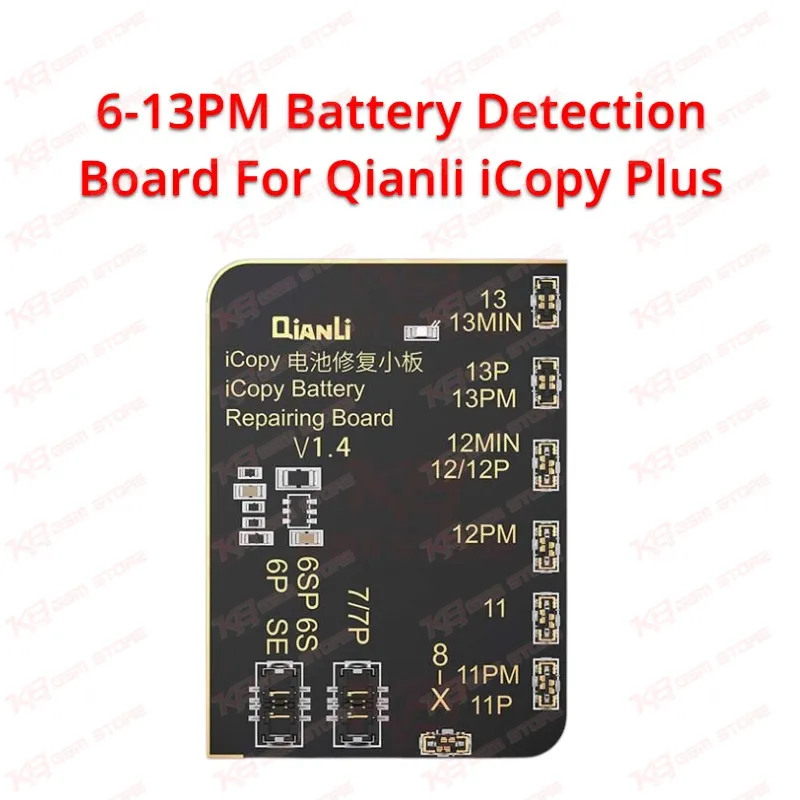
Every GSM technician who handles iPhone battery replacements knows the frustration of a genuine-looking battery triggering a "Not Genuine" or "Service" warning on the lock screen. The QianLi iCopy Battery Detection Connecting Board solves exactly this problem by giving you direct access to the battery's stored EEPROM data through your iCopy Plus programmer. Instead of guessing why a battery shows degraded health after a replacement, you connect the board to the iCopy Plus, read the existing battery chip data, and rewrite corrected values including cycle count and efficiency percentage. This eliminates the false "Service" flag that pushes customers to think their repair went wrong, even when the physical battery itself works fine. For a repair shop working through dead phone battery jobs daily, this single board turns a recurring customer complaint into a five-minute fix. The board connects through the iCopy Plus main unit and does not function as a standalone tool, so it only makes sense as an addition to a technician's bench that already runs the iCopy Plus 2.1 firmware or a later version. Coverage spans iPhone 6, 6 Plus, 6S, 6S Plus, SE, 7, 7 Plus, 8, 8 Plus, X, XR, XS, XS Max, 11, 11 Pro, 11 Pro Max, 12 series, and 13 series up to 13 Pro Max, which covers the bulk of battery replacement jobs coming into any Pakistani repair shop today. On the workflow side, this board fits directly into the EEPROM programming stage of a battery service job: you separate the battery flex, connect it to the board's socket, run the read function in the iCopy software, verify or correct the stored parameters, then write the updated data back before reassembly. Technicians handling bulk battery replacement work — service centers doing dozens of units a week — benefit most, since manually disputing "Service" warnings with customers eats into shop time that this board removes entirely. It also helps on jobs where a battery was swapped by another shop and the phone now shows inconsistent health percentage or an inflated cycle count; you can normalize that data instead of sourcing another battery. Build quality matters here since the board sees repeated flex-cable insertions, and most versions on the market include an onboard power indicator LED so you can confirm a proper connection before running any read or write operation, avoiding a failed session that could corrupt chip data. Because the board depends entirely on the iCopy Plus programmer's software and firmware version, keeping your iCopy Plus updated matters for board compatibility with newer iPhone chip revisions, particularly on 12 and 13 series units where Apple tightened battery pairing checks. For a workshop already running ISP or eMMC-level board repair work, adding this battery board rounds out your setup so you are not sending battery-only jobs elsewhere while your bench already has the core iCopy Plus hardware sitting idle for this task. It is a narrow-purpose tool, built for one job, but it is a job that comes through the door constantly on any bench doing iPhone hardware repair, which makes it one of the more cost-effective additions a technician can make to an existing iCopy Plus setup.