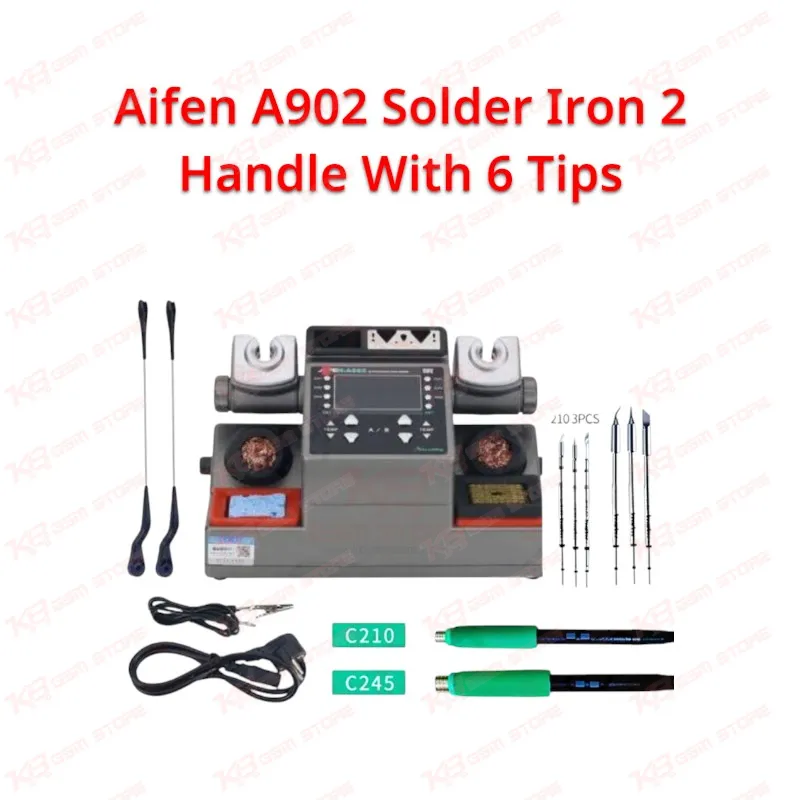
Walk into any repair shop running BGA and board-level work, and the bottleneck usually isn't skill, it's the iron sitting idle while you wait for it to reheat after switching tasks. The AIFEN A902 solves that by putting two independent 350W channels on one station, so you keep one handle set up for fine IC pad soldering and the other loaded for heavier joint work, both live at the same time. Instead of the temperature drift you get with older AC voltage controlled irons, the A902 runs on program chip temperature control, which holds the tip at your set point through the full 100°C–450°C range (212°F–842°F) even under continuous load, so the tip doesn't cool down mid-joint when you're working a dead phone board. This particular set gives you a T210 handle and a T245 handle along with three C210 tips and three C245 tips, and because the station accepts C115, C210, C245, and C470 heating cores across the board, you can drop in a C115 for micro-pitch IC legs or a C470 core on the T245 handle when you need to move a large amount of tin on a bigger joint, without buying a second machine. Both handle brackets tilt up to 45 degrees, so you angle the iron to match how the board sits under your microscope instead of fighting a fixed stand. For technicians running back-to-back jobs, the memory function matters more than the raw wattage: each station holds three separate memory temperatures, a short press for a second recalls the saved setting and a long press for three seconds stores a new one, so you're not resetting the dial every time you move from a network IC job to a charging port repair. Six standby presets (0, 150, 180, 200, 250, 280) sit ready in the background for whichever task comes up next. Set the handle down in its stand and the A902 drops into automatic sleep to save the tip and cut down on oxidation buildup; lift it back out and it's back at working temperature almost immediately, which matters on a busy bench where the iron sits idle between customers. A key lock stops the settings from shifting if the station gets bumped, the buzzer confirms every button press so you're not second-guessing whether a setting actually took, and Celsius/Fahrenheit switching is built in for technicians who trained on either standard. Short-circuit protection cuts power automatically if something goes wrong internally, which is a real consideration on a station that two people might share across a shift. In terms of where this fits on the bench: this is the tool you reach for after diagnostics has already pointed you to a specific component, whether that's an IC change on a board with a boot loop issue, a jumper wire on a trace that's been cut during a previous repair, reflowing a connector after a charging issue, or reballing prep work before a chip goes back on. It's not a hot air station and it's not a reflow oven, it's the precision hand-soldering side of PCB rework, sitting between diagnostics and testing in your workflow. Repair shop owners running multiple technicians on one bench get the most out of the dual-channel layout since two people can solder at once without either one waiting on the other, and training institutes teaching board-level repair get a station where students can practice tip changes across C115 through C470 without needing four separate irons in the room. The 350W output means you're not underpowered when a job calls for the C470 core on the T245 handle, but the program chip control keeps things stable enough that fine C115 work under a microscope doesn't feel like overkill either. For a workshop doing everything from screen connector repair and display problem diagnostics through to hardware fault work on the motherboard itself, having one station cover both ends of that range with two handles running simultaneously cuts down on the number of tools taking up bench space, and the memory presets mean you're not re-tuning temperature settings every time the next phone comes in with a different fault.