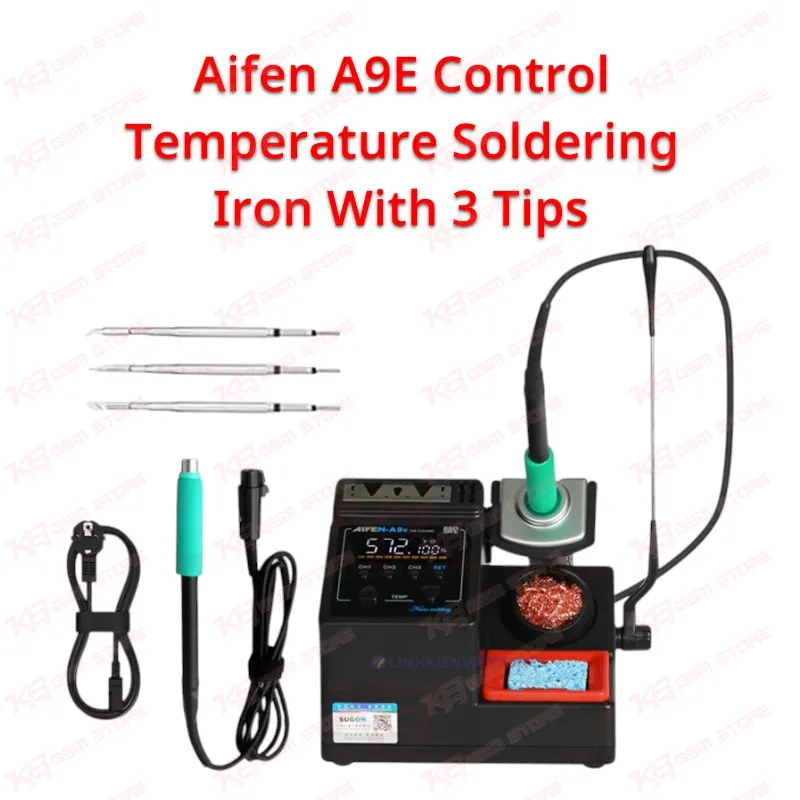
Every technician who spends the day switching between jumper wires, connector pins, and IC legs knows how much a slow-heating iron costs you in turnaround time, and the AIFEN A9E exists to close that gap. Instead of relying on a basic AC heating element like older irons on your bench, the A9E runs on program chip temperature control, a microcontroller-driven system that reads and adjusts tip temperature far faster and more accurately than analog dial irons. You press the handle button or set your target on the display, and the tip reaches working temperature in about two seconds, so you are not standing around waiting for the iron to catch up between jobs. Because the internal logic constantly monitors heat loss during soldering, the A9E applies real-time temperature compensation: the moment the tip touches a cold PCB pad or a mass of solder and starts to lose heat, the unit compensates instantly to hold your set point, which matters when you are working lead-free solder that needs a steady, higher melting temperature to flow cleanly. This kind of consistency directly affects your solder joint quality on charging port pins, small SMD pads, and battery connector legs where a temperature dip can leave you with a cold joint and a callback. The station accepts C210, C115, and C245 soldering tips, which covers the three handle families most workshops in Pakistan already run, so you are not locked into one tip ecosystem when you buy the base unit. If your bench already has T210, T115, or T245 handles from other brands, the A9E's larger socket design is built to fit them, giving you flexibility instead of forcing a full retip of your existing tools. Three save buttons, CH1, CH2, and CH3, let you lock in your regular working temperatures, so a technician doing display flex soldering can save a lower setting, while a colleague doing battery connector rework saves a higher one, and switching jobs becomes a single button press instead of manual dial adjustment every time. The auto sleep function is a small detail that pays off over a full working day: set the handle in the stand and the unit drops power automatically, extending tip life and cutting standby heat and power draw, then pick the handle back up and it reactivates to your saved temperature within moments. On a bench where the iron is picked up and set down dozens of times between diagnosis, jumper lagana, and IC change work, that auto sleep cycle noticeably reduces tip oxidation compared to irons left running continuously. The A9E runs on universal AC110-220V input, so it works without a step-down transformer across the local supply variations technicians deal with in different cities. Build quality on this model targets repair shop conditions rather than hobby use: the aluminum bracket holds the hot iron securely between uses, a silicone tip organizer keeps your spare C210, C115, and C245 tips sorted instead of rolling around loose in a drawer, and the adjustable-angle stand lets you position the holder to suit your bench layout. For technicians handling common repair scenarios like a dead phone after a failed flash, a board showing hardware fault symptoms, or a charging issue traced back to a damaged connector, having one iron that heats fast, holds temperature accurately, and swaps tips without recalibration removes one more variable from your diagnosis-to-repair workflow. The A9E fits naturally alongside your existing ISP box, UFS programmer, and hot air station as part of a complete board-level repair setup, since PCB rework, IC reballing, and connector soldering all depend on the same underlying requirement: a soldering iron that reaches the right temperature immediately and stays there under load. Whether you run a single-technician repair counter or a multi-bench service center, the combination of fast heating, program chip accuracy, and multi-tip compatibility makes the A9E a practical upgrade from basic temperature-controlled irons without pushing you into rework-station-level pricing.