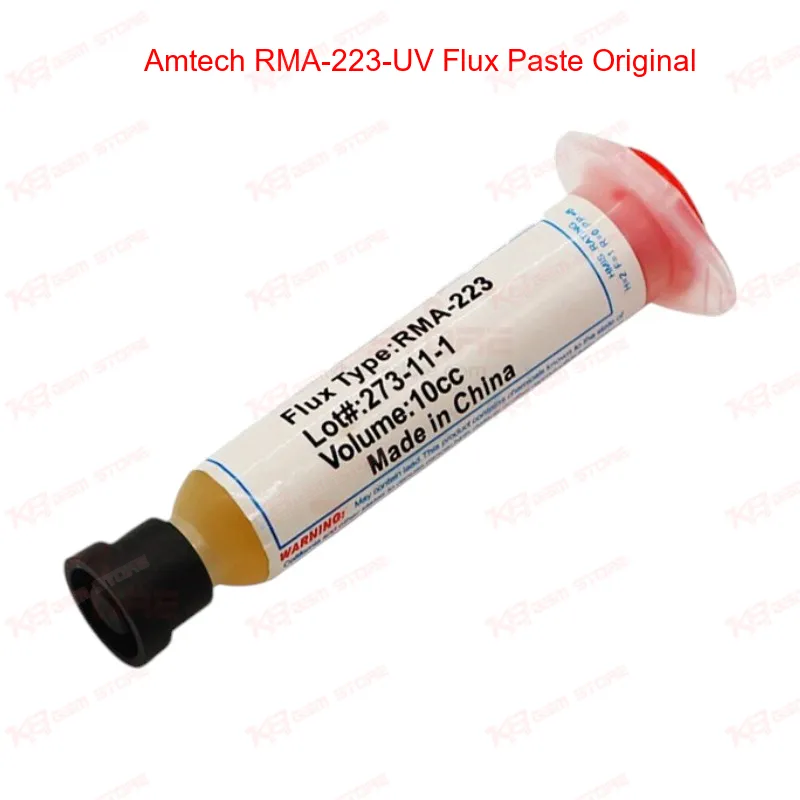
Amtech RMA-223-UV is one of the most widely used flux pastes on mobile repair benches across Pakistan, and for good reason. It solves a specific problem technicians deal with daily: standard fluxes leave a pale yellow film after reflow that hides solder joints and makes post-repair inspection difficult. RMA-223-UV avoids this by combining high-quality alloyed powder with a resinic pasty base, giving you a clean board surface after soldering instead of a messy one that needs extra cleaning steps before you can even check your work. The UV-reactive formulation is the standout feature. Under UV light, any leftover flux residue becomes clearly visible, so you can confirm the board is properly cleaned before closing up a repair. On dead phone repairs where reballing or IC change is the fix, this matters — a poorly cleaned board can cause corrosion or intermittent faults down the line, and this flux gives you a reliable way to check before you move on. RMA-223-UV is a high-viscosity, no-clean flux, which means it stays where you place it instead of running across the board during heating. That control matters when you're working close to adjacent components on a densely packed PCB, whether you're doing charging IC reballing, PMIC rework, CPU IC replacement, or general SMD soldering. The paste spreads evenly under heat, holds solder balls in position during reballing, and doesn't splash or bead up unpredictably like thinner fluxes can. A low ionic activator system keeps the soldering process cleaner in another way too — it produces less smoke during heating, which is a real quality-of-life improvement on a repair bench where you're running the hot air station or soldering iron for hours at a stretch. Less smoke also means less contamination risk around sensitive components nearby. After the board cures, the surface insulation resistance of any remaining residue stays high, which protects against short circuits and leakage current issues that can develop on boards exposed to humidity or heavy use — a real consideration in Pakistan's climate where boards in service centers see a wide range of conditions. The flux also resists oxidizing gold, copper, phosphorus, and bronze surfaces, so pads and traces stay in good condition through the rework process instead of degrading from repeated heat cycles. Cleanup is straightforward. Once the joint sets, residue peels off easily by hand or with tweezers in most cases, which saves time compared to fluxes that need heavy solvent cleaning. The paste is compliant with the RoHS 2002/95/EC directive, so it's safe for use in professional repair environments without the hazardous-substance concerns that come with older flux formulations. This is a tin-planting and reballing essential — pair it with your reballing stencils and BGA rework station for stencil-based tin planting on charging ICs, PMICs, CPU ICs, and NAND/eMMC chips. It also works as a general-purpose flux for board-level soldering: display connector repair, charging port rework, network IC replacement, and any hand-soldering task where you need a paste that holds position and cleans up fast. For repair shops handling high volumes of dead-after-flash boards, boot loop issues, and charging faults, RMA-223-UV earns its place as a daily-use consumable rather than an occasional-use item. It's a straightforward addition to any GSM repair kit — dependable, low-mess, and built around the exact pain points technicians run into when reballing and reworking phone and computer boards.