Skip to product information
1 of 5

AY A108 Multi-function Dot Matrix Battery Repair Programmer for iPhone 8 to 14 Pro Max

AY A108 Multi-function Dot Matrix Battery Repair Programmer for iPhone 8 to 14 Pro Max

Regular price Rs.1.00 PKR
Regular price Sale price Rs.1.00 PKR
Sale Sold out
Shipping calculated at checkout.
Quantity

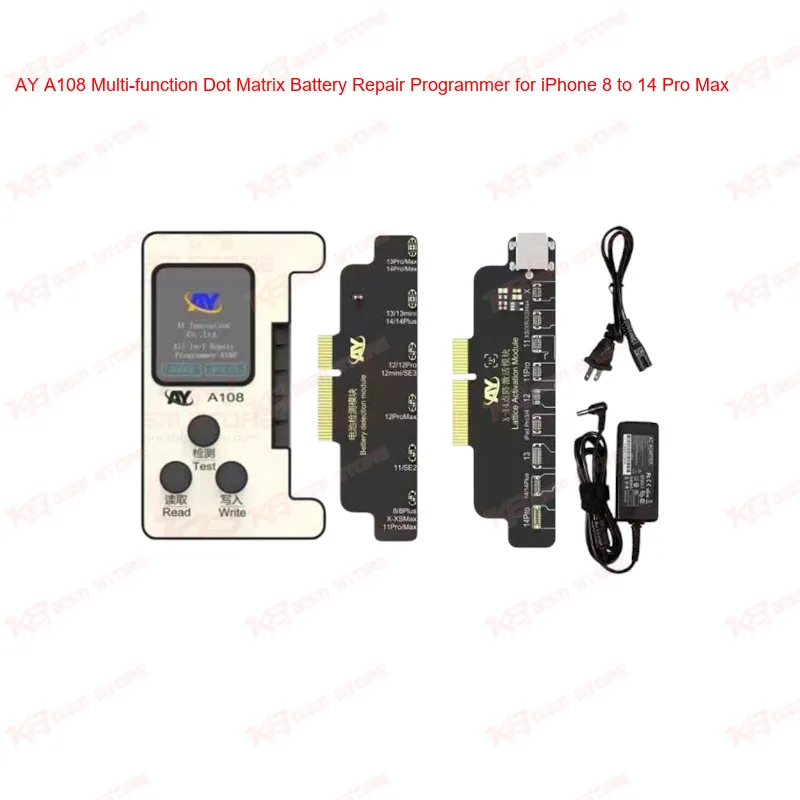
The AY A108 solves the battery data and Face ID problems that show up daily on your repair bench. You read and write original battery data, restore true tone after a screen change, and fix Face ID after a dot matrix or flex cable fault — without needing a donor board. Built by the Diyfixtool team, this programmer works as a single-unit device or connects online for live firmware updates, so your tool keeps expanding as new iPhone models launch. For any GSM shop handling iPhone 8 to 14 Pro Max, this box turns a "dead after flash" battery warning or a blank Face ID into a five-minute job instead of a lost customer.

SKU:MST-FLASHING-DEVICE-12

⚖️ Weight: 0.39 kg

  • Safe & Secure Payment
  • Fast Delivery
  • WhatsApp Support
View full details

Every iPhone repair shop in Pakistan runs into the same wall sooner or later: a customer changes their battery, and suddenly the phone throws a "Service" warning or the battery health percentage disappears. Another customer gets Face ID working one day and it's gone the next after a board-level repair. The AY A108 exists to close that gap. It reads and writes the original battery data so the phone stops flagging non-original parts, and it repairs the underlying dot matrix data behind Face ID so the sensor array talks to the board correctly again. You are not guessing with this box. The AY A108 automatically identifies the problem block on the connected phone, so you don't spend time manually checking which chip or flex is at fault before you even start the repair. That matters on a busy bench where every extra minute is a customer waiting at the counter. Connect the host and the battery detection module, run the AY Assistant software on your PC, and the tool walks you through backing up existing dot matrix or battery data before you touch anything — a step that protects you from turning a battery job into a bricked Face ID module. Coverage runs across the models Pakistani shops actually see the most. Face ID repair through the dot matrix system covers iPhone X up to 12 series, and Face ID chip flex cable repair extends to the X through 14 series. Battery data repair covers iPhone 8 through 14, which means the bulk of walk-in battery replacements — including "battery health not showing" and "non-genuine battery" complaints — fall inside this tool's working range. True tone restoration is supported for iPhone 7 through 11 in one function group and 12 mini through 13 in another, so screen swaps that kill true tone calibration get fixed on the same bench visit. What separates the A108 from a one-time-use box is how it stays current. The firmware updates online for free, and the manufacturer keeps pushing fixes and new device support through this channel — interface corrections, added identification for newer iPhone generations, and improvements to how battery data displays after a read. You are not locked into whatever functions the box shipped with; the tool grows as Apple releases new models and as the developer team patches known issues. This is the kind of ongoing support technicians ask about before buying any programmer, because a box that stops getting updates six months after purchase turns into dead weight on the shelf. Operation is straightforward for anyone who has run a GSM box before. It works single-machine, meaning you can run repairs without staying connected to the internet during the actual repair process, or you can run it online for real-time firmware and function updates. Automatic standby kicks in when the unit isn't active, which keeps the hardware from unnecessary wear during long shop hours. The interface supports Chinese and English, so there's no language barrier slowing down a technician working through a diagnosis at 11 PM on a Saturday. On the workflow side, this tool sits at the intersection of board-level repair and software-level repair. After a technician replaces a battery flex or reflows a Face ID dot projector connector, the phone often still needs its underlying data corrected — that's where the A108 takes over. It's not a replacement for micro-soldering skills; it's the step that comes after the hardware fix, restoring the data layer so iOS stops throwing warnings. For shops that already handle board repair, reballing, and flex cable replacement, this programmer fills the missing piece between "physically repaired" and "fully working like factory."
The package includes the host unit and a battery detection module, giving you what you need to start battery data repairs out of the box. Additional modules — including the dot projector module and model-specific Face ID flex cables for iPhone X through 13 series — are available separately if your shop wants to expand into full Face ID chip-level repair. This modular setup means you invest in the core unit first and add capability as your customer demand grows, instead of paying for functions you won't touch in your first year. For any technician tired of turning away "battery health missing" or "Face ID stopped working after repair" customers, the AY A108 converts those jobs from refer-outs into same-day repairs completed on your own bench.

Key Features

Reads and writes original battery data to clear "non-genuine battery" warnings

Restores Face ID function after dot matrix chip or flex cable damage

Automatically identifies the faulty problem block before repair

True tone recalibration after screen replacement

Free online firmware upgrades add new device support over time

Works single-machine or online, giving flexibility on the bench

Automatic standby reduces hardware wear during idle time

Cloud data backup protects original data before any write operation

Specifications

Brand Entity AY / Diyfixtool
Product Entity AY A108 Battery & Face ID Repair Programmer
Technology Entity Dot matrix data repair, EEPROM read/write
Compatible Device Entities iPhone 8 to 14 Pro Max series
Repair Process Entity Battery data repair, Face ID chip repair, true tone repair
Industry Entity Mobile Phone Repair, GSM Tools, PCB-level iPhone repair

Compatible Devices

iPhone 8, 8 Plus, X, XS, XS Max, XR, 11, 11 Pro, 11 Pro Max, 12, 12 Mini, 12 Pro, 12 Pro Max, 13, 13 Mini, 13 Pro, 13 Pro Max, 14, 14 Pro, 14 Pro Max — Face ID dot matrix repair covers X to 12 series, Face ID chip flex cable repair covers X to 14 series, battery data repair covers 8 to 14 series, true tone repair covers 7 to 13 series.

Common Repair Uses

Battery data read/write after battery replacement, Face ID restoration after dot matrix or flex cable damage, true tone recalibration after screen replacement, rear camera and Face ID data repair following board-level rework.

FAQ

What is the product name?
The product name is AY A108 Multi-function Dot Matrix Battery Repair Programmer for iPhone 8 to 14 Pro Max.
What is the brand of this product?
The brand of this product is AY, developed by the Diyfixtool team.
What is the model of this product?
The model of this product is A108.
What is this product used for?
This product is used for battery data repair, Face ID restoration, and true tone recalibration on iPhone boards.
Which devices are compatible with this product?
This product covers iPhone 8 to 14 Pro Max for battery repair, X to 14 series for Face ID chip flex repair, and 7 to 13 series for true tone repair.
Who should use this product?
This product is suitable for mobile repair technicians, repair shops, service centers, and professional iPhone board repair specialists.
Does this programmer fix Face ID after a dead phone repair or board swap?
Yes, it repairs the dot matrix data behind Face ID for X to 12 series and handles chip flex cable repair up to the 14 series, correcting Face ID that stopped working after a board-level repair.
Can this tool fix true tone after a screen change without soldering?
Yes, true tone recalibration for iPhone 7 to 13 runs through the software read/write process without requiring a soldering step for most cases.