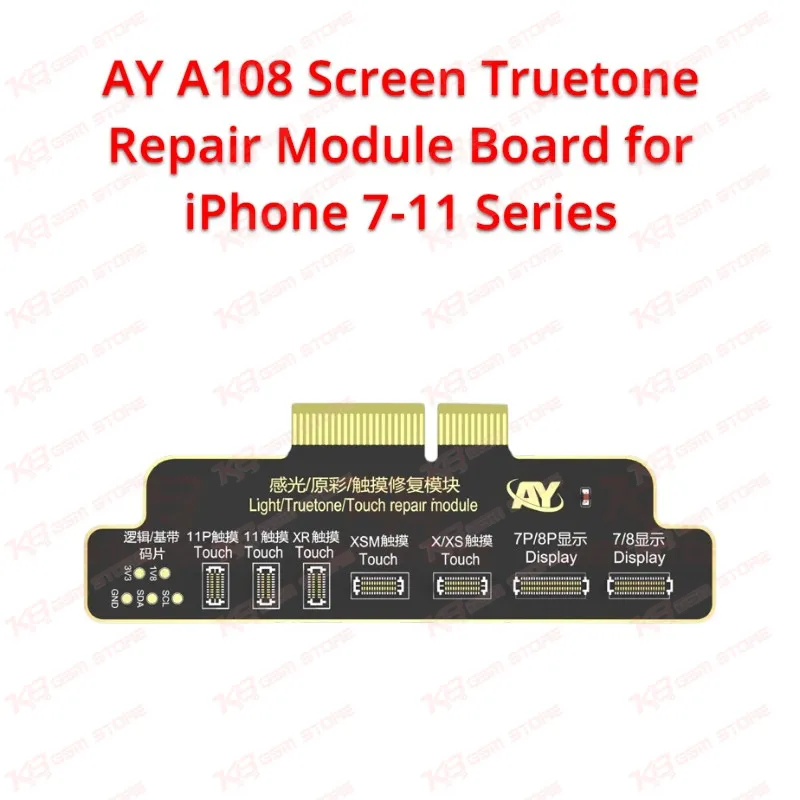
Every technician who handles iPhone screen replacements on the 7, 7 Plus, 8, 8 Plus, X, XR, XS, XS Max, 11, 11 Pro, and 11 Pro Max knows the pattern: the new glass fits, the digitizer responds, but True Tone drops out, the screen stops adjusting brightness on its own under changing light, or the touch layer goes unresponsive in patches. Apple ties display calibration data to the paired logic board, so a straight panel swap without re-pairing that data almost always triggers this exact display problem. The AY A108 Screen Truetone Repair Module Board exists to close that gap. It plugs directly into the AY A108 host device (sold separately, not included with this module) and gives the host the hardware bridge it needs to read, write, and repair the true tone and light sensor calibration data on 7-11 series boards. You connect the module to the target device, launch the corresponding function inside the AYRepair software on your A108 box, and let the tool pull the stored calibration profile back onto the new screen assembly. There is no soldering step in this workflow and no need to transplant a coating chip between the old and new screens, which keeps the repair fast and keeps the original display glass intact for reuse or resale. Technicians who have been stuck manually swapping the true tone chip under a microscope, or explaining to a customer why the replacement screen looks slightly dim or yellow-shifted compared to the original, get a cleaner fix path with this board: connect, run the function, verify the light sensor responds correctly, and hand the phone back with a matched display. This module fits directly into the standard mobile repair workflow at the diagnostics and post-repair verification stage. After a screen replacement job, once the digitizer and glass are confirmed working, the technician checks True Tone and auto-brightness behavior. If either is missing or behaving incorrectly, the board goes onto the A108 host, the correct function loads for the connected model range, and the calibration write runs. Because the module is scoped specifically to the 7-11 series, it keeps its function set narrow and reliable rather than trying to cover chipset families the A108 platform handles through separate modules for the 12-13 series or later Face ID and battery repairs. That separation matters on a busy repair bench, since a wrong module for the wrong device generation is one of the more common causes of failed true tone writes reported by technicians using dot matrix and true tone repair boxes. For a Pakistani repair shop or service center running steady iPhone screen replacement volume, this module turns a true tone or light sensor complaint from a return visit or a customer dispute into a same-session fix. It also protects margin on screen jobs: instead of writing off a panel because true tone will not calibrate, or downgrading the customer to a cheaper aftermarket screen with no true tone support at all, the shop can offer a proper calibrated repair using parts already on hand. Compact and lightweight, the board is built to sit in a drawer or tray next to the A108 host and other repair modules without taking up bench space, and it connects the same way each time, so junior technicians can be trained on the true tone repair step quickly once the host device and workflow are already familiar to the shop.