


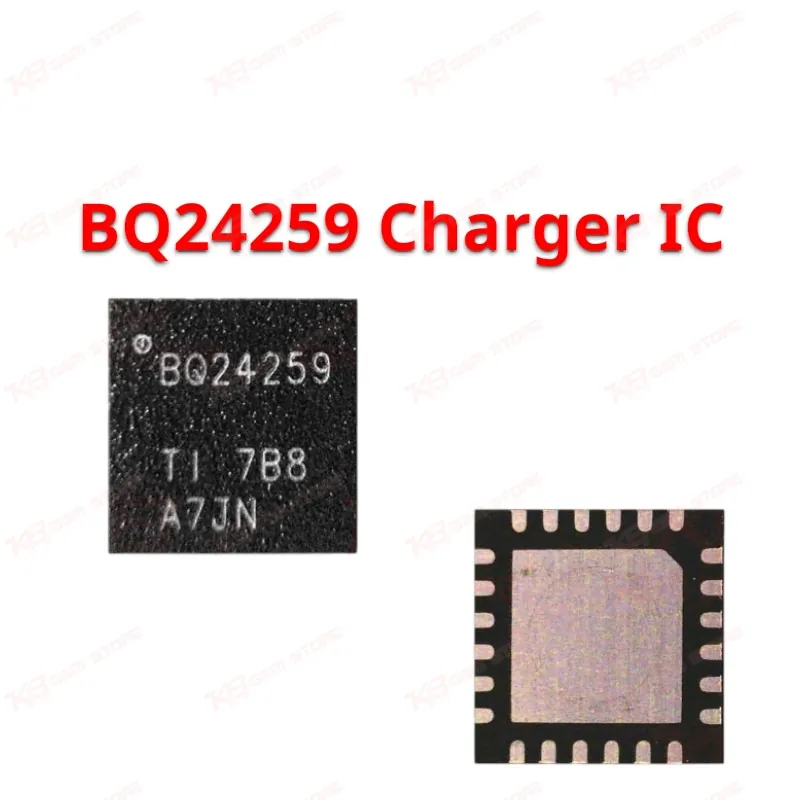
BQ24259 Charger IC
BQ24259 Charger IC
Regular price
Rs.350.00 PKR
Regular price
Sale price
Rs.350.00 PKR
Shipping calculated at checkout.
Quantity
Couldn't load pickup availability
The BQ24259 is a Texas Instruments I2C-controlled single-cell Li-Ion/Li-Polymer battery charger IC with integrated power path management, built for smartphone and tablet charging circuits. It handles input current limiting, charge current regulation up to 2A, thermal protection, and USB OTG boost operation on a single 24-pin VQFN chip. Widely used across Xiaomi, Motorola, Infinix, and Tecno charging boards, this IC gives repair technicians a direct fix for dead charging, no-power, and slow-charging faults. Genuine, tested stock available for professional mobile repair use at KB GSM Store.
⚖️ Weight: 0.01 kg
SKU:MST-IC-129
- Safe & Secure Payment
- Fast Delivery
- WhatsApp Support


Description
FAQ
What is the product name?
The product name is BQ24259 Charging IC.
What is the brand of this product?
The brand of this product is Texas Instruments.
What is the model of this product?
The model of this product is BQ24259.
What is this product used for?
This product is used for managing single-cell Li-Ion and Li-Polymer battery charging and power path control in smartphones.
Which devices are compatible with this product?
This product is compatible with Xiaomi Redmi 5A and MI5A, Motorola E4 and XT1663, Motorola Moto M, Infinix Hot 5 and Hot 6, and Tecno Camon CX Air, L8 Lite, and Spark Plus K9.
Who should use this product?
This product is suitable for mobile repair technicians, repair shops, service centers, and professional users.
What is the maximum charge current supported by the BQ24259?
The BQ24259 supports a maximum charge current of 2A through its I2C-controlled switch-mode architecture.
Does the BQ24259 protect against overvoltage input from a bad charger?
Yes, the BQ24259 includes 6.4V input overvoltage protection to guard the charging circuit from damaged or non-standard adapters.