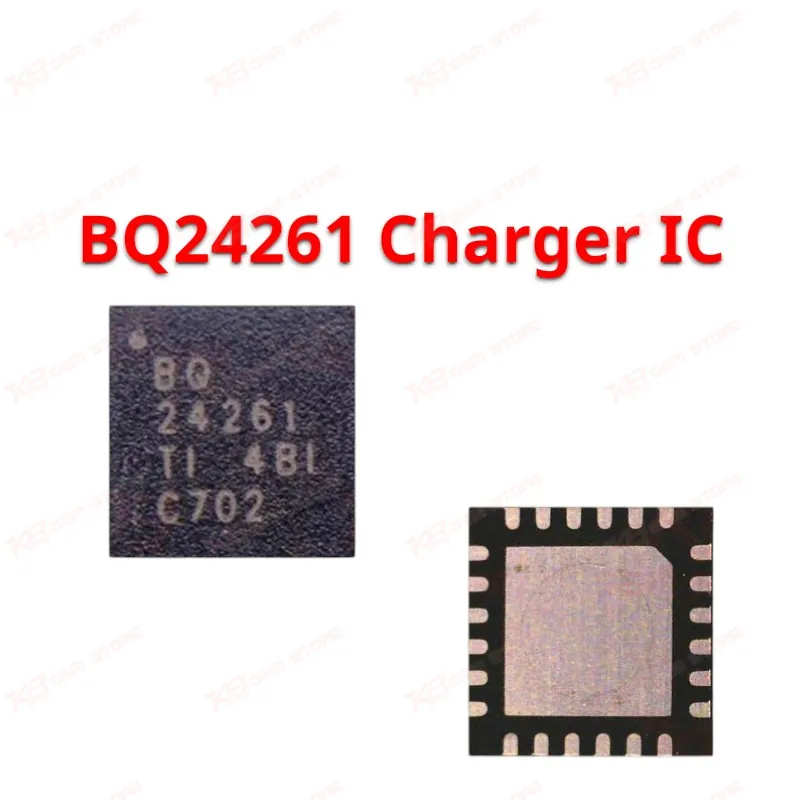
The BQ24261 is a switch-mode single-cell Li-Ion and Li-Polymer battery charger IC from Texas Instruments, built around a buck-topology charging architecture with integrated power-path management. On a repair bench, this chip sits at the center of the charging and power delivery circuit, controlling how input power gets converted, regulated, and routed to the battery and system rail simultaneously.Power-path management is the core function that matters most for board repair work. Instead of charging the battery first and then powering the system from it, the BQ24261 splits input power so the system runs directly from the input source while the battery charges in parallel. This setup allows a board to power up and boot even with a deeply discharged or completely dead battery connected, which is exactly the scenario technicians encounter with dead-after-flash boards or devices that show no response despite a fresh battery being installed. The integrated 17mΩ power-path MOSFET keeps voltage drop low during this process, so system rails stay stable under load.Charging performance on this IC reaches up to 3A of programmable charge current with 5% accuracy and 93% peak efficiency, controlled through an I2C interface rather than fixed analog pins. That means the host processor sets charge current, termination voltage, and input current limits dynamically, which is why a faulty BQ24261 often shows up as a board that detects charging voltage on the connector but never actually ramps up current into the battery — a classic "charging issue" or "charging not increasing" complaint technicians see daily. Battery charge voltage regulation runs between 3.5V and 4.44V, covering standard single-cell Li-Ion chemistry with room for fast-charge voltage profiles.Input tolerance is a practical strength for repair work. The IC carries a 30V absolute maximum input rating with built-in overvoltage protection, and it operates normally across a 4.2V to 13.2V input range. This wide margin protects the charging circuit against voltage spikes from damaged chargers, bad cables, or reversed polarity mistakes on the bench — a common cause of secondary board damage after a charging port repair. USB-OTG boost capability lets the same IC reverse direction and supply 5V at 1A out through the input pin, supporting USB host/OTG functionality on devices that use this feature.For technicians running IC change and reballing work, the BQ24261 comes in two package options: a 24-pin VQFN measuring 4mm x 4mm, and a 36-pin DSBGA at 2.6mm x 1.6mm. The VQFN package is the more practical choice for hot air rework and manual reballing since its larger pitch and exposed pad make hand soldering and hot air removal more manageable compared to the fine-pitch DSBGA variant, which typically needs a reflow station or precision hot air control.Common failure symptoms tied to this class of charger IC include boards that show a charging icon but don't accumulate percentage, boards that only charge when powered off, boards stuck in a boot loop when connected to a charger, and hang-on-logo issues triggered by unstable power-path switching. Before committing to an IC change, technicians typically confirm the fault isn't a bad connector, damaged trace, or dry solder joint, since power management ICs get replaced far more often than necessary when the real fault sits elsewhere on the charging path.Thermal monitoring through a dedicated thermistor pin and JEITA-compliant temperature profiles add another protection layer, cutting or reducing charge current if battery temperature moves outside safe limits — relevant for boards where thermal sensing traces have also taken damage. Operating across -40°C to 85°C, the BQ24261 fits both bench-testing conditions and normal in-device operating ranges without derating concerns for typical Pakistani workshop environments.