Skip to product information
1 of 5

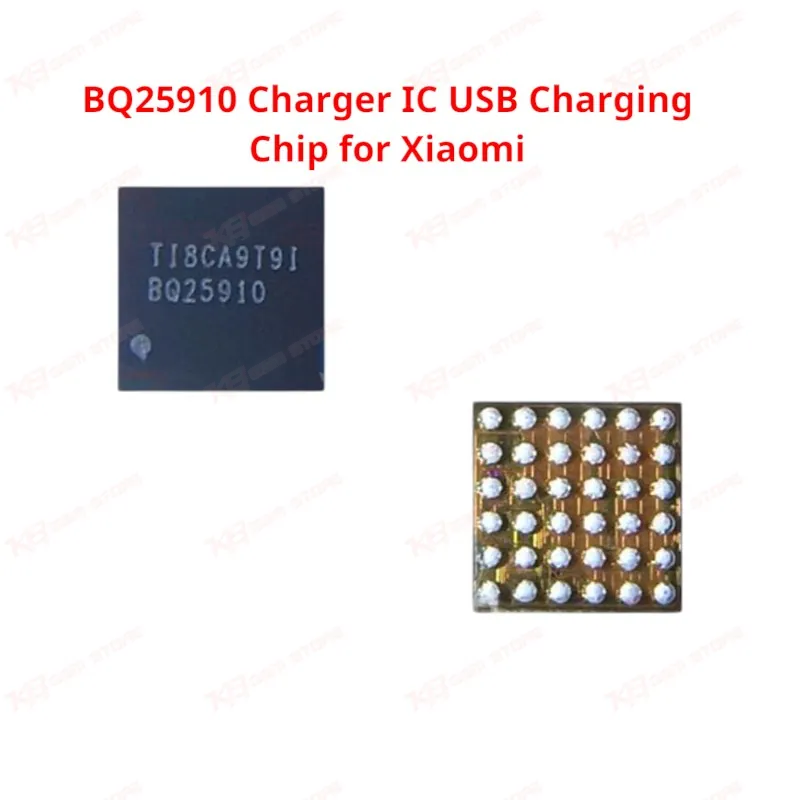
BQ25910 Charger IC USB Charging Chip for Xiaomi

BQ25910 Charger IC USB Charging Chip for Xiaomi

Regular price Rs.600.00 PKR
Regular price Sale price Rs.600.00 PKR
Sale Sold out
Shipping calculated at checkout.
Quantity

The BQ25910 is a Texas Instruments I2C-controlled three-level switch-mode charging IC built for single-cell Li-Ion and Li-Polymer batteries in a 36-ball DSBGA package. It supports up to 6A charge current and works in parallel/dual-charger configuration, a setup common on Xiaomi boards like the Mi 5A. Use it for dead-after-flash charging faults, no-charging complaints, or board-level charging IC replacement on your repair bench. Genuine part number, sourced for technicians who need accurate charging IC replacements without guesswork.

⚖️ Weight: 0.01 kg

SKU:MST-IC-113

  • Safe & Secure Payment
  • Fast Delivery
  • WhatsApp Support
View full details

Description

If a Xiaomi board comes into your shop with a "not charging" or "dead after flash" complaint and the charging circuit tests faulty, the BQ25910 is often the chip you're chasing. Texas Instruments designed it as an I2C-controlled three-level switch-mode charger for single-cell Li-Ion, Li-Polymer, and LiFePO4 batteries, and Xiaomi uses it in a parallel charger setup — meaning it works alongside a primary charging IC to split the charging load and push higher current into the battery faster.On boards like the Mi 5A, you'll typically find the BQ25910 paired with ICs such as the BQ24259, BQ27426, or BQ24297. This parallel-charger arrangement is why Xiaomi phones from this generation can pull higher charge currents without one IC overheating — the load gets shared. If you're diagnosing a charging fault and see one of these companion ICs on the schematic, check the BQ25910 footprint too, since a failure in the parallel charger often shows up as slow charging, intermittent charging, or the phone charging only when the primary IC is under load.The chip supports input voltages from 3.9V to 14V, with a 20V absolute maximum rating, so it tolerates a wide swing in adapter voltage without immediate damage — useful when a technician is troubleshooting a board that's already been exposed to a bad charger or reversed polarity. Input current limit is programmable from 500mA to 3.6A in 100mA steps, letting the system throttle input based on what the USB port or adapter can actually deliver. On the output side, charge current tops out at 6A and battery charge voltage regulates between 3.5V and 4.775V, with ±0.4% charge voltage accuracy — tight enough that a board with a marginal charging IC often shows voltage regulation errors before it fails outright.Switching frequency runs at 750kHz using a three-level buck topology, which TI states delivers 95.4% charging efficiency at 1.5A from a 5V input and 93.3% at 3A from a 9V input. That efficiency matters on a real board because it means less heat dissipation around the charging circuit — so if you're seeing excessive heat near the charging IC area on a Xiaomi board, it's worth checking for a shorted or degraded BQ25910 rather than assuming it's normal operation.All the switching MOSFETs, current sensing, and loop compensation are integrated inside the chip, along with a reverse-blocking FET. That means there's no external sense resistor to worry about when you're doing continuity checks around the IC — if current sensing looks off, the fault is almost always on the chip itself rather than a discrete component nearby. Standby battery leakage stays under 10µA, so a phone that drains its battery unusually fast while off could point to a leaky charging IC on the parallel charger side.For board-level work, this IC comes into play during dead-after-flash recovery, no-power diagnosis, charging port repair follow-up (after ruling out the port itself), and general "charging issue" complaints where the primary IC tests fine but the board still won't pull full current. Reflow with proper hot air temperature control, use flux generously, and confirm ball alignment before reballing — the 36-ball DSBGA package is small and easy to shift during rework if you rush the jumper or don't stabilize the board first.Always confirm the exact IC marking against your board's schematic before ordering, since Xiaomi shares charging architectures across some models but not all. KB GSM Store stocks genuine BQ25910 units for technicians across Lahore, Karachi, and Islamabad who need a reliable source for board-level charging repairs without unverified or relabeled stock.

Key Features

I2C controlled three-level switch-mode buck charging architecture

Supports parallel/dual-charger configuration for higher charge current

6A maximum charge current for single-cell Li-Ion/Li-Polymer batteries

Wide 3.9V–14V input range with 20V absolute maximum rating

Programmable input current limit from 500mA to 3.6A

Up to 95.4% charging efficiency at 1.5A from 5V input

Integrated MOSFETs, current sensing, and loop compensation

Under 10µA standby battery leakage current

Specifications

Brand Entity Texas Instruments
Product Entity BQ25910 Charging IC
Technology Entity I2C Three-Level Switch-Mode Buck Charger
Compatible Device Entities Xiaomi Mi 5A, Xiaomi parallel-charger boards
Repair Process Entity Board-Level Charging IC Repair, Dead-After-Flash Recovery
Industry Entity Mobile Phone Repair, GSM Board-Level Repair Pakistan

Compatible Devices

Xiaomi Mi 5A (verified parallel-charger pairing); general compatibility scope covers Xiaomi boards using a dual/parallel charging IC architecture alongside companion ICs such as BQ24259, BQ27426, or BQ24297 — confirm exact model against board schematic before replacement.

Common Repair Uses

Dead-after-flash charging recovery, no-charging or slow-charging diagnosis on parallel-charger boards, charging IC replacement after board-level short, overheating charging circuit repair, standby battery drain troubleshooting.

FAQ

What is the product name?
The product name is BQ25910 Charger IC USB Charging Chip for Xiaomi.
What is the brand of this product?
The brand of this product is Texas Instruments.
What is the model of this product?
The model of this product is BQ25910 (BQ25910YFFR / BQ25910YFFT).
What is this product used for?
This product is used for board-level charging repair on Xiaomi phones with charging faults, including dead-after-flash boards and slow or no-charging complaints.
Which devices are compatible with this product?
This product is verified for use on the Xiaomi Mi 5A and general Xiaomi boards built with a dual/parallel charging IC architecture.
Who should use this product?
This product is suitable for mobile repair technicians, repair shops, service centers, and professional users.
What is the maximum charging current the BQ25910 supports?
The BQ25910 supports a maximum charge current of 6A in parallel charger configuration.
Does the BQ25910 work as a standalone charger or does it need a companion IC?
The BQ25910 operates as a parallel/slave charger and works alongside a primary charging IC such as the BQ24259 or BQ24297 on the same board.

Ask any Query