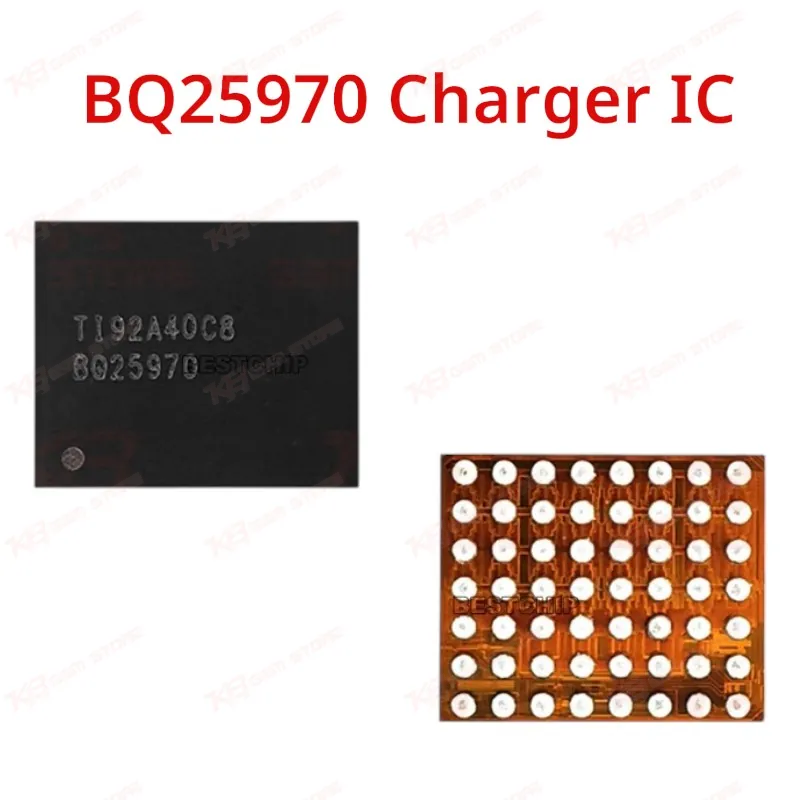
When a VIVO X23, X23A, NEX, or X27 comes into your workshop charging slow, not charging at all, or refusing to enter fast-charge mode even with a good cable and adapter, the fault usually traces back to the BQ25970 on the board — not the charging port or the battery. This chip is the switched-cap fast charger IC that manages how power moves from the USB input to the battery, and once it degrades or takes moisture damage, the phone loses its flash-charge capability even though the charging circuit still looks intact on a basic continuity check.The BQ25970 works differently from a standard buck-converter charger IC. Instead of stepping down voltage in one stage, it uses a switched-capacitor 2:1 architecture: input voltage runs at roughly double the battery voltage, and the IC converts that down while doubling the output current. This halves the current running through the charging cable and connector for the same power delivered to the battery, which is why flash-charge phones stay cooler at the cable and port during fast charging. Texas Instruments rates this conversion at 97% efficiency, so very little energy gets wasted as heat inside the board itself.For board-level repair, this matters because a faulty BQ25970 often shows up as a phone that charges fine on a basic 5V charger but never reaches full fast-charge current, or a phone that shows a charging icon with no actual current draw. On the bench, you'll typically confirm the fault with a current-supply test: connect the board to a DC power supply on the battery line, then check current draw and IC temperature when a fast-charge source is applied. If the IC runs hot immediately or the board pulls no fast-charge current at all, IC change is the fix rather than jumper lagana on the charging port tracks.The BQ25970 includes a 12-bit effective ADC that continuously reads bus voltage, bus current, output voltage, battery voltage, battery current, bus temperature, battery temperature, and die temperature. On a working board, this data feeds back to the main PMIC and charging management software to regulate the charge profile — which is also why software marna or a factory reset rarely fixes a charging issue if the IC itself has failed. Protection circuitry on the chip covers input over-voltage, input over-current, output over-voltage, battery over-voltage, and battery over-current, with an external OVP FET path rated up to 17V input protection on this specific part number (this feature is unique to the BQ25970 variant, not shared with the BQ25971 sibling part).For the rework itself, this IC ships in a 56-ball DSBGA package on a 3 mm x 3.6 mm footprint, so you'll want a fine-pitch hot air nozzle, a stencil sized for this footprint, and a preheat station to protect surrounding components on a densely packed board like the X23 or NEX. Reball with low-temperature solder paste matched to the board's other BGA components, and confirm ball alignment under a microscope before reflow — a bridged or lifted ball on a 56-ball part this small is a common cause of a "fixed" board that still won't fast charge.Store this IC in an anti-static tray or ESD bag until use, since the ADC and protection circuitry are sensitive to static discharge during handling. Matched against the original part marking and sourced for VIVO X23, X23A, NEX, and X27 board compatibility, this chip gives you a direct like-for-like replacement without altering the phone's original charging behavior or fast-charge speed.