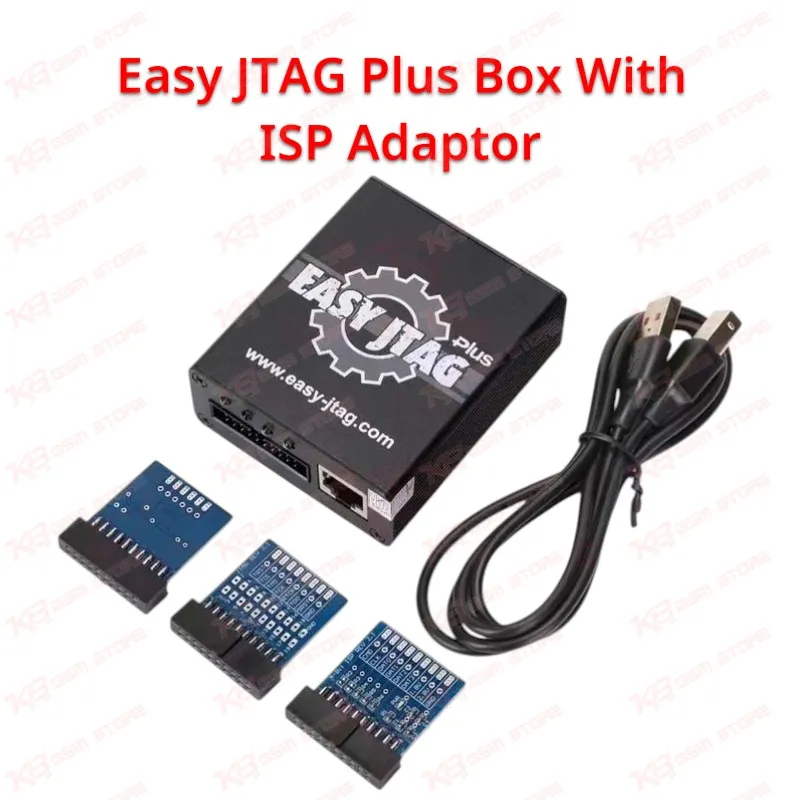
Every eMMC and JTAG repair job comes down to one question: can the tool talk to the chip reliably, and can the software do something useful once it's connected? The Easy-JTAG Plus Box with ISP Adaptor answers both. On the hardware side, it runs a SAM3X8E host controller paired with a Xilinx Spartan6 FPGA core, giving it enough processing headroom to handle eMMC, JTAG, ISP, SPI, NAND, and UFS 2.0/2.1 protocols from a single interface instead of forcing a technician to juggle separate boxes for each memory type. The USB 2.0 High Speed host interface pushes data at up to 480 Mbps between the box and the PC, and the eMMC socket interface itself moves data at up to 30 MB/s over an 8-bit bus, which keeps full chip reads and writes from becoming a coffee-break task. The integrated ISP engine, branded as the Z3X High Power Pro Engine, supports both 1-bit and 4-bit ISP connections, and the included ISP soldering adaptor covers the direct-to-board scenario: when a phone's eMMC chip is inaccessible through a socket or the board layout doesn't allow standard adapter seating, the technician solders directly to the ISP test points and programs the chip in place. This matters most on dead-after-flash cases and units stuck with a boot loop issue, where the eMMC partition table or bootloader needs a direct rewrite rather than a software-only fix. The JTAG side runs through an ARM 20-pin industry standard connector, and the box's built-in pinout finder scans and identifies JTAG connections automatically, which saves real time on unfamiliar boards where the pinout isn't already documented. Supported core architectures span ARM7, ARM9, ARM11, PXA3xx, PXA270, Cortex-A8, Cortex-A9 dual-core, and OMAP850, giving JTAG-level access to a wide range of the processors found in Android hardware from MediaTek and Qualcomm-based devices, along with older Samsung Exynos platforms. Voltage handling covers a custom selectable range of roughly 1.8V to 3.8V, so the box adjusts to the chip's actual operating voltage instead of forcing a fixed level that risks damaging sensitive memory. On the power management side, VCC and VCCQ lines run through overcurrent-protected switching, and the box draws its primary power from USB with an optional micro-USB port available when a board needs additional current during programming, reducing the chance of a brownout mid-write on a demanding job. For SPI work, the integrated engine clocks up to 21 MHz, covering the flash ICs commonly found on Android and feature-phone boards. NAND support adds Apple PPN NAND compatibility on top of standard NAND operations, and the eMMC side includes a full Android file browser with JEDEC 5.1-compliant reconfiguration, so technicians aren't limited to raw read/write operations when they need to inspect or rebuild a partition structure. SD card operations round out the memory-handling side, covering read, write, erase, lock, and unlock functions on removable cards pulled from repair jobs. Software-wise, the box pairs with the Z3X Easy-JTAG Plus application and requires online activation, which is standard across the Z3X ecosystem and ties the box to genuine, supported firmware rather than an unlicensed clone build. Recommended PC specs are modest by today's standards: a 2GHz-class processor, 2GB of RAM, 1GB of free storage, and Windows 7 SP1, 8.1, or 10 in either 32-bit or 64-bit, meaning most repair-bench PCs already already meet the requirement without an upgrade. The package includes the Easy-JTAG Plus main hardware, a preactivated Z3X smart card, the ISP soldering adaptor set, a JTAG soldering connector, a USB A-to-B cable, and one year of access to the flash file support servers, so a technician isn't left hunting for firmware files after the first few jobs. In day-to-day use on a repair bench, this translates to a single box that handles a dead phone stuck on the boot logo, a unit with a display problem traced back to a corrupted eMMC partition, a device with a charging issue linked to power-rail faults on the board, or an FRP lock case that needs a partition-level fix rather than a software bypass. Compared to running separate JTAG and eMMC tools, the combined protocol support cuts down the number of devices sitting on the bench and reduces the back-and-forth of moving a board between different programmers mid-repair.