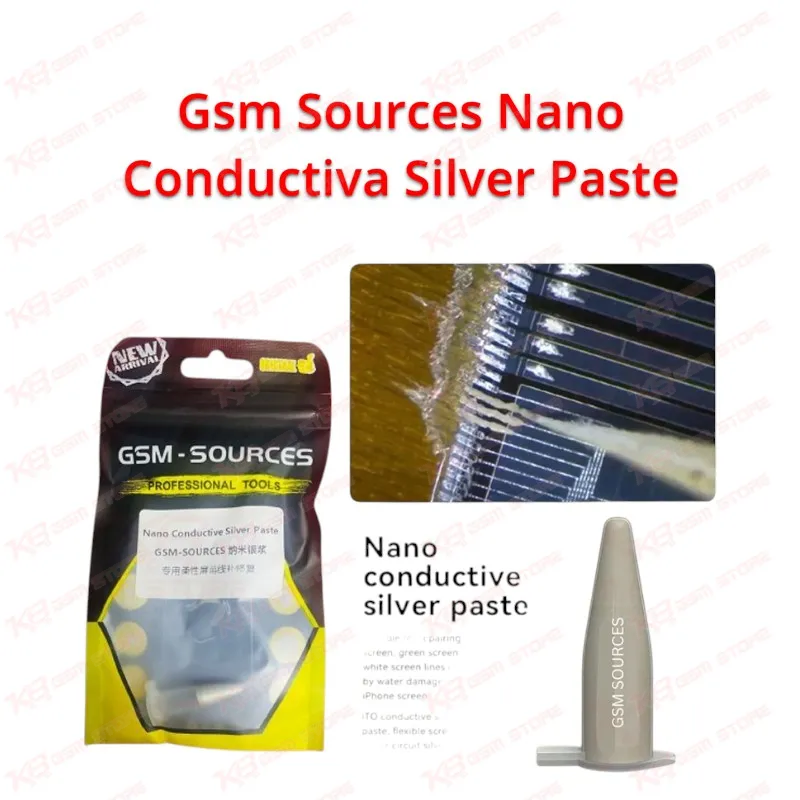
When a phone takes water damage, the first place it usually shows up is the display, and a Pakistani technician will recognize it instantly as a yellow line, green line, or white line running across the screen even though the panel itself is fine. That fault sits in the ITO flex circuit, where corrosion or moisture eats through a microscopic conductive track, and once that track breaks the signal has nowhere to go. GSM Sources Nano Conductive Silver Paste exists to rebuild exactly that track, using silver particles refined down to nano and micron scale so the paste can flow into a line thinner than a human hair without spilling onto the tracks beside it. You dip the tip of the applicator or a fine brush into the paste, trace it directly over the broken ITO line under a microscope, and let it cure with a hot air gun on low heat or a UV lamp depending on your bench setup. Once cured, the silver particles knit together into a single continuous path, and the display line disappears because current is flowing through the trace again instead of stopping at the break. The particle size under 0.3 microns matters more than it sounds — a coarser paste will short two adjacent tracks together and turn a single line fault into a screen that will not turn on at all, so the fine grain here is what keeps the repair safe on today's high-density flex circuits. The solid content sitting near 80% means you are not fighting a runny compound that spreads past where you place it; it holds its shape on the flex until you cure it, which gives you control when you are working a track that sits a few millimeters from a dozen others. Adhesion is strong enough to survive normal handling and reassembly, so once the repair is cured and the display is boxed back up, the fix holds through daily use rather than failing again in a week. This is not a general-purpose flux or solder paste — it is a dedicated ITO conductive repair compound, and it belongs in the same drawer as your OCA glue and polarizer sheets rather than with your soldering consumables. On a repair bench that takes in a steady stream of dead after water phones, this paste turns what used to be an automatic LCD replacement into a same-day trace repair, which matters a lot when a client walks in with a hang on logo or a screen with color lines and does not want to pay for a full panel swap. It also has use beyond iPhone screens: any flexible ITO circuit or fine conductive trace on a flex cable, sensor, or thin-film component can be repaired the same way, wherever a physical break in a printed conductive line needs to be closed rather than replaced. Keep the tip sealed between uses since exposed silver paste dries out quickly, apply it in thin single passes rather than thick blobs, and always test continuity under magnification before closing up the device, because a rushed application is the most common reason this kind of repair comes back for rework.