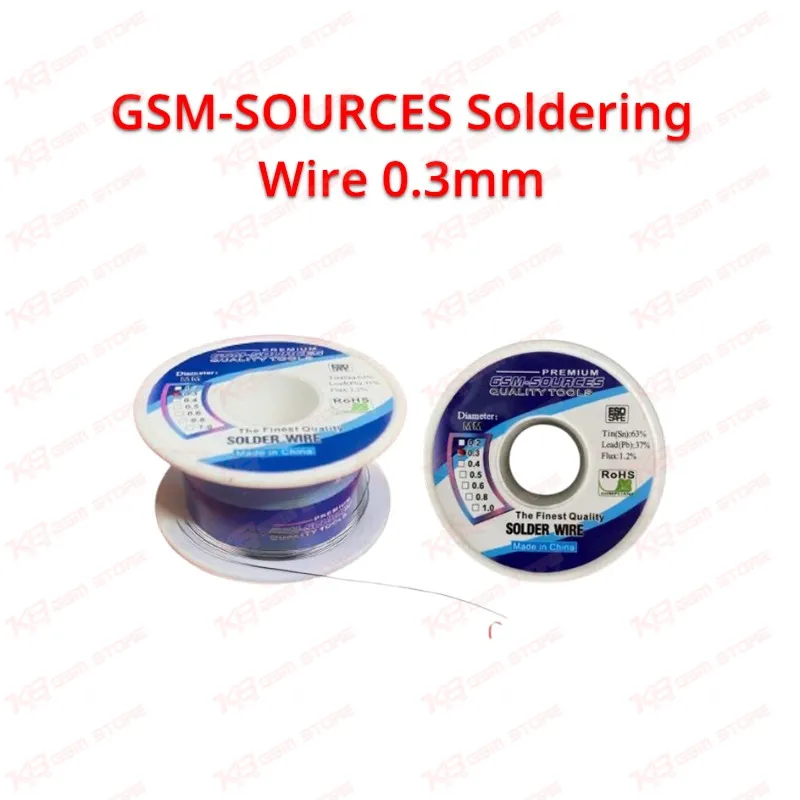
On a mobile repair bench, the solder wire you pick decides how clean your board work turns out, and GSM-SOURCES Soldering Wire 0.3mm is made for exactly that kind of precision. The 0.3mm diameter suits tight PCB pads, SMD points, and jumper lagana work where a thicker wire only floods the joint and bridges nearby tracks. High conductivity and high thermal conductivity let the wire melt fast and even the moment it touches a hot iron tip, so you're not sitting on a pad longer than needed and risking a lifted trace or a dead after flash board. That low melting point matters most when you're reworking a board that's already been through one bad repair attempt — you get a controlled melt instead of a temperature spike that damages nearby ICs or connectors. Solder-ability on this wire runs high, which shows up as smooth flow into the joint rather than balling up or resisting the pad, and that directly cuts the cold joints and re-touch work that slow down a busy workshop. Insulation resistance stays strong once the joint cools, which matters on boards packed with fine-pitch tracks where a weak joint turns into an intermittent hardware fault weeks later — the kind of complaint that brings a phone back to your counter with a charging issue or a hang on logo problem traced to a bad solder point. No spattering during application keeps flux and molten solder off nearby components, protecting ICs, connectors, and small SMD parts you're not currently working on. The non-corrosive, anti-oxidation, and anti-corrosion properties mean the finished joint doesn't degrade with humidity or age, so a board you repair today doesn't come back with the same fault six months on. Bright and full soldering points aren't just cosmetic — a bright, well-formed joint is your visual confirmation that the connection is solid, letting you inspect your own work at a glance instead of relying on a continuity test every time. This wire fits directly into common mobile repair workflows: reattaching a lifted IC leg after a jumper lagana job, resoldering a charging port or battery connector, fixing a broken trace during a board-level display problem repair, tacking down a jumper wire after a track cut for a network issue fix, or general component-level rework where a heavier gauge wire simply won't sit accurately. It's equally useful for desoldering work, where controlled melt flow helps you lift components cleanly without dragging pads off the board. At 50g per roll, it's sized for daily bench use rather than industrial production, so a technician or small repair shop gets enough wire for sustained work without paying for bulk they won't use before the roll oxidizes. Whether you're running IC repair, CPU reballing prep, PCB trace repair, or routine soldering and rework on customer boards, this diameter and wire quality slot into the fine, controlled end of your toolkit, sitting alongside your hot air station and soldering iron as one of the few consumables that directly affects whether a repair holds long-term or comes back as a repeat complaint.