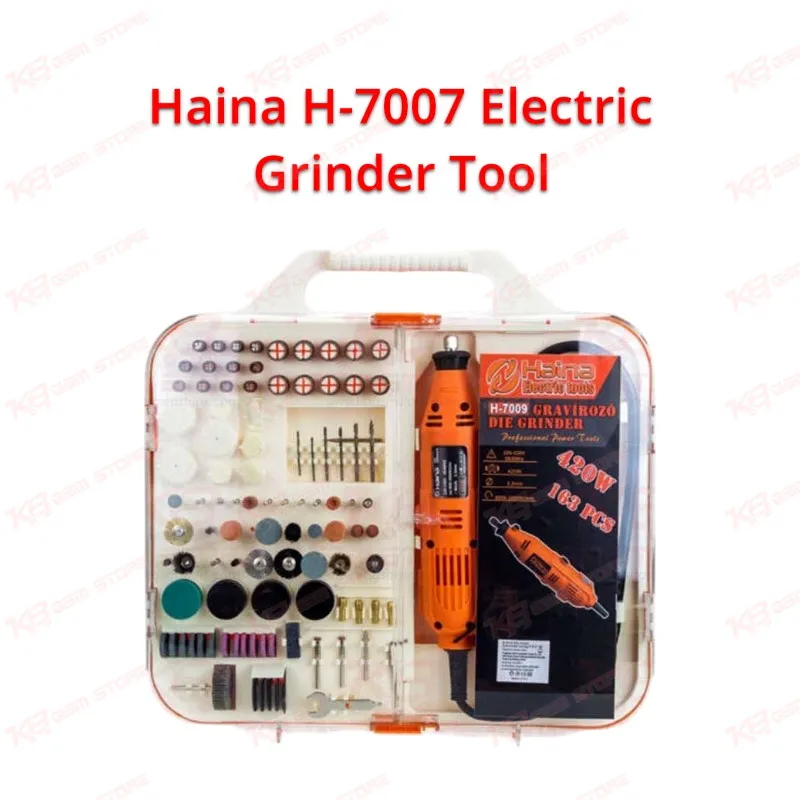
Every mobile repair bench eventually needs a dependable grinding tool, and the Haina H-7007 fills that gap without overcomplicating the job. It runs on a 180W motor rated for 220V-240V at 50-60Hz, which puts it comfortably within standard Pakistani household and workshop power supply. You get a no-load speed range of 8000 to 30000 r/min, so you control the cutting and grinding pressure instead of the tool controlling you. That range matters when you switch between rougher tasks like frame shaping and finer work like polishing a connector edge or cleaning up a board after IC change karna. The 3.2mm collet takes standard grinding, polishing, cutting, and engraving bits, which keeps your accessory costs low since most mobile repair tool kits already carry bits in that shank size. A flexible shaft comes with the set, and this is where the H-7007 earns its place on a technician's bench. Instead of holding the full motor body while working close to a board, you hold the lightweight pen-grip handpiece connected through the shaft, which gives you steadier hands during PCB trimming, mold removal, or shaping work around tight connectors and shields. Corded electric operation removes the usual downside of battery-powered rotary tools, where the motor loses torque as the charge drops. You plug in, and the speed stays consistent from the first minute to the last, which matters when you're grinding down a stubborn epoxy mold or cleaning corrosion off a board edge and can't afford a mid-job power dip. At 3.5kg, the unit sits solidly on a workbench without feeling like dead weight when you move it between stations. Repair shop owners running multiple technicians on one bench find this useful, since the tool doesn't need to be babied or recharged between users. On the workflow side, the H-7007 fits naturally into PCB repair, board cleaning, and reballing prep. Technicians use it to trim excess solder or flux residue around IC pads, shape connector housings that don't sit flush after a hardware fault, smooth chassis edges on a phone frame after a drop repair, and clean up board surfaces before reflow or hot air rework. It also works for general engraving and light polishing tasks that come up around a repair counter, from marking tool handles to cleaning oxidation off metal contacts. None of this requires software, firmware, or device-specific setup. It's a mechanical tool, so compatibility isn't about phone brands or chipsets; it's about the accessories you load into the 3.2mm collet. Standard grinding stones, polishing felts, cutting discs, and engraving tips all fit, which means your existing bit collection from other rotary tools likely works here too. For technicians who deal with dead phone chassis, damaged connectors, or board-level hardware fault repairs on a regular basis, having a variable-speed grinder on hand cuts down the need to send boards elsewhere for shaping or cleanup work. It's a tool that earns its keep on repetitive, hands-on repair tasks rather than sitting unused. The build keeps things straightforward: a corded motor unit, a flexible shaft attachment, and a 3.2mm collet chuck, all rated for continuous workshop use rather than occasional hobby projects. That's the practical value here, a grinder that does grinding, polishing, and light engraving reliably, without pulling you into accessories or setup you don't need for a repair bench.