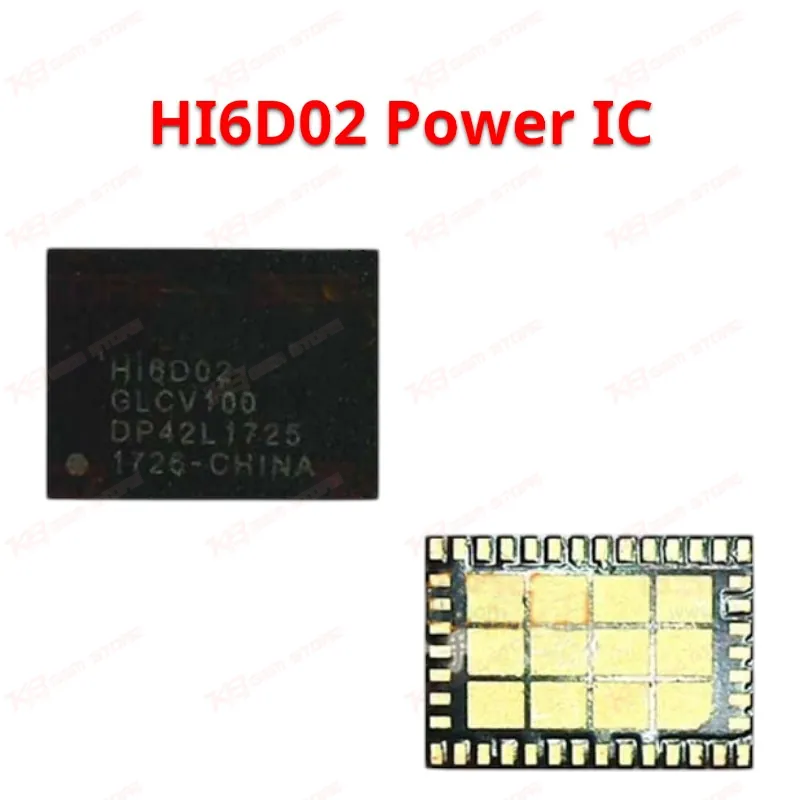
When a Huawei or Honor phone comes into your workshop with a signal problem — dropped calls, no network bars, or a "searching" status that never resolves — your diagnostic path often leads straight to the RF power amplifier stage on the board, and the HI6D02 sits right at that stage. Despite carrying "Power IC" in its trade name across most repair-parts catalogs, the HI6D02 is a HiSilicon RF Power Amplifier (PA) chip, built in a QFN42 package. Knowing this distinction matters at the bench: mixing up a PA chip with a PMIC wastes reflow time and risks damaging an unrelated section of the board.You'll find the HI6D02 referenced together with the HI6559 PA chip in supplier BOMs and part listings, which points to shared use on HiSilicon Kirin-based Huawei and Honor boards, particularly around the Honor Play and P20 series generation of devices. If your bench work already covers HiSilicon Kirin repair — Honor 8/9/10 series, P20/P30 series boards — the HI6D02 fits into that same RF signal chain you're already familiar with.On the repair bench, the HI6D02 comes into play when your diagnostics point to RF amplification failure rather than a cracked antenna connector or a loose flex. Typical symptoms include weak signal strength, intermittent network drops, no signal despite a working SIM and antenna, or a phone that only picks up signal in specific locations. Before you commit to an IC change, run your usual elimination checks: confirm the SIM tray and antenna connectors are seated, rule out a cracked antenna pad, and check continuity on the RF trace leading into the PA stage. Once you've isolated the fault to the amplifier itself, the HI6D02 gives you a direct chip-level fix instead of sending the board out or replacing the whole logic board.Handling the QFN42 package requires the same care you'd give any fine-pitch component on a repair bench. Use hot air with controlled temperature and consistent airflow, keep your nozzle size matched to the chip footprint to avoid disturbing neighboring components, and reflow with leaded or lead-free paste depending on your station's calibration. A stencil matched to the QFN42 footprint makes reballing and realignment far more reliable than freehand paste application, especially given how tightly packed RF sections tend to be on Huawei/Honor boards.Because this is board-level RF work, board markings and schematic verification should come before you order or install. Chip variants and revisions differ across Huawei/Honor board generations, and a mismatched PA chip can leave you with a phone that powers on but never finds signal. If you're not fully certain of the board revision, cross-check the marking on the existing chip against your schematic or distributor documentation first.For technicians running a HiSilicon-focused repair queue — Honor Play, P20 series, and related Kirin-chipset boards — the HI6D02 is a component worth stocking alongside your HI6559 and other Huawei PA/PMIC inventory. It's a targeted fix for a specific, recognizable failure pattern rather than a general-purpose part, which is exactly why accurate identification before ordering saves you a wasted reflow cycle.