


i2C C09 Digital Waveform Ammeter Voltage Measurement With Charge Detection
i2C C09 Digital Waveform Ammeter Voltage Measurement With Charge Detection
Regular price
Rs.19,000.00 PKR
Regular price
Sale price
Rs.19,000.00 PKR
Shipping calculated at checkout.
Quantity
Couldn't load pickup availability
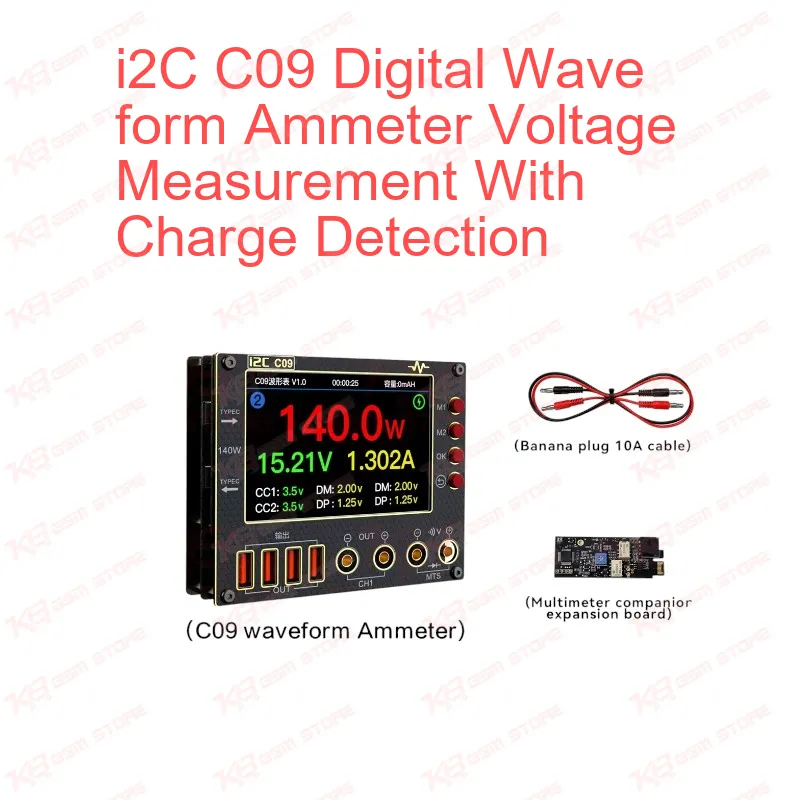
The i2C C09 Digital Waveform Ammeter gives technicians a dual-channel voltage and current testing solution built for board-level diagnostics on dead phones, charging faults, and power circuit issues. A 4.0-inch IPS high-brightness screen displays readings in pointer, curve, and digital modes, letting you catch millisecond-level voltage spikes that a standard multimeter misses. It handles 140W full-protocol charging power testing, ultra-high-speed diode scanning, and 0-24V positive/negative voltage measurement, covering both quick component checks and deep power-path analysis on a single repair bench tool.
SKU:MST-SOLDERING-ACCESSORIES-597
⚖️ Weight: 0.7 kg
- Safe & Secure Payment
- Fast Delivery
- WhatsApp Support



Description
FAQ
What is the product name?
The product name is i2C C09 Digital Waveform Ammeter with Charge Detection and Voltage Measurement.
What is the brand of this product?
The brand of this product is i2C.
What is the model of this product?
The model of this product is C09.
What is this product used for?
This product is used for board-level voltage and current diagnostics, charging power testing, and diode fault-finding on mobile phone motherboards and PCBs.
Which devices are compatible with this product?
This product works as a universal diagnostic tool for mobile phone motherboards and PCB power circuits, not tied to a specific brand or model.
Who should use this product?
This product is suitable for mobile repair technicians, repair shops, service centers, and professional users.
Does the i2C C09 support fast-charging protocol testing?
Yes, it supports full-protocol charging power testing up to 140W, covering common fast-charge standards used on modern phones.
Can the i2C C09 detect a short circuit on a dead phone board?
Yes, its dual-channel current and diode scanning functions identify abnormal current draw and shorted components on the 0~40V and 0~2.8V test ranges.