Skip to product information
1 of 5
Brand: JCID

i2C MC14 Face ID Repair Instrument For iPhone X to 14Pro Max

i2C MC14 Face ID Repair Instrument For iPhone X to 14Pro Max

Regular price Rs.6,500.00 PKR
Regular price Sale price Rs.6,500.00 PKR
Sale Sold out
Shipping calculated at checkout.
Quantity

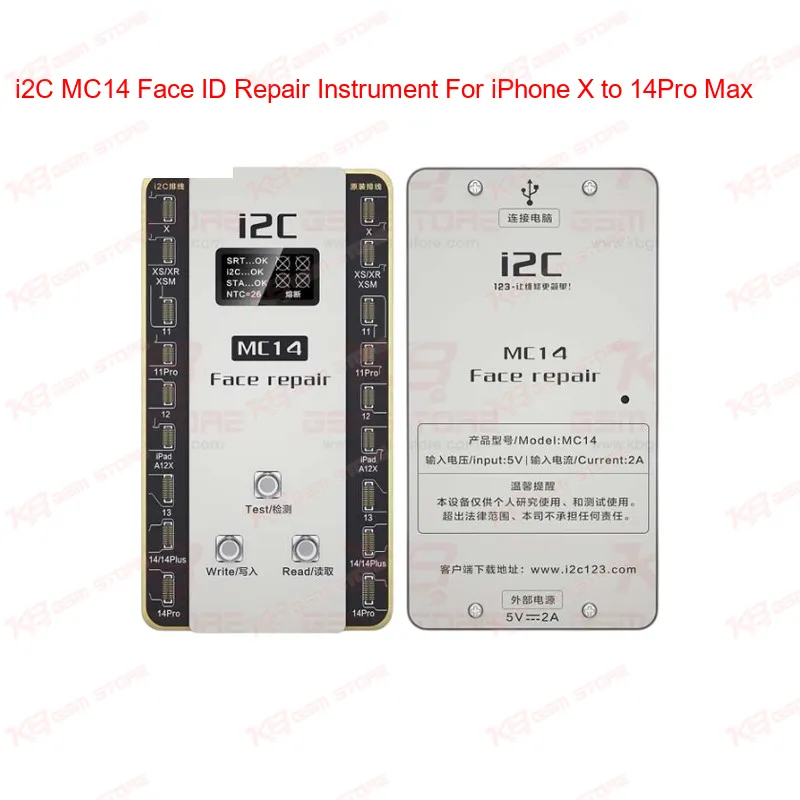
The i2C MC14 gives your repair bench a soldering-free way to fix Face ID dot matrix faults on iPhone X through 14 Pro Max, plus iPad Pro 3rd and 4th generation. You get one-key detection, activation, and read/write on the dot matrix module without touching a soldering iron. The double-row connector avoids foot conflict, so technicians handle the flex cable without alignment guesswork. Built for dead-after-repair Face ID cases, moving high/low sensing faults, and deep-feeling errors, the MC14 works with both external and built-in dot matrix cables. It's a practical addition for any GSM shop that handles frequent Face ID complaints.

SKU:MST-FLASHING-DEVICE-14

⚖️ Weight: 0.35 kg

  • Safe & Secure Payment
  • Fast Delivery
  • WhatsApp Support
View full details

Face ID failures rank among the trickiest complaints a repair shop deals with — a customer opens the phone for a screen or battery job, reassembles it, and Face ID stops working. The i2C MC14 exists specifically for this scenario. It targets dot matrix fuse faults, the kind that show up as "face moving high and low" errors or deep-sensing failures after a board-level repair or a dot matrix cable swap. What separates the MC14 from a soldering-based fix is the split, one-key repair method. You connect the external dot matrix cable alongside the original cable at the same time, and the device handles detection, activation, reading, and writing in a single automated pass. There's no disassembly of the dot matrix chip itself, no short-circuit risk from a shaky solder joint, and no manual pin alignment. For a technician running several Face ID jobs a day, that timing difference matters — what used to be a soldering job with real risk of a dead sensor becomes a plug-and-run procedure. The double-row connector is a genuine upgrade over older single-row designs. Foot conflict — where adjacent pins interfere with each other during connection — was a common source of failed reads on earlier tools. The redesigned connector reduces that failure point, which means fewer repeat attempts and less time spent troubleshooting a bad connection instead of the actual fault. The MC14 supports three separate face maintenance paths: the external dot matrix cable, the original built-in cable, and the built-in dot matrix chip. That flexibility covers most real-world cases you'll see on the bench, whether the phone came in with a pre-existing cable issue or the fault sits deeper on the board. The activation process itself uses a low-pressure method, described by the manufacturer as non-destructive and traceless — there's no visible mark left on the connector after the job, which matters if the phone goes back to a customer who inspects the board. Software connectivity through the i2C mobile phone repair assistant adds cloud backup for dot matrix data and supports remote software upgrades, so the tool's capability isn't fixed to whatever ships in the box. As i2C adds device support or refines the activation algorithm, the update reaches your unit over the network rather than requiring a hardware swap. In a Pakistani repair shop context, this tool fits the gap between "dead Face ID after flash" and "Face ID hang after board repair." Technicians who currently outsource Face ID cases to a specialist shop or attempt a soldering-based dot matrix repair with mixed results get a faster, lower-risk option on their own bench. For shops handling iPhone X through 14 Pro Max volume, or iPad Pro 3rd/4th gen units, the MC14 covers the current generation range where dot matrix faults are most commonly reported.

Key Features

Split, one-key dot matrix repair without soldering

Simultaneous connection of external and original dot matrix cable

Automated detection, activation, read, and write in one pass

Upgraded double-row connector reduces foot conflict

No welding or short-circuit risk during connection

Low-pressure, non-destructive, traceless activation process

Support for 3 face maintenance methods: external cable, built-in cable, built-in chip

Cloud backup and remote software upgrade via i2C repair assistant

Specifications

Brand Entity i2C
Product Entity MC14 Face ID Dot Matrix Repair Instrument
Technology Entity Dot Matrix Activation and Read/Write Technology
Compatible Device Entities iPhone X–14 Pro Max, iPad Pro 3/4 Series
Repair Process Entity Face ID Repair, Dot Matrix Fault Correction
Industry Entity Mobile Phone Repair, GSM Technician Tools

Compatible Devices

iPhone X through iPhone 14 Pro Max, and iPad Pro 3rd/4th generation — verified device-specific compatibility per manufacturer listing.

Common Repair Uses

Face ID dot matrix fault repair, dot matrix cable activation and read/write, face-moving high/low sensing fault correction, deep-feeling sensor error repair, post-disassembly Face ID recovery after screen or logic board work.

FAQ

What is the product name?
The product name is i2C MC14 Face ID Repair Instrument for iPhone X to 14 Pro Max.
What is the brand of this product?
The brand of this product is i2C.
What is the model of this product?
The model of this product is MC14.
What is this product used for?
This product is used for repairing Face ID dot matrix faults, including sensing errors and dead-after-repair Face ID issues.
Which devices are compatible with this product?
This product is compatible with iPhone X through iPhone 14 Pro Max, and iPad Pro 3rd/4th generation.
Who should use this product?
This product is suitable for mobile repair technicians, repair shops, service centers, and professional GSM technicians.
Does the MC14 require soldering to repair Face ID?
No, the MC14 uses a solder-free activation process, connecting the dot matrix cable directly without any welding or board-level soldering.
Can the MC14 fix Face ID after a board repair or dot matrix cable replacement?
Yes, it detects and repairs dot matrix fuse faults such as face moving high/low and deep-feeling errors that commonly appear after disassembly or cable replacement.