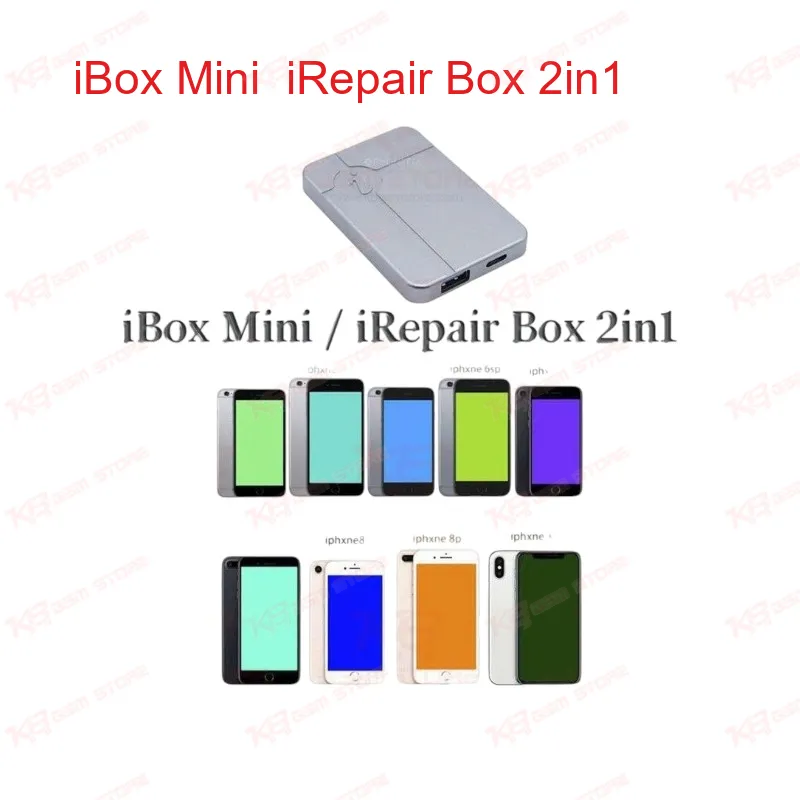
Every GSM technician knows the frustration of a WiFi IC change turning into a full NAND swap job. The iBox Mini / iRepair Box 2in1 exists to cut that step out completely. It's a DFU-mode programmer that talks directly to the iPhone or iPad's NAND controller through USB, letting you read and write SYSCFG data without lifting the chip off the board.How the box actually works on your benchYou plug the device into DFU mode with one click — no manual button combinations, no timing guesswork. Once connected, the tool pulls SYSCFG data: serial number, Bluetooth address, WiFi MAC, device model, region/country code, and camera calibration records. If a phone comes in dead after flash, or the WiFi/Bluetooth stopped responding after an IC change, you write this data back without touching the NAND chip physically. For iPhone 8, 8 Plus, and X specifically, the box supports one-click WiFi data unpacking straight from NAND, which used to require desoldering.This matters most on jumper and IC-change jobs. Normally, swapping a WiFi/BT IC on a 7, 7 Plus, 8, 8 Plus, or X means the paired NAND data goes out of sync, forcing a NAND change too. With this box, you skip that — the IC change stays a board-level fix instead of turning into a full NAND replacement.Chipset and device coverageThe tool targets A7 through A11 chipset iOS devices. On the iPhone side that's the 7 and 7 Plus, 8 and 8 Plus, and X. On iPad, coverage extends across iPad 2/3/4/5, iPad Air and Air 2, iPad mini 2 through 6, and iPad Pro 10.5-inch and Pro 2nd generation 12.9-inch. If your shop handles a steady mix of these models — which most Pakistani repair shops still do, given how many are in active circulation — this single box covers a large chunk of your DFU and NAND-data workload.Software sideThe software runs on Windows 7, 8, and 10 (no Mac support), and the manufacturer pushes free upgrades so new model support and bug fixes land without buying new hardware. Given how often iOS repair tools go through firmware revisions, this upgrade path matters for a box you'll keep using for years.Where it fits in your repair workflowThink of this as your first stop before an ISP or CPU-level NAND job. A phone that's dead after flash, stuck at hang on logo, or showing a WiFi/network issue after board work doesn't automatically need a NAND change — check SYSCFG data through this box first. It sits between basic flashing tools and full ISP/EMMC-level programmers: lighter than a full rework station, but far more targeted than generic flash boxes, because it's built specifically around Apple's SYSCFG and DFU architecture.For a technician doing pattern unlock, FRP lock removal, or general software marna work on Android boxes, this tool won't help — it's iOS-only, DFU-specific. But for shops that do iPhone board repair, IC change, jumper lagana work, or NAND-related dead phone diagnostics, it earns a permanent spot on the bench next to your hot air station and multimeter.Build and handlingThe unit is built with an aluminium housing, keeping it light for repeated bench use and USB plug/unplug cycles without the casing wearing out. At roughly 0.1 KG, it's compact enough to keep in a toolbox without adding real weight to a mobile repair kit.Practical value for a Pakistan repair shopBoard-level iPhone repair is a steady revenue stream for service centers here, and NAND removal always carries risk — lifted pads, cracked chips, dead boards. Cutting that risk out on WiFi IC and dead-after-flash jobs directly protects your margin on each repair, since a botched NAND swap turns a paid job into a warranty loss. This box pays for itself the first time it saves you from an unnecessary NAND removal.