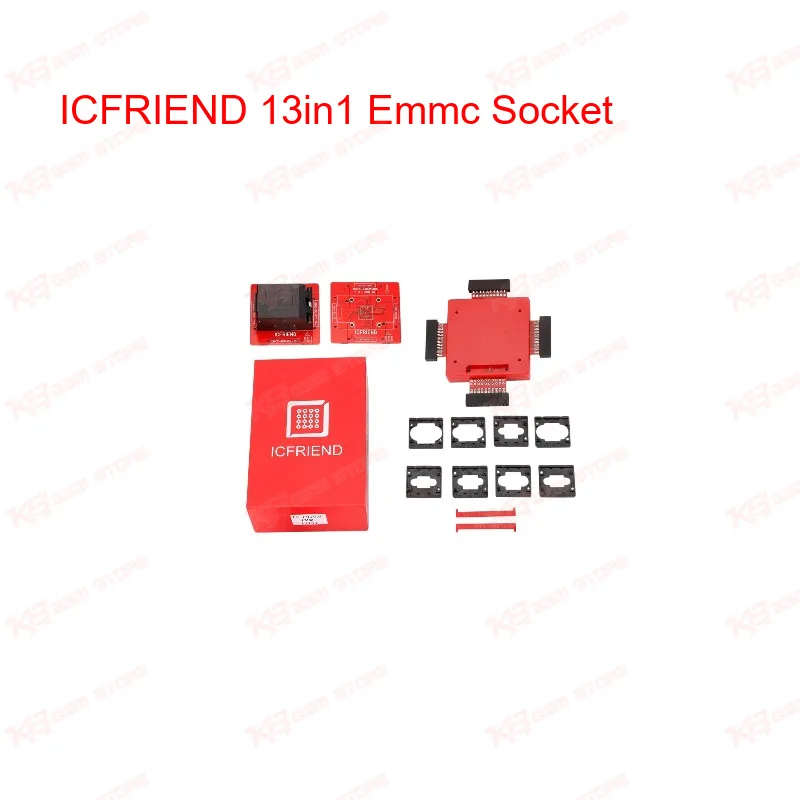
When a phone comes into your workshop completely dead after flash, or stuck in a boot loop that software tools cannot touch, the eMMC chip is often where the real problem lives. The ICFRIEND E-Mate X 13-in-1 BGA Socket Adapter puts that chip within direct reach. Instead of desoldering the eMMC and risking pad damage on a board you may need to return intact, you land the chip into the correct socket and let your box handle the read/write operation directly. This kit is not a single adapter — it is a full socket system. You get a 9-in-1 socket adapter covering EMCP-BGA-162/186, EMCP-BGA-254, EMCP-BGA-221, and EMCP-BGA-153/169 packages, a 4-in-1 socket adapter covering EMCP-BGA-168, EMCP-BGA-136, EMCP-BGA-529, and EMMC-BGA-100 packages, an EMMC-UFS NB2 adapter, and 9 individual flash memory adapters. Between them, the set handles chip footprints from 10x10mm up through 15x15mm, which means you are not buying a separate socket every time a new BGA size lands on your bench. Compatibility is where this adapter earns its place next to your existing tools. It works directly with Riff Box, Riff Box 2, Medusa Pro Box, Octoplus Pro Box, Z3X Easy JTAG Box, Z3X Easy JTAG Plus Box, UFI Box, eMMC Pro Tool, GPG eMMC Box, and ATF — so if your bench already runs one of these boxes, you plug this socket in and start reading chips without hunting for a matching adapter elsewhere. That range covers most of the eMMC-capable hardware technicians in Pakistan already own, whether you run a Z3X-based setup for FRP lock and pattern unlock work or a Medusa Pro box for deeper eMMC firmware repair. On the workshop floor, this socket earns its keep on the jobs that software-only tools cannot fix. A phone that is dead after flash, showing hang on logo, or stuck in a boot loop from corrupted partition tables often needs a direct chip read to diagnose or recover. Before you attempt a risky reflash or a board-level repair, pulling a full backup of the eMMC through this socket protects the customer's data and gives you a fallback if the repair goes wrong. For data recovery jobs — a customer's photos or contacts on a phone with a dead motherboard — this is often the only path left once the board itself will not boot. The socket design itself is built for repeat use rather than a single job. You can disassemble it, clean out debris, and replace the pin contacts when they wear down, which extends the working life of the adapter well beyond a fixed, sealed unit. That matters on a busy bench where the same socket sees dozens of chips a week across different device brands. Setup stays simple. There is no font or package type to manually select on most jobs — you seat the chip, select the corresponding adapter in your box software, and the read or write operation runs from there. That keeps the learning curve short for technicians who are comfortable with eMMC work but new to a specific box's software. If your repair shop handles chip-off data recovery, eMMC firmware repair, dead-after-flash cases, or backup-before-flash work as a regular part of your service menu, this socket adapter removes one of the biggest bottlenecks — chip compatibility — from that workflow. Pair it with an ISP pinout tool for board-level access and a hot air rework station for chip removal, and you have a complete eMMC service chain on one bench.