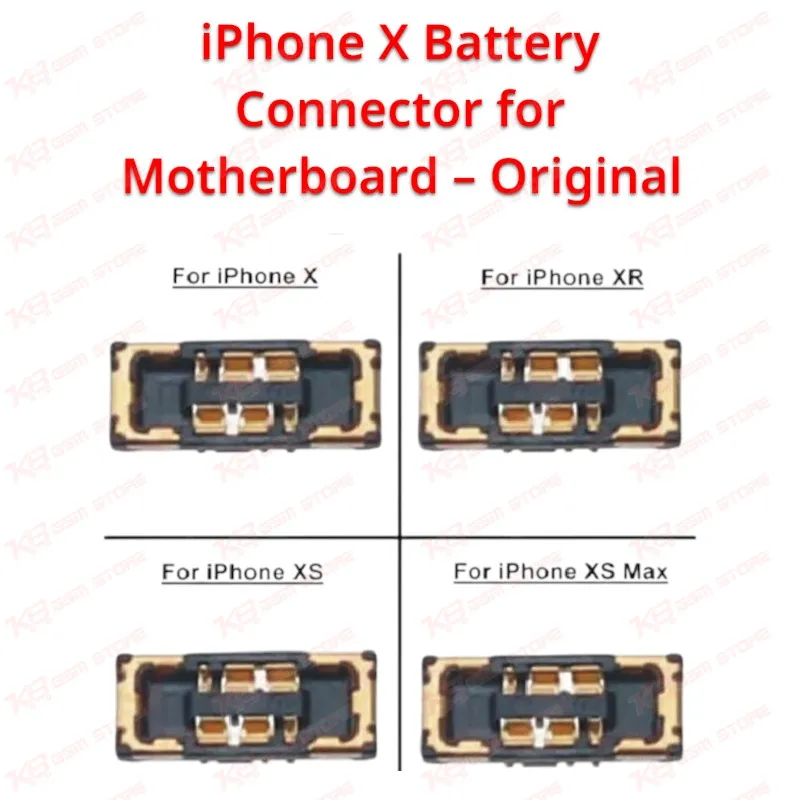
The battery connector on the iPhone X sits at board position J3200 and forms the only physical bridge between the battery flex cable and the logic board's power management circuit. When this 4-pin connector cracks, lifts, or loses one of its solder joints, technicians see a familiar pattern: the phone reports 0% charge even with a known-good battery installed, it restarts every few minutes without warning, or it only powers on when firm pressure is applied near the connector housing. These symptoms point directly to a broken solder connection rather than a battery fault, and swapping the battery alone will not resolve the issue. Board-level diagnosis starts by testing continuity across all four pins with a multimeter while gently flexing the board near the connector site, since a hairline crack often shows intermittent readings rather than a dead short or open circuit.Replacing this connector demands a hot air rework station set to a controlled temperature profile, fine tweezers, flux, and a steady hand, because the iPhone X logic board runs noticeably thin compared to earlier models. Heat applied at the connector site transfers quickly across the board, so nearby components including the CPU, NAND, and power management IC sit close enough to feel that same heat if the technician works without shielding or a focused nozzle. Preheating the board evenly before targeting the connector reduces thermal shock and lowers the risk of warping adjacent pads. Once the old connector lifts free, cleaning the pad thoroughly with flux and solder wick prepares a flat, oxide-free surface for the replacement part to seat correctly.Alignment matters more than speed during reinstallation. The four pins on this connector correspond to fixed pad positions on the J3200 footprint, and even a slight rotation or offset during placement leads to a cold joint or a bridged connection once reflowed. Technicians typically tack one corner pin first under magnification, confirm the part sits flush and square against the pads, then reflow the remaining pins under low airflow to avoid shifting the part. After reflow, a continuity check across each pin against the corresponding trace confirms a clean connection before the board goes back into the housing. Skipping this verification step is a common reason boards come back for a second repair, since a marginal joint may pass a quick power-on test but fail again within days under normal handling and battery flex movement.This connector fits the standard iPhone X battery FPC footprint and does not require any firmware or software matching, since it functions purely as a mechanical and electrical bridge rather than a paired component. It works alongside standard repair bench tools already common in most GSM workshops, so shops adding this part to their inventory do not need to invest in specialized equipment beyond what board-level battery repair already demands. Stocking this connector as a standard bench item shortens turnaround time on a repair category that otherwise sends boards out for external micro-soldering, letting shops close out dead-phone and no-charge cases in-house on the same day a customer drops off their device.