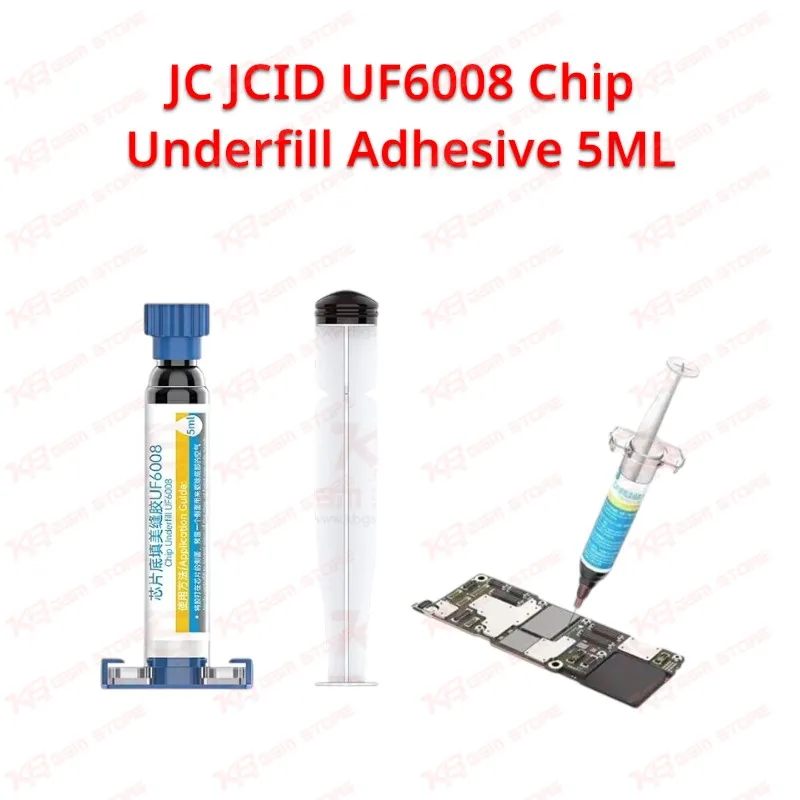
Every GSM technician who reballs a NAND, CPU, or PMIC chip knows the repair isn't finished the moment the board boots — the real test comes weeks later, when normal handling, drops, or thermal cycling put stress on that freshly resoldered joint and the phone comes back dead again. The JCID UF6008 Chip Underfill Adhesive exists specifically to close that gap in your workflow, and it does it at the chemistry level rather than by adding extra hardware to your bench. This is a black underfill compound made by Shenzhen JC Innovation Device Co., Ltd. (JCID), and its job is simple in concept but critical in effect: after you reball or resolder a NAND, CPU, or PMIC package onto a mobile phone motherboard, you run a thin bead of UF6008 along the edges of the chip while the board is still warm, and capillary action pulls it underneath the package within 1-3 minutes, spreading it evenly across the entire footprint of the BGA pads. Once the underfill has fully diffused, it cures on its own — 1 minute at 150°C or 5 minutes at 100°C — and hardens into a supportive layer that locks every solder ball in place, distributing mechanical stress across the whole chip instead of concentrating it on the outer row of balls, which is where cracked joints and cold solder failures usually start. This matters most on iPhone CPU and NAND rework, where board flex from drops is a leading cause of a phone going into boot loop or landing hang on logo weeks after a technician already fixed the original hardware fault, and it matters just as much on Android PMIC and power IC reballing, where a board that was dead after flash often turns out to have a hairline crack under a chip nobody thought to underfill. What sets UF6008 apart from generic epoxy or superglue fixes some technicians improvise with is that it stays reworkable — apply heat again, and the cured underfill softens instead of turning brittle or bonding permanently, so if you ever need to lift that same chip again for a repeat repair, you don't have to fight through a rock-hard glue layer or risk lifting pads while trying to chip it away. That reworkability is the difference between a professional repair process and a one-way bodge, and it's why UF6008 fits naturally into a proper board-level repair workflow: diagnose the fault, remove the damaged IC, reball it with matching solder balls, resolder it under a hot air station or BGA rework machine, then finish with underfill before the board goes back into the housing. In terms of where this sits in your repair bench setup, treat UF6008 as a companion product to your reballing stencils, flux paste, and hot air station rather than a standalone item — a technician who reballs NAND or CPU chips without underfilling them afterward is skipping a step that directly affects how long the repair actually holds, especially in Pakistan's repair market where phones get handled roughly and boards go through repeated heat cycles from multiple shop visits. The 5ML bottle size gives a small-to-medium repair shop months of use, since each application only needs a small bead around the chip perimeter, and storing it in a cool spot at room temperature keeps the compound from setting prematurely inside the bottle. For a shop that regularly handles iPhone board repair, Android PMIC change, or any job where a customer keeps coming back with the same dead phone symptom after an IC change, adding UF6008 to the reballing process is one of the simplest ways to reduce comeback repairs and build a reputation for repairs that actually hold.