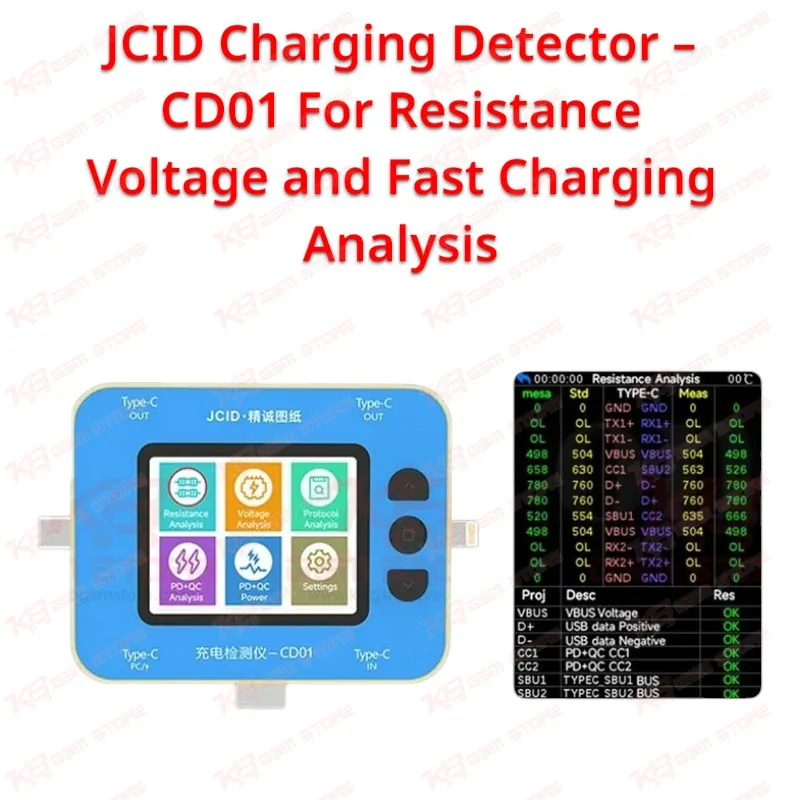
When a phone comes in with a charging issue, you usually have two options: strip the board down on a hunch, or measure first and open it only when you actually know where the fault sits. The JCID CD01 Charging Detector exists for the second option. It reads the resistance, voltage and current behavior of a charging port directly through the cable, so you get a diagnosis before you touch a screwdriver. One scanning port handles both Type-C and Lightning, which means the same unit covers your iPhone bench work and your Android bench work without swapping tools between jobs. The core of the CD01 is its online connection to JC Intelligent Drawing. Instead of relying on memorized "normal" resistance values, you pull up the reference schematic for that specific board and compare your live reading against it on the spot. When a value comes back out of range, you know immediately whether you're looking at a hardware fault on the charging IC, a damaged filter component, or a cable problem that has nothing to do with the phone at all. That distinction alone saves you from opening boards that didn't need opening, and it points you straight to the component when a board genuinely needs an IC change karna job. Fast charging diagnosis is where the CD01 earns its place on a technician's bench. It identifies PD, QC, FCP, SCP, VOOC, SuperVOOC, FlashCharge and SuperFlashCharge automatically, and it runs a protocol handshaking success check so you can tell a customer with certainty whether their phone is actually negotiating fast charge correctly or silently falling back to a slow charge rate. The real-time voltage monitor tracks D+, D-, CC1 and CC2 line status while the handshake happens, so instead of a pass/fail guess you watch the negotiation unfold on the 2.4-inch screen. That level of visibility turns a vague "it charges slow sometimes" complaint into a concrete finding you can act on, whether that means replacing a cable, flagging a bad adapter, or committing to board-level rework because the fault is confirmed on the phone side. The DC test port accepts 4V to 30V at up to 5A, which covers the voltage range you'll see across USB-PD chargers, quick charge adapters and the higher-voltage fast charge standards used by current Android flagships. Power to the unit itself comes through Type-C or USB 3.0, so it runs off a standard bench power source or a laptop port without needing a dedicated adapter. Build-wise, the CD01 stays compact at 104 x 81 x 10mm, small enough to sit next to a soldering station without eating bench space, and the interface runs in Chinese or English depending on what your shop prefers. Physical buttons handle navigation, and a built-in gyroscope switches the screen orientation automatically depending on how you're holding or positioning the unit during a test, so you're not fighting an upside-down display mid-diagnosis. The interface itself is customizable down to theme, language and sound, which matters more than it sounds like on a bench where you're running the same test sequence dozens of times a day and want the fastest possible read on the numbers. Every unit ships with a JCID monthly card bound to the device rather than a physical card, and you activate it by logging into JC Intelligent Drawing from a connected computer the first time you use it; if the software doesn't recognize the device on connection, reconnecting the detector resolves it in most cases. For a Pakistani repair shop or service center handling a steady stream of no-charging and slow-charging complaints, the value of the CD01 comes down to time. A resistance and protocol check that takes under a minute replaces the old approach of disassembling a phone to inspect the charging IC visually, and it gives you documented voltage and protocol data to back up a repair quote or explain to a customer exactly what failed. Whether you're running a dedicated charging diagnostics station or adding this as a first-check step before any board goes to your rework area, the CD01 fits into an existing repair workflow rather than replacing it, sitting between intake and disassembly as the tool that tells you whether disassembly is even necessary.