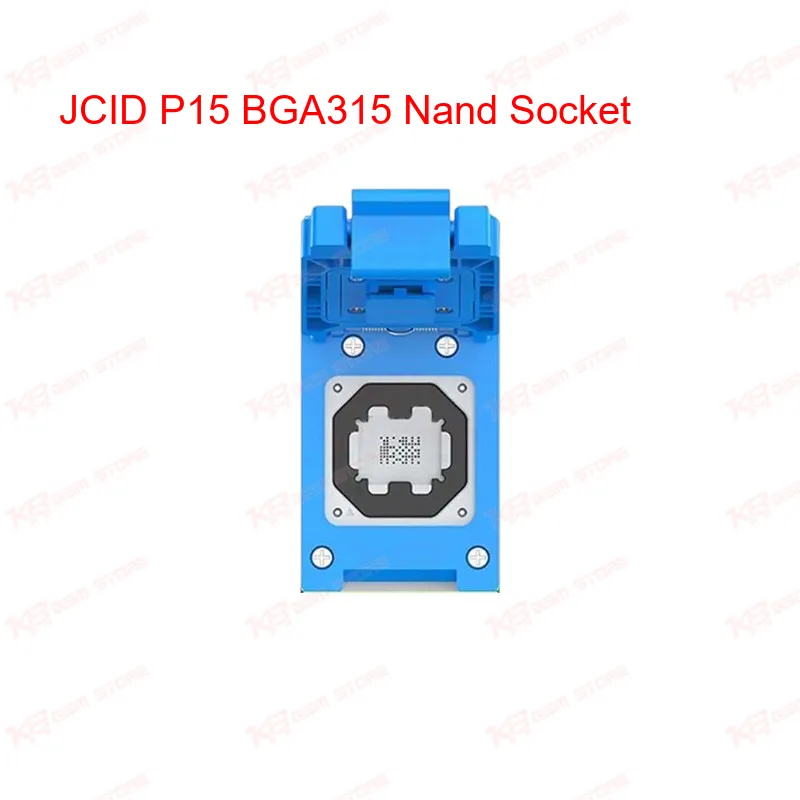
Repairing NAND flash on newer iPhone models means dealing with the BGA315 package, a chip footprint that older sockets simply cannot handle. The JCID P15 BGA315 Nand Socket solves this by giving your existing JCID P15 programmer the exact interface it needs to communicate with BGA315 NAND chips found on current Apple logic boards. If your workshop already owns a P15 base unit, this module extends its coverage into the newest device generation without buying an entirely new programmer. At its core, this socket is a precision connector module. It seats the BGA315 NAND chip and routes the correct pin mapping to the P15 programmer, allowing the JC software to detect the chip and carry out read, write, and repair operations reliably. Technicians dealing with a dead phone after a failed update, a hang on logo situation caused by corrupted syscfg data, or a board pulled for NAND swap all rely on this kind of socket to get consistent chip communication without cold solder joints or misaligned contacts damaging the pads. One of the socket's main strengths is syscfg data handling. On iPhone boards, the syscfg partition inside the NAND stores calibration and configuration data tied to components like the baseband, camera, and battery. When this data gets corrupted or lost during a board swap, symptoms show up as network issues, camera errors, or battery health warnings that a straightforward IC change karna approach won't fix. With the BGA315 socket connected to the P15, a technician can read the original syscfg, back it up, and write it back after chip-level repair or board transplant, restoring proper function instead of leaving the device with permanent software fault indicators. The socket also supports the P15's purple screen repair function, a well-known technique for iPhones that boot into a purple or garbled display screen due to NAND read/write failures. Rather than replacing the entire NAND chip on a board where desoldering risks lifting pads, technicians can address this fault directly through the socket connection, saving time and reducing the risk of pad damage on tightly packed newer boards. Nand unbind is another core operation this module enables. When a NAND chip gets replaced on an iPhone 14 or 15 series board, the new chip needs to be unbound from its previous pairing before the device will boot normally. The BGA315 socket lets the P15 perform this unbind procedure directly, which has become a standard step in any board-level NAND swap on current Apple hardware. For repair shops handling iPhone storage upgrades, this socket also plays a role in capacity expansion work, where a higher-capacity NAND chip is written and configured to replace a smaller original one. This has become a common paid service in many Pakistani repair shops working on second-hand iPhone units, and having the correct socket for the BGA315 package is a prerequisite for taking on this kind of job reliably. Build quality matters heavily in a component like this, since sockets see repeated insertion cycles and need to maintain stable contact pressure over time. A worn or loose socket produces intermittent connection issues that look like NAND failure but are actually contact problems, wasting technician time on false diagnoses. The BGA315 socket is designed to seat firmly, keeping communication with the P15 base unit consistent across repeated use. This module is purpose-built as an add-on, not a standalone tool. It requires the JCID P15 Nand Programmer base unit and the corresponding JC software to function, so shops already running a P15 for BGA60, BGA70, or BGA110 work can add BGA315 coverage without duplicating hardware investment. For any workshop actively taking in iPhone 14 and 15 series boards, this socket is the piece that keeps NAND-level repair capability current.