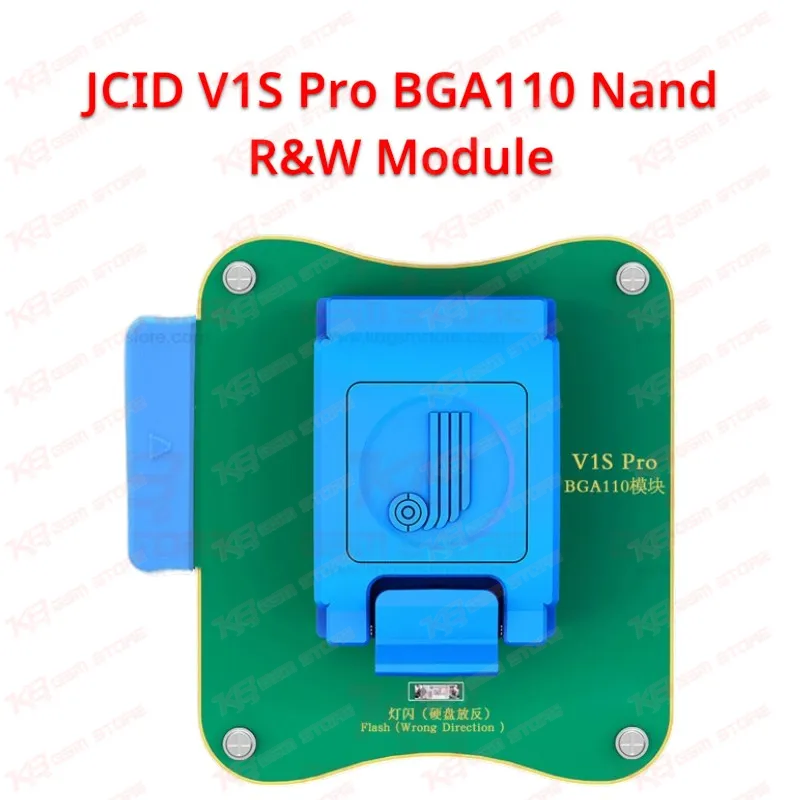
Working on a dead phone after a failed flash or a board that will not boot past the Apple logo usually means the fault sits below what any software tool can reach, and that is exactly where the JC V1S Pro BGA110 module earns its place on a repair bench. This module is the BGA110 chip-off socket designed for the JCID V1S Pro programmer, built specifically to read, write, and format NAND flash chips removed from iPhone 8 through iPhone 13 Pro Max logic boards, with confirmed support extending to the iPhone SE2. Once you desolder the NAND chip from a damaged board, you seat it directly into the BGA110 socket, connect the module to your V1S Pro unit, and pull a full backup before attempting any board-level repair or IC replacement. That backup becomes your safety net: if a jumper repair, IC reflow, or CPU rework goes wrong, you still have the original data ready to write back rather than starting from zero. Technicians handling hardware fault boards, liquid damage cases, and CPU IC change jobs rely on this kind of read-before-repair workflow because it turns an unpredictable repair into a controlled one. The module also handles SYSCFG data recovery, which matters when a board loses its calibration information after a chip swap or a failed board donor repair, since restoring accurate SYSCFG data is often the difference between a phone that boots clean and one that throws persistent error messages tied to Face ID, baseband, or battery health reporting. Because the BGA110 module connects through the same V1S Pro base unit used for screen true tone repair, battery data correction, and WiFi unbinding, technicians already running JCID hardware do not need a separate machine for NAND-level work, and the module's compatibility with older JC PRO1000S and V1SE boards means shops upgrading from earlier JCID generations keep their existing module investment usable rather than replacing it outright. In a typical dead-after-flash case, a technician will pull the board, identify the NAND chip location, desolder it with a hot air station, clean the pads, and seat the chip into the BGA110 socket before running a read operation through the V1S Pro software over WiFi, with no need for a separate PC connection for most functions. If the read comes back clean, the same data can be written to a replacement chip or restored after the board undergoes further hardware repair, closing the loop between diagnostics and board recovery. For technicians running higher repair volumes, having a dedicated NAND module removes the guesswork from chip-off jobs and standardizes the workflow across the shop, since every technician on the bench works from the same read and write process rather than improvising with unverified third-party tools. The BGA110 module fits naturally alongside ISP pinout tools, UFS adapters, and eMMC programmers already on a well-equipped repair bench, since chip-off NAND recovery is one part of a broader board-level repair path that starts with diagnostics and ends with functional testing after reassembly. For shops in Lahore, Karachi, and Islamabad running high board-repair volume, a dedicated JCID-compatible NAND module cuts the guesswork out of jobs that would otherwise mean sending a board out or writing off a phone entirely, and keeps sensitive recovery work in-house rather than dependent on a third party.