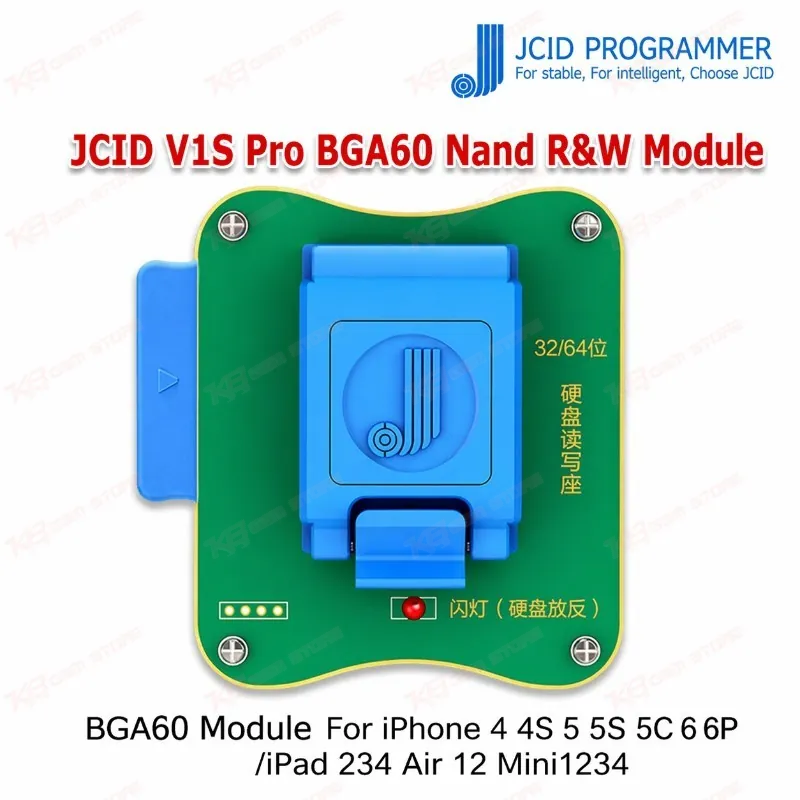
Working on a dead iPhone 6 or an iPad stuck at the Apple logo often comes down to one component: the NAND flash chip, and the JCID V1S Pro BGA60 Nand R&W Module gives you a direct path to that chip through your V1S Pro programmer without needing a separate desktop reader for every job. Once you insert the module into the V1S Pro host, you get read, write, and format access to 32-bit and 64-bit NAND packages used across the iPhone 6, iPhone 6 Plus, and the iPad 2 through iPad mini 4 range, letting you dump existing NAND data before attempting a repair, rewrite corrupted blocks after a bad flash, or fully format a chip when software marna alone will not clear the fault. On your repair bench, this module covers the boards where a phone goes dead after flash, hangs on the Apple logo, or loops through boot without completing startup, since these symptoms frequently trace back to NAND corruption rather than a hardware fault on the logic board itself. The BGA60 socket is built to match the physical footprint of the NAND package on these older Apple boards, so you avoid the guesswork of adapter compatibility that comes with universal programmer rigs. Because the module runs through the V1S Pro's WiFi-enabled main unit, you skip the computer-and-cable setup that older standalone NAND boxes require, and your read/write jobs sync through JCID's networked repair environment for firmware and profile updates. This matters on a busy bench where jumper lagana and IC-level troubleshooting already eat into your turnaround time; cutting a step out of the NAND diagnostic process means you get boards back to customers faster. The module also plugs into JCID's broader V1S Pro ecosystem, so if your shop later takes on BGA70, BGA110, or BGA315 socket work for newer iPhone generations, you extend the same host unit instead of buying a second programmer. For shops that specialize in iPad refurbishing, the BGA60 module covers the iPad mini 2 through 4 and the standard iPad 2 through 6 generations, which share NAND packages with the iPhone 6 family and see the same dead-after-flash and storage-corruption failures. Technicians handling batch board repair — reflashing multiple dead boards pulled from trade-in stock, for example — benefit from the module's direct format function, since a full NAND format clears persistent error states that a partial rewrite sometimes misses. The read function also serves as a diagnostic first step: pulling a NAND dump before you touch a board tells you whether the chip itself is dead or whether the fault sits elsewhere on the PCB, which saves you from unnecessary IC change karna on a board where the real problem is a corrupted flash sector. If you already run a JCID V1S Pro or V1SE host and handle iPhone 6-series or older iPad repair volume, this module fills a real gap in your socket lineup rather than sitting idle, and it keeps your NAND workflow inside one unified programmer instead of splitting your bench across multiple brands of read/write tools.